
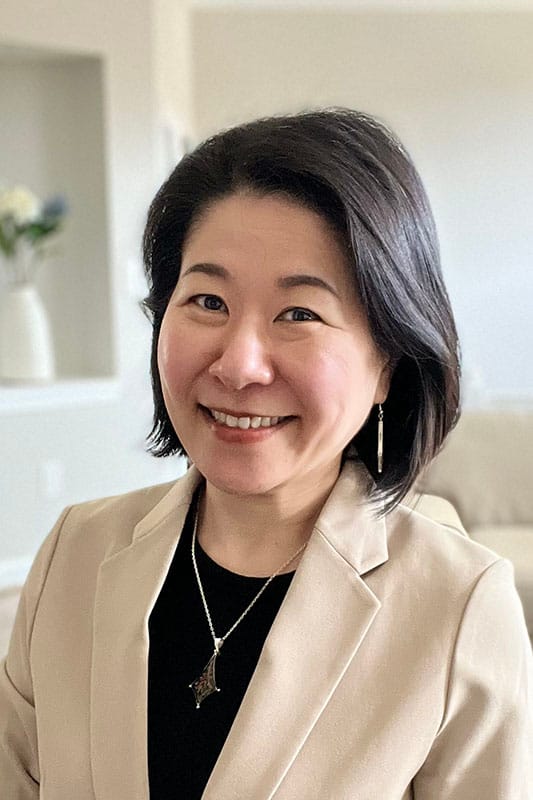
Born in Australia and raised in Egypt until she was three, Kazuyo Kato moved between the United States (Washington, DC, San Francisco) and Japan throughout her elementary to high school years. She has built her career at organizations focused on U.S.-Japan relations and international affairs in both countries. She currently serves as Executive Director of Japan Center for International Exchange (JCIE USA), a U.S. 501(c)3 organization specializing in policy dialogues and exchange programs. Previously, she was Senior Director of Global Partnerships & Initiatives at Japan Society in New York and Director of Programs and Administration at Sasakawa Peace Foundation USA in Washington, DC. Earlier, she was with the Sasakawa Peace Foundation in Tokyo as well as Armitage International, LLC and the International Security Program of the Center for Strategic and International Studies (CSIS) in Washington, DC. She graduated from Stanford University with a B.A. in International Relations and an M.A. in International Policy Studies.
(Click on this icon to follow Kazuyo:  )
)
Podcast
Transcript
Introduction
Hello, everyone. I am really excited to welcome my dear friend, Kazuyo Kato, today. [As the Executive Director of JCIE USA,] Kazuyo is one of very few leaders of Japan-related organizations in the DC area who’s originally from Japan. She grew up in various countries and is familiar with different cultures, and has a very deep knowledge of both the United States and Japan. And she has great experience and expertise working in nonprofit organizations and people-to-people exchange. She is always wise, and someone who I look up to as not only a friend, but also a mentor who’s close in age.
Thank you so much, Kazuyo, for joining me today.
Thank you so much, Shiori, for inviting me to this series. I want to also thank you for being a good friend for so many years.
Childhood and Upbringing
Could you please start by sharing with us where you were born and raised?
I come from a family of diplomats. My father served in the Japanese foreign ministry, so I grew up in a couple of different countries. I was born in Australia when he was stationed there. Then he was directly posted to Egypt, so I was in Cairo until I was three years old. After that, we returned to Tokyo. Until I was nine years old, I lived in Tokyo, in a neighborhood called Higashiyama, where the government workers’ complex was. Those were my formative years in terms of developing my identity.
After that, I went back and forth between the United States and Japan because my father was posted in Washington, DC and San Francisco. I grew up in both countries from elementary school to high school, until I decided to stay in the States for college.
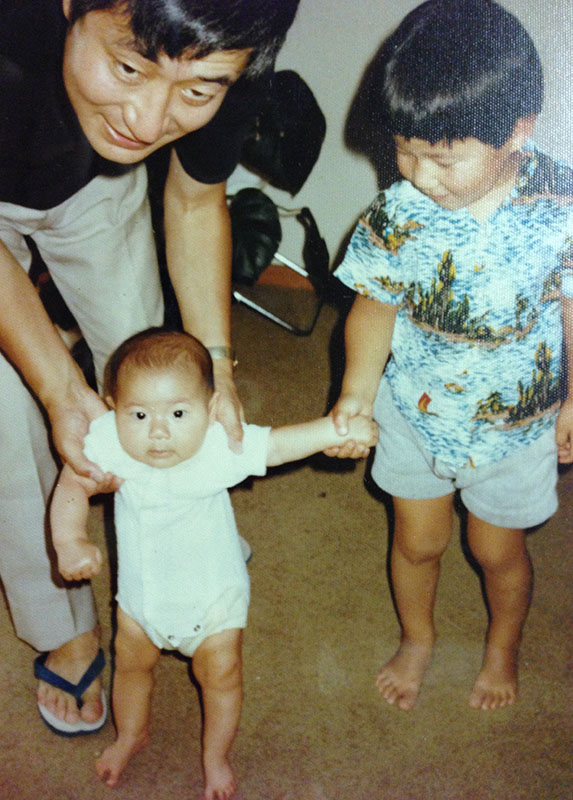
How was your identity formed while you were growing up in so many different countries? Did you always consider yourself a Japanese person in a foreign country, or do you feel like you were part of the local community in Australia, Egypt, etc.?
I wish I had more memories of my years in Australia or Egypt, but I actually do not. My identity has always been Japanese. I think that is because all my family members were all Japanese. And I grew up in a Japanese neighborhood from three years old to nine years old. Those were very formative years for my identity. So I didn’t struggle with my identity during my childhood.
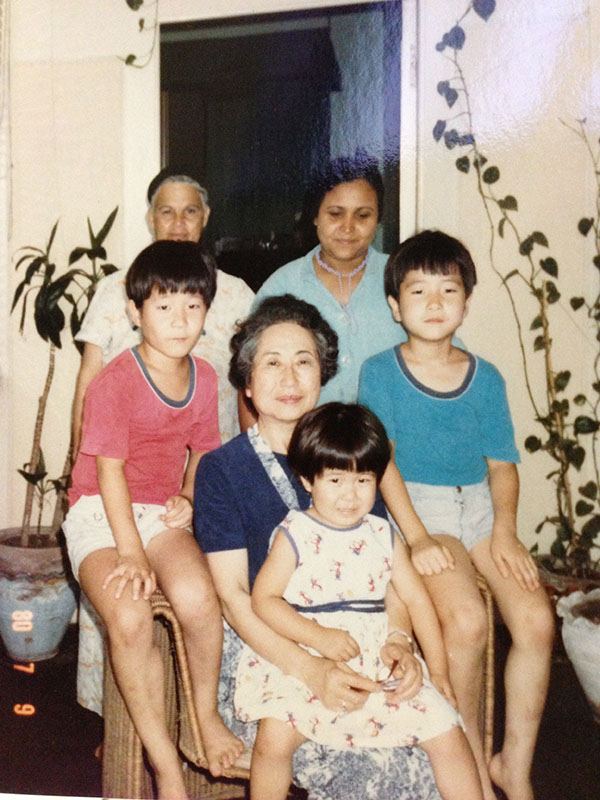
What about when you were older? As you went back and forth [between the U.S. and Japan], were there specific decisions where you felt that you should move to the United States or go back to Japan at a particular point?
Up until high school, I didn’t have a choice of where to live. When I went back and forth, that wasn’t really based on my decision. However, in high school, as I was thinking about where to go to college, I did make the decision to stay in the United States and go to college here.
I see America as sort of like another parent. Some people say that if you grew up in multiple countries, it’s always helpful to have one country as a source of identity. But I’m not quite sure if that applies to me. I still feel like I have one leg in the States and one leg in Japan. And that’s who I am. I’m originally from Japan, but I do owe a lot to the United States for nurturing me and developing who I am.
Overcoming Challenges
Did you ever struggle with making new friends or fitting into a community when you moved around?
Definitely. That was a challenge both in Japan and the United States, but particularly in the United States, because I had trouble speaking and communicating in English. The first time I moved here was when I was nine years old, and I just couldn’t express myself the way I wanted to.
I had a similar challenge in high school. Even though I could communicate, in high school, a much more sophisticated level of communication skills is required, and it’s a much more social environment where you’re supposed to make a lot of friends. The gap between that reality and my capacity was really large, and I struggled with that.
How did you overcome that? Did you learn something about how to relate to people from different cultures, people who speak different languages, et cetera?
All the memories I have from living in the States both in elementary school and also in high school were traumatizing. So I don’t think I overcame that immediately, but I did over time.
If I were to give advice to people struggling today, going to school in the States as a foreign student, for example, I just want to say that “Time will tell.” Even if it’s difficult now, if you stand firm and just get through the experiences you’re having today, eventually you’ll come out of it stronger. Because that was my experience. It took time, because it was trauma for me.
It took me until maybe my late 20s to process what happened during those years, to make sense of it, and to use that experience to my advantage as an adult. So it took time, is all I can say.
But over the years, I decided that the experiences gave me a larger worldview, for example. I started to see the positives of having lived in different cultures, but it took time for me to appreciate and recognize those as a good outcome.
I completely understand how you felt. I had a similar experience. I was in Japan from nine to 15 years old, and during that time, my English became really rusty. Then I moved back to the United States for high school. You’re right, it’s such a difficult time in your life because as a teenager, there’s so much that you’re going through. You also have this language struggle, and making friends [is tough]. But considering your leadership now, I’m just amazed at how far you’ve come.
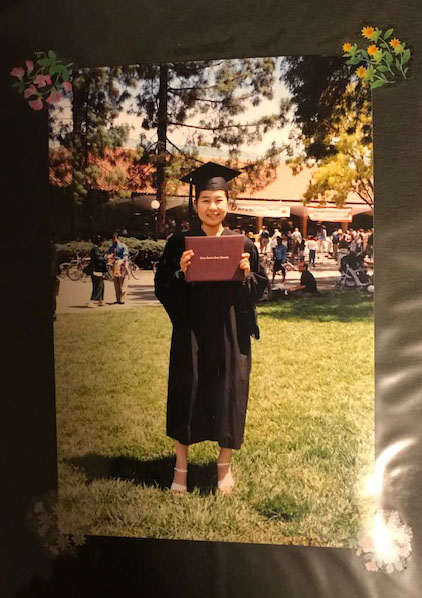
Sharing Our Struggles
In a wonderful Asahi Shimbun interview of you, you mentioned how in Japan, some people told you that you were full of yourself because you spoke English. And you said that it’s one of the reasons you felt like you wanted to come study in the United States. Could you talk a little bit more about that?
I think it’s quite a typical experience to be told and made to feel like you’re arrogant. You’re an arrogant person just because you’re able to speak English during English language classes and you stand out.
At the time, I wasn’t upset or sad, but I do remember the sense of embarrassment that I felt. And that was a feeling like I did something wrong, something that I wasn’t supposed to do. I think it’s just how people grow up and learn to fit into expectations. So experiences like that made me think, “Okay, this is the societal expectation in Japan. And I made a mistake by speaking out or not being conscious of what others think of me.”
But that didn’t really lead me to say, “That’s why I’m not going to work or live in this country. I want to go to the States.” It just was an experience that made me recognize the huge difference in societal expectations between the United States and Japan.
Thank you for sharing that. I think about that a lot because I went through something similar. I was really scared of the Japanese community for quite a while. And even now, I feel more comfortable in the United States.
What I really admire about you is, even though you went through that, you still loved and wanted to help Japan. I think it’s really wonderful how you were mature enough to recognize that.
Maybe [this is only] in hindsight. I’m not sure.
Was your time in Japan after you came back from the U.S. somewhat easier compared to your time in the United States?
I also had a hard time coming back to Japan after being in the U.S. for elementary school. The challenge was of a different nature. It was basically about fitting into a new community all over again. Even though I had friends in elementary school in Japan, the time that I spent in the States meant that I wasn’t able to maintain those friendships. So I don’t particularly have a more positive memory of growing up in Japan as a student versus here in the States. But going back to your question, I overcame it through time and by recognizing the positive impact it had on me.
Something I didn’t do at the time is express these struggles with my parents. I’m not sure if that’s a common experience for people who go through this. I didn’t have the guts to say to my parents, “I’m struggling making friends.”
So I don’t think my parents were aware, but if I were a parent and my kids were struggling, I would hope that they would share that because family support could make a big difference.
I would think that most children of a certain age would not be able to, because the parents can’t help moving around. I think children might feel like the parents would blame themselves if the children confess that they’re going through a hard time. At least that was my logic.
For me, my experience is slightly different because I was bullied in Japan. Those were the hardest years of my life so far. And I was unable to tell my parents, more so because I felt that they would be ashamed of me. I know this is weird logic.
No, it’s not, actually. That’s the perfect word to describe how I felt at the time. I felt ashamed that I wasn’t happy where I was or I wasn’t succeeding in fitting in. So I don’t think that’s a strange thing.
But it eventually comes out, I think. And for me with bullying, it was so clear because my parents accompanied me to some school event, they saw that no one was talking to me, and that’s when they realized. And I think it hurt them more because they didn’t hear it from me. So I think you’re right, as a parent, it would be better to know.
Something Bigger Than Yourself
You mentioned that your father is a diplomat. That could have been one of the careers that you considered. Despite that, after working at some private companies, you ultimately decided to enter the nonprofit world. I was wondering why that was.
I think my father did have an impact on that choice. Seeing him work for his country instilled in me in this idea that working for something larger than yourself is a very honorable and wonderful thing to do. So I’ve always had this sense of duty that I need to do something for society or something greater than your individual happiness.
I think the nonprofit sector has that mission. Each nonprofit has a mission to contribute to the larger society. So my upbringing did have an impact on that choice.
Would you mind explaining what you do at JCIE [where you serve as the Executive Director of the U.S. entity]?
JCIE stands for the Japan Center for International Exchange. It is a U.S. nonprofit, nonpartisan, non-governmental organization. And we work as a policy institute dedicated to U.S.-Japan relations. We have staff in Washington, DC, where I am, and in New York, and we have a partner organization in Tokyo, which is also called JCIE [Japan].
Our mission is twofold. One is to deepen the understanding of Japan and U.S.-Japan relations in the U.S., particularly in the policy community. We also have a mission to deepen collaboration between the two countries in areas of mutual interest and need.
We run programs where we bring people together from the U.S. and Japan to engage in bilateral research or dialogue. We also have programs that involve study tours and exchanges among current and future leaders of the two countries.
For example, every year, we bring a bipartisan group of U.S. Congressional staff to Japan to participate in a week-long study tour. We try to improve their understanding of the importance of U.S.-Japan relations as key staff members supporting members of Congress.
We also have thematic programs where we hope that the U.S. and Japan will exercise greater leadership and collaborate further, such as global health, democratic resilience in Asia, healthy and active aging, and women’s leadership.
It’s always difficult to be a leader of an organization. But with everything that’s going on, socially and economically, I think it’s especially hard to keep an organization together and keep your staff motivated. And I really admire you for doing that.
You mentioned in the beginning that you chose the nonprofit world because you wanted to work for something bigger than yourself. But when you see people in similar fields, such as people in international development who are no longer able to work because their jobs are in jeopardy or it’s financially difficult, how do you keep yourself motivated, and how do you motivate your staff members?
It’s a challenge. The nonprofit sector has its own challenges because you need to fundraise and find people who are willing to support your work.
This is a sector for people who are very mission-driven. If you’re not that kind of person, it’s going to be difficult. But I truly believe in the importance of bringing Americans and Japanese experts together. And I believe that fundamentally there are shared values and goals between the people of our two countries. I’m a very mission-driven person and that keeps me going.
Finding Your Own Leadership Style
Shifting gears a little bit, I wanted to ask about your leadership style. You’re one of the few leaders of Japanese ancestry—even of Japan-related organizations—in DC. In Japan, it’s frowned upon to stand out. (Or that’s traditionally been the case—maybe things are changing recently.) How did you develop your leadership despite growing up in that environment? Do you feel like your upbringing in the U.S. helped? How did you find your own personal leadership style?
I’m still working on it. I am learning through trial and error, and observing other leaders to decide what I think is effective leadership. And the way I define effective leadership is being able to bring other people to join you in achieving certain goals or missions. I’m still learning how to do that.
When I think about all the leaders who have nurtured me, I think there are some universal aspects to what makes a good leader. Regardless of whether you’re Japanese or American or whichever context you live in and work in, I think I found some qualities that work in both cultures. And I’m trying to adopt those qualities to the extent I can.
There’s a sea of outspoken leaders who seem to really like and excel at putting themselves out there. How do you make sure that JCIE remains recognized, and how do you exert your own leadership?
It’s very hard, but I try to tell myself that as long as we do good work, eventually people will recognize it.
I’ve learned over time that leadership is not just about visibility. There are a lot of visible leaders, and there was a time when I thought that being a strong leader means you have great visibility. That’s true to an extent.
But I think a leader by definition also needs followers. And I have seen leaders who stand out but don’t really have followers. I feel that you can’t just be visible. You need to form a team to work together towards a mission.
There was a time when I also thought that a strong leader cannot show weakness. But I’ve also seen leaders who compensate their insecurity with a show of strength—to the extent that they have weak followers.
I try to recognize that I can be true to myself as a leader, and that it’s more important to seek help from staff where you’re not feeling confident about something. That’s what working with a team means.
I also used to think that I needed to be 100 % confident about everything I do as a leader. That is certainly not the case. What I learned is that you face so many uncertainties and that’s okay. You may be uncertain about what you decide to do, and that’s okay. But as a leader, you need that courage to make decisions that you think are right for the organization.
I think you’re absolutely right. It’s so interesting how confidence and courage sound similar but are actually very different. And it’s great that you trust your staff members to show them that vulnerability and ask for their wisdom. But I think you’re right that you need to be the one to really show the courage and take action based on the feedback that you get from them.
Learning from the Giants
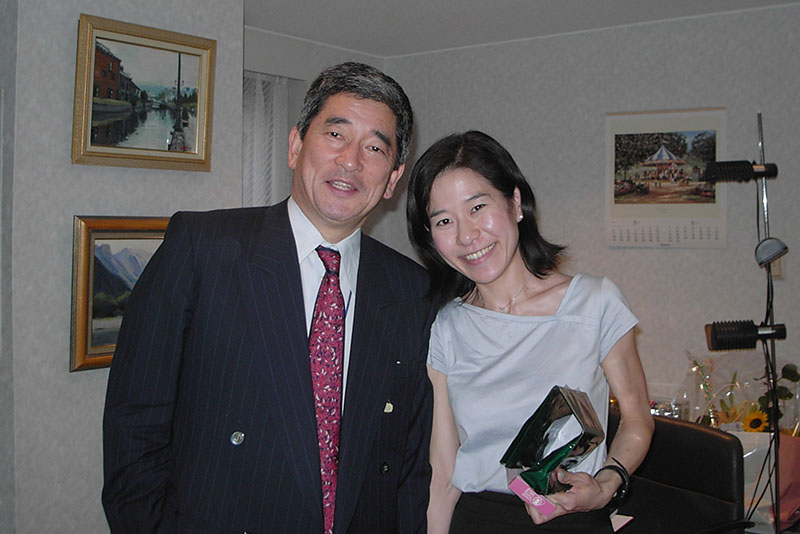
Speaking of leaders, I wanted to ask about people who recently passed away, like Richard Armitage and Joseph Nye, and a few years ago during COVID, Yukio Okamoto. When Mr. Armitage passed away, you mentioned that you had the opportunity to work with him, as well as under Mr. Okamoto. Could you share a little bit of your experience working for the two of them? What did you learn from them in terms of leadership, courage, taking action, etc.?
I feel enormously grateful for the opportunity I had to work with individuals like Mr. Armitage and Mr. Okamoto.
I think one statement that Mr. Armitage made about leadership is an example of a universal value that applies to both the United States and Japan. This was right after the Iraq War, and he said: “A good leader needs three elements: vision, execution, and accountability.” And I think those qualities are not unique to the United States.
I also want to share my observations of their leadership qualities that I think are quite special. One is this enormous energy that they brought to any room. I don’t think you can learn to have that kind of energy. I sometimes think you might just be born with it. But it’s one of those energies that make other people want to work for you and follow you and do the best job. To this day, I don’t know if that’s something you can learn to project yourself. But I do try to bring that energy with me when I can, because I know that it helps other people.
I can think of three things that were common among the good leaders that I worked for, including Mr. Armitage and Mr. Okamoto. The latter I only worked for as an intern so the experience might be a little different for other people. But one thing I can say, related to their energy, is they had speed. They didn’t sit around. They were always acting. They didn’t waste time. I guess it’s an indication that they were always working very hard. And I try to do that myself.
Second, they were very fair and clear. They might tell you things that you don’t appreciate at the time. Things were not sugar coated, but it’s what you needed to hear. And I realize that looking back. [What they told me] was the best advice I’ve gotten throughout my life.
And finally, something in common about good leaders is that they’re funny. They can be very silly. I think about why that is. Some people are guarded and don’t show the silly side of themselves, or maybe they’re just not silly people. But the leaders who I enjoyed working for, at least, had a sense of humor. And I think that is important because that’s where you connect with people on a human level.
Thank you so much. Energy, speed, and sense of humor—those are really important elements that you just shared with us. And you’re right, some people do have charisma that they’re just born with. But I think it also comes from experience, because I think confidence gradually develops as you learn to lead more people and you gain more followers. I think that’s something that you certainly have.
Whenever I get to work with you in the context of JCIE, you are always thoroughly prepared. I think that’s something that helps you be calm and confident. As a moderator and as someone who gives opening remarks and whatnot, it seems like you’ve done so much research. You’re always personable, and you make people laugh and feel at ease. So I think you’ve definitely incorporated all the elements that you just discussed.
Thank you for that. Every leader I’ve seen who has true followers works hard. There are charismatic leaders who seem like everything is really easy for them. But what I learned is there’s usually a lot of work behind that facade. So I tell myself that it’s okay to put in that effort, and that it would reflect on your work eventually.
You’re absolutely right. On the surface, they make it look easy, but it’s actually not at all. And it’s really based on their past experience and what they’ve gained until then.
Related to this, I mentioned Joseph Nye earlier. I didn’t get to have him as a boss, but I studied his work in grad school and college, and got to interpret for him a few times. Similarly, we lost Naoyuki Agawa. I got to work with him at the Embassy of Japan and always admired him. Losing both of these leaders in a really short period, on top of Mr. Armitage and Mr. Okamoto, seems like a really sad time for those of us working in U.S.-Japan relations.
I also feel that the qualities that you mentioned to become and remain a good leader stay the same, but U.S.-Japan relations and world affairs seem to be very different now compared to when Mr. Armitage and others were at the peak of their career. We have so many different opinions coming at us on social media, and there are so many wars going on. This is exactly when we need these leaders who can work across the aisle and have a unifying voice.
When I see so many people like that pass away, the news makes me cry even though I didn’t know them super well. It seems like a really scary time to lead people in this climate. How do you deal with that? How do you see the change in U.S.-Japan relations and how would you incorporate that in the way you lead others?
I felt the same way when I heard news about people like Mr. Armitage and others passing. You feel like you rely so much on their leadership and wisdom. I wish I could go to them today and say, “How do you feel about what’s going on in the world? Tell me how I should be dealing with it.”
But as many others have said since then, now it’s our time to carry the baton and lead the way. There’s no time to be scared. We just need to do what we need to be doing. There are a lot of distractions right now. There are moments when I hesitate about the work that we’re doing. But I tell myself, “All I can do is try to do what is right for the organization to the best of my abilities.” And I move forward, even though not quickly, step by step, and I try to make an effort.
For example, we just took a group of six congressional staff to Japan. We always make sure that we take a bipartisan group and reach across the aisle. And what I saw at the end was a group of six new individuals who have a better understanding of Japan.
For them, it wasn’t obvious how important the U.S.-Japan relationship is to the Japanese people, but they came back recognizing that. And to me, that is a very meaningful outcome and change in six people’s mindsets. These are small steps, but those are the kinds of things I need to keep doing with my team.
The group also got along among themselves too, even though they were from different political affiliations. So that gives me hope that these efforts do form that foundation that we need to continue to strengthen the U.S.-Japan relationship. And the common experience that brought them together in a positive way was the U.S.-Japan relationship, so I feel very happy about that.
That’s a wonderful perspective. I’m sure it was such a memorable experience for them. I’m sure you also made an impact on the people that you introduced them to in Japan as well. You’re absolutely right. Even though it’s such a difficult and scary time, you are really making a huge impact.
Relationships and Finding Our Homes
I wanted to ask some personal questions again. Your husband also has a multicultural background and has ties to various countries. Is that what drew you to him when you first met?
I think so. We have no common background in terms of where we grew up or where we work today. But the reason I think we got along was because both of us grew up in countries different from where we were from, and are very open-minded about people who come from different backgrounds. Even though we would never have connected if it weren’t for online dating apps, what brought us together is this common experience of being multicultural. We are not surprised to meet people who are very different from us. We actually find that interesting. For some people who grew up in one place their entire lives, that might not be the case.
I really admire you as a couple. I always enjoy spending time with both of you. You have such a fun dynamic, teasing each other and everything!
Related to this, do you think you might stay in the U.S. for the foreseeable future?
A friend of mine from Japan said something that I think is quite true. When you’re young and want to grow, people tend to prefer the States because it’s a culture where you’re given the opportunity to challenge yourself in many ways. And you’re willing to do that because you’re still young and energetic. But as you get older, you start to become more defensive. You don’t need challenges. You just want to relax. And for that kind of mentality, Japanese society is a little bit more comfortable because it’s about maintaining peace and harmony with other people. And you feel like part of the community.
So as I get older, I think about where I want to spend the final days of my life, and I’m still torn.
I think that completely makes sense. What I’m learning is that there is no one right answer for any of us. It’s really something that you have to figure out on your own, speaking with family and consulting others. We just have to make the decision that seems right at that time. And that decision might change going forward, and that’s okay as well.
It is really interesting that when you compare the experiences that you’ve had in both countries, you did struggle in both, but ultimately you feel like the time that you had in the U.S. was harder. And I wonder if that’s somewhat related to your identity that leans more towards Japan and the feeling that you want to return to Japan at some point.
That’s a good analysis in a way.
Individualism is one of the qualities of American culture. There’s this sense that you need to survive on your own. And coming from Japan, going to schools where you need to assert your individuality and unique characteristics and stand out was a challenge. Because in Japan, you’re sort of told to blend in with others.
I completely understand that. And that’s why it’s all the more admirable that you’re now a leader of an organization, because it must have taken so much work, not only in terms of connecting with others, but also in changing your mentality and mindset. I think that’s amazing.
Pride in Where You Come From
Would you have any advice for others who grew up in multiple cultures or are also struggling with figuring out their career, where to be based, etc.?
I don’t feel I’m qualified to give advice to anybody because I’m still figuring it out myself. However, I can share what I tell myself when I struggle with questions like “Where do I belong?”
I often struggle because people try to fit you into one category based on how you appear or how you look. That’s how they want to relate to you and understand you. And I struggle when people do that to me, but I tell myself, “Don’t let others define who you are.”
So if I were to turn that into advice: don’t let others put you down for being who you are. Be proud of where you come from and how your identity has developed. And don’t change yourself based on what you think other people might think of you.
Over time, I’ve become prouder of where I belong and of my identity. The older I get, the more I feel like I want to contribute to maintaining certain traditions from Japan or the States that I grew up appreciating. Even though I’ve been away from Japan for many years now, I want to make sure that I follow those traditions. That’s a precious part of me that I was fortunate enough to carry with me to the United States.
That’s absolutely valuable. Thank you so much. It’s so easy to lose [sight of] where we came from in our day-to-day work. I think you’re doing a wonderful job, especially how you always make sure to celebrate certain holidays, for example. You’re a wonderful cook and have a great sense of hospitality as well. I think that’s somewhat related to Japanese culture. And I really appreciate [your kindness in inviting me to those celebrations].
Ok, I think we’ve covered everything!
Thank you, Shiori, for giving me an opportunity to think through my experience. It was a good exercise.
Thank you so much for answering my many personal and pointed questions. You’ve been so kind and patient with me. I really appreciate it.
Thank you for the opportunity.
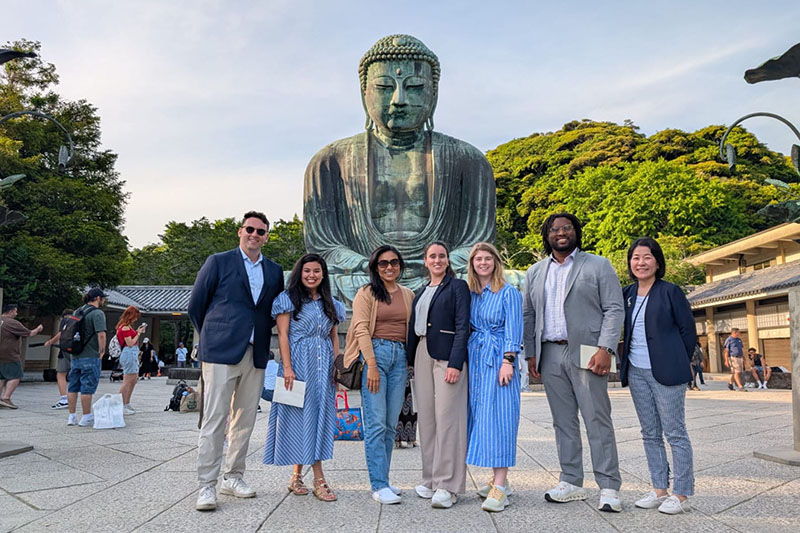
With the participants of JCIE’s 2025 U.S. Congressional Staff Exchange Program in Kamakura