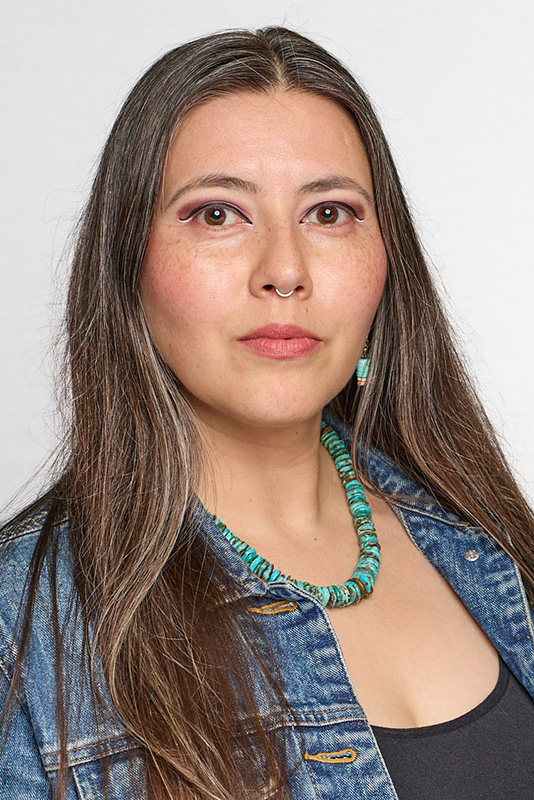
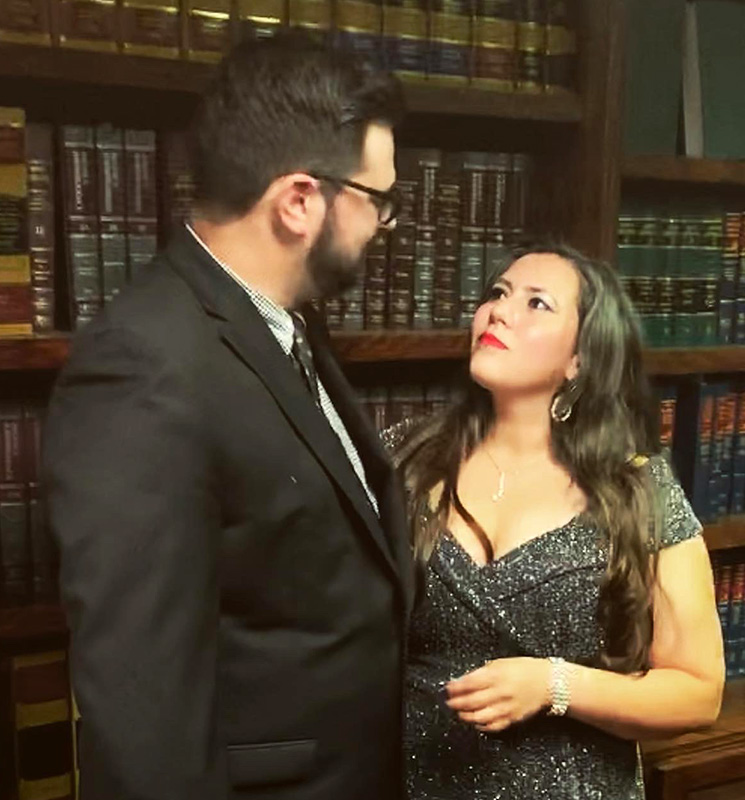
Gigi Modrich is an Indian law practitioner, roller derby skater, and stand-up comedian. She was brought up in a multiethnic household: her mother is Jicarilla Apache and her father is Croatian American. While she is multiracial, her upbringing focused on her Native American culture. She attended Dartmouth College because it was founded for the education of Native Americans. She earned her Juris Doctorate from Cornell Law School and then joined a law firm to serve Tribal clients. She now lives in Los Angeles—with her husband, Eric, and dog, Lulu—where she teaches beading at a Native non-profit.
(Click on these icons to follow Gigi: 
 )
)
Podcast
Transcript
Introduction
Hello, everyone. This is Episode 14 of the podcast CrossWorld Puzzles.
Today, I’m so happy to welcome my friend, Ms. Gigi Modrich. I met Gigi in college, where we were roommates during our first year. I learned that she’s Native American on her mother’s side. She was always so kind and friendly, and always looked out for me when I was feeling lonely. As someone who always takes great care of others around her, it’s no surprise that she became a lawyer protecting the rights of Indigenous people.
But in recent years, she’s also developed a new career in comedy, often drawing upon her Native heritage. And I’m really fascinated by how she’s balancing these two realms that seem so different. Today I’m really excited to ask about her identity as a Native American, her work as a lawyer, and her thoughts on comedy.
Thank you so much, Gigi, for joining me today.
Thank you, Shiori, for having me. It’s so good to connect with you again after all these years.
Absolutely! I’m so grateful to you for saying yes, even though I’ve been out of touch for so long. Thank you again.
And first, may I ask you about your beautiful outfit?
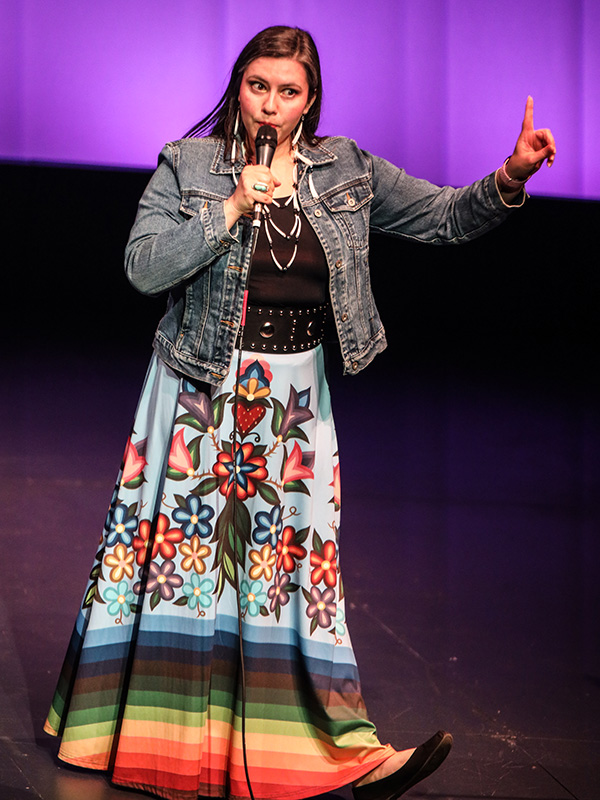
Yes, thank you. I wanted to wear something that was from a Native creator. This is by J. Okuma. She is a fashion designer from the La Jolla band of Indians here in California. So I wanted to make sure I wore something that was from a Native fashion designer. There are now so many designers who are able to sell to anyone who’s willing to purchase. This particular piece has dentalium, which was a form of currency and a wealth indicator in Native cultures, as well as other shells and imagery. It’s a nice piece, so I appreciate being able to wear it for you.
Thank you so much for that. And I love how it’s by someone from California.
Childhood and Identity
You’re now based in Los Angeles. But when we first met, I think you said that you were from New Mexico. May I ask where you were born and raised?
That’s a great question. I tell everyone I’m from New Mexico because my mother is Jicarilla Apache, and our reservation is in Dulce in northern New Mexico. However, my father is of Croatian descent, and he was in the Air Force. So I was actually born in Michigan, and was raised in Ohio for a good part of my life.
And it wasn’t until high school that I actually lived in New Mexico. I sent myself to a boarding school in New Mexico to: one, get out of Ohio, and two, get closer to my tribe and my homelands.
Growing up, did you already have a strong Native American identity?
Yes. My mother is full-blooded Native American. There are three separate tribes [we are related to], and the tribe we are closest to and visit as our homelands is the Jicarilla Apache Nation.
My father was on active duty when I was a kid. So I didn’t really connect—and still have not really connected—with my Croatian background. I don’t speak the language. I don’t speak the language on my Native side for other reasons, but for Croatia, I’ve never been to my homelands there. I don’t really enjoy the food.
So, being a child raised by my mother who’s Native, I’ve always had a very strong identification with my Native heritage.
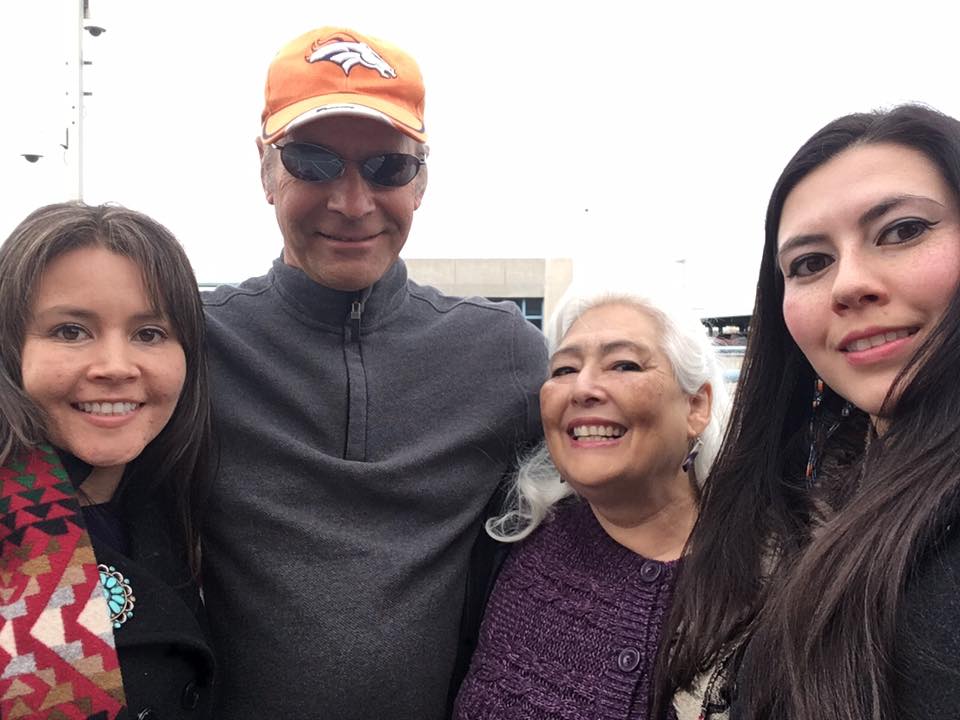
That is wonderful. While you were growing up, were there others around you who had similar identities? Perhaps relatives on your mother’s side and other friends you could relate to?
I tell people that I’m from New Mexico, but I spent a lot of my formative years in Ohio. The town I was in was not the most diverse place.
So there was only one other family that had [a child with] any kind of Native American ancestry, and they were Cherokee. It was pretty lonely. I think because the Cherokees and the Apaches are so different, there wasn’t a lot of camaraderie between the two of us, unfortunately.
That makes a lot of sense.
Family History
About how many people are in the Jicarilla Apache tribe?
When I was General Counsel for my nation, I think we were about at 3,500 and that was years ago that I last looked at a population chart for my tribe. And that’s 3,500 enrolled folks.
In the United States, every federally-recognized tribal nation has sovereignty and gets to identify the criteria for membership and eligibility to be an enrolled member of that tribe. I’m sure state-recognized tribes have their own criteria as well.
And there’s a difference between being enrolled in your tribe and being a descendant. There are other indicators too. You could have been enrolled in your tribe at one point and then the tribe has decided to disenroll you or your family. Then you would no longer be a member of that tribe.
I am a descendant of the Jicarilla Apache Nation just due to history. Our rolls were done in 1936, I believe. A roll is what you would have for citizenship purposes. If you were present on whichever reservation or area that the federal government puts you at that time, your name was written down and you were counted. And that’s the roll from which folks operated.
[When the rolls were done] my great-great-grandmother was not present at the time. She had been kidnapped and taken into Mexico. So my family’s not enrolled.
But there’s also blood quantum, which is a federal construct that was designed to mathematically eliminate Indians. Because of that, luckily folks on my tribe recognize my family, and we are welcome and included in ceremony.
My goodness! You mentioned blood quantum. Does that refer to the percentage of blood that’s Native? Is that something that’s quantified?
Yes. I am pro-tribal sovereignty, meaning I want tribes to have the ability to create their criteria for citizenship. Every nation can select how they identify members.
For my nation, I’ve seen a few different blood quantum scenarios. I don’t know if one was ever ratified, but you need to be quarter Jicarilla Apache Indian in blood to be a member or a citizen.
For other nations, there might be blood quantums that are higher, up to maybe a half. There are nations who do lineal descent, meaning, as long as you have someone who on those 1930s rolls that was a member of your family, you are eligible for citizenship.
So everyone does it a little differently, as is their right. It is hard to be culturally and ethnically an Indian while not being a citizen.
That’s incredible and it seems so unfair. Of course, everything [that happened to Native Americans] is terribly unfair. But the fact that it’s all based on something that happened almost 100 years ago, and whether someone happened to be present decides the [fate of the] rest of the family even now seems crazy.
Yeah, it’s definitely an interesting part of federal Indian policy. And I often look at federal Indian policy and I wonder, was there a mastermind thinking about the repercussions and where we would land today? Or were people shooting from the hip and making stuff up?
I’m going to say it was probably the latter. And then we see these very disastrous, almost like evil genius outcomes for people today.
Right.
Native Terminology
Before we go further, I’m sorry, but I’m going to ask some really basic questions about terminology. You’ve mentioned “nation”: is that the word that’s used for federally or state-recognized places? And how is that different from the word “tribe”?
Sure. The way tribal nations are described in the United States from a legal standpoint is that they are domestic, dependent sovereign nations within the U.S.
I think they should be on their own platform and given the same deference as other countries. So if you were talking to the Jicarilla Apache Nation, it’d be the same thing as talking to the Republic of Ireland. It’d be elevated, in my opinion, and legally [stronger].
We use the word “nation” now to talk specifically about federally recognized tribes. And tribes themselves have incorporated the word. My tribe used to be the Jicarilla Apache Tribe. And a few decades ago, we changed our name to the Jicarilla Apache Nation.
Like other words used in society, the terminology and vernacular are changing. Back in the 1990s, Native Americans were called “American Indians.” And I think in the 2000s, it became “Native American.”
And you’ll still hear people say the word “Indian.” I use “Indian.” I love the word “Indian.” I’m a lawyer. I practice federal Indian law. That is what it is called to this day because of Title 25 of the U.S. Code. If you look at the binding, it says “Indians.” And if you look at the Title 25 of the Code of Federal Regulations, it says “Indian.” So legally, I’m an Indian, and legally, I use the word “Indian.”
I also love the discomfort that it creates for folks when they sit with me as I say the word “Indian.” They’re wondering, “Is she using the right word? Is she allowed to use it?” I like having people confront the history and the reason why we have the word “Indian,” as opposed to try to figure out how to be more comfortable in this moment.
Thank you so much for clarifying that. I was going to ask you about the word “Indian” as well, because when I was growing up, I think we were taught that the word was discriminatory, and that we should say “Native American” instead. Hearing the explanation from you, a lawyer, now it really makes sense that that’s how it’s written in law. That’s so interesting.
Yeah. So you’ll see the word “Indian” used even in laws that are introduced today. If you look at stuff on congress.gov or any kind of bill introduced, if it deals with Indians, it’ll have that word. I don’t think of it as a dirty word.
I think it’s a generational thing, too. My mom will probably say, “Call me an American Indian.”
So for outsiders, is it safer to say “Native American”? Which would be better?
You know me, and you know I’m from the Jicarilla Apache Nation. So what you would do is introduce me like, “This is my friend Gigi, and she’s Jicarilla Apache.”
The safest thing is to find out who you’re talking to and say, “This is my friend from the Navajo Nation.” But if they prefer the Navajo word for themselves, it’s “Diné.” So they might say, “Please say I’m from the Diné Nation.” It gets very complicated.
Thank you so much for being so patient with me. I understand that I really need to rethink my vocabulary and learn a lot more.
You’re doing great, though!
Thank you so much!
Befriending Other Natives in College
Now I wanted to talk about our alma mater, Dartmouth College. I am so thrilled that I got to be roommates with you.
So Dartmouth has a Native American Studies major, and compared to peer colleges, it has a higher Native American population. So I assume you got to meet a lot of other Native students. I remember your friend Cody, for example. Was it reaffirming and comforting to meet someone with similar circumstances (but also very different because the tribes and nations are so varied)?
Yeah. I went to Dartmouth mostly because my guidance counselor at my boarding school was like, “You’d do great there. It was started for the education of Native Americans. So you should go.”
Being at Dartmouth was the first time I got to be surrounded by more than one other Native American in school. Because even at my boarding school, there was just one other guy who was from Taos Pueblo—lovely man. But yeah, I got to meet all these people from all these different nations and different states. Everyone had different cultures and languages, but it was a really cool environment to be in.
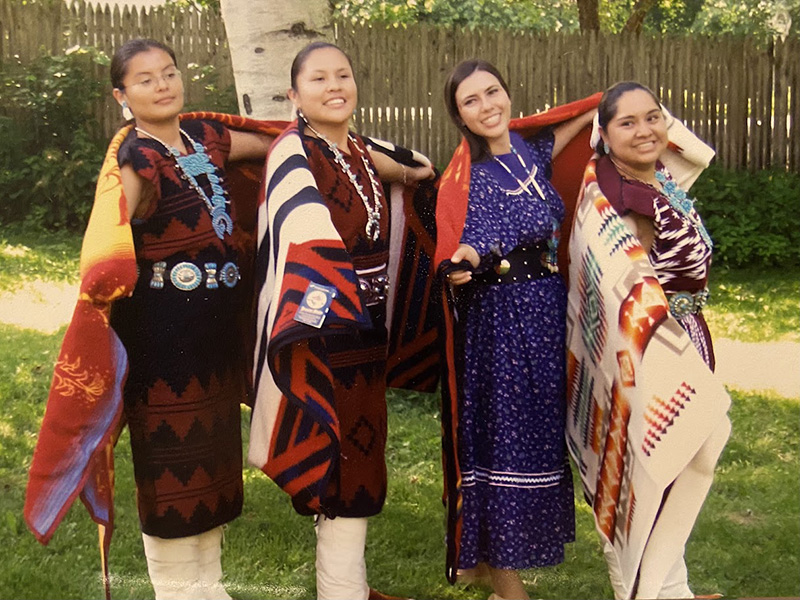
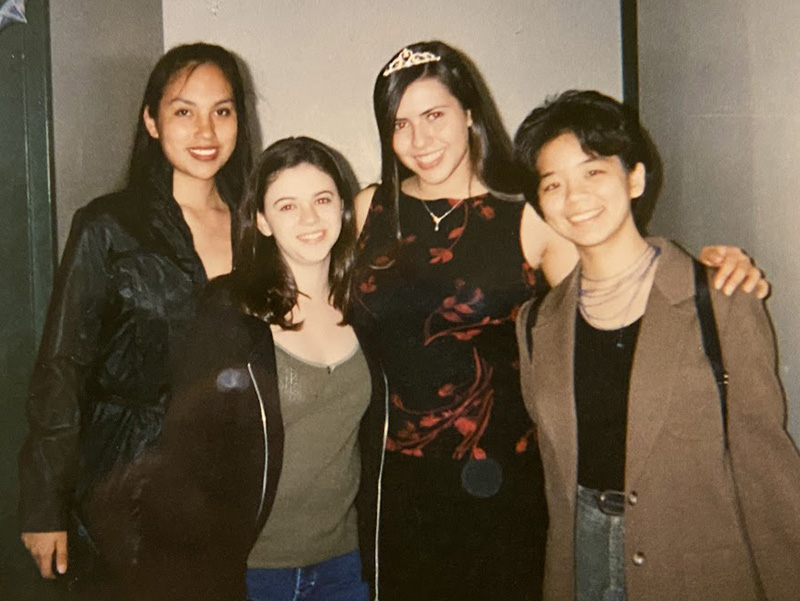
You mentioned Cody. She was right next door to us in our dormitory. It was so cool. She’s Seminole and Otoe, and she’s this gorgeous Miss Indian Nations winner. And she saw me and never questioned if I was Indian enough to be included in her crew. And I’ve been so grateful for the friendships that I made at Dartmouth with the Native women who were there. There were a bunch of Navajo women who were so kind. Cody taught me to fancy dance, and that was something I’d always wanted to do.
What is fancy dancing?
Fancy dancing is a type of powwow dancing where the women wear shawls and hold them out with our arms outstretched. So there’s a pan-Indian culture in America as well. And I think we see that mostly here in Los Angeles. We have the largest population of Native Americans in the country.
I didn’t know that!
It’s such a melting pot of every Indian culture. So I teach beadwork here in LA as well, because I got to learn during the pandemic and I want to pass on the knowledge.
Getting back to the question, yeah, being around the Native kids at Dartmouth was a huge blessing.
That’s great. Thank you.
I wanted to ask about how Dartmouth seems to have changed its branding over the years. I remember the school logo was so interesting when I enrolled. It seemed to depict two [naked] Native American individuals walking in the woods. And there’s this light shining from a book up above in the sky. It seemed to be looking down upon the Native population.

And then the logo changed in 2018 and now it’s just the letter D with a tree. It’s very simple and modern, and yet there’s a lot of history lost there. There’s quite a fine line between showing history and trying to make things right.
On the school website, I couldn’t immediately find the history of how it was founded as an educational institution for Native Americans—probably because now when we look at it in a modern light, it looks like forced assimilation.
How can we depict history in a way that’s not offensive, but also accurate and making sure that the legacy of Native American history is not lost?
That’s a tough question. And I’m really glad that you sent me the new logo. I had no idea they rebranded in 2018. I actually really liked the old seal.
Oh, ok!
And I think it was because we [Native Americans] were right there. I loved the Vox Clamantis in Deserto [the school motto written on the logo; Latin for “the voice crying in the wilderness”]. There we were in front of the doors of an Ivy League institution that predates the establishment of this country. So I liked it. I never really noticed that they were naked until you pointed that out. I guess I assumed they were wearing a onesie or something. Who knows?
Haha, maybe they are! Or maybe it’s just simplified.
So I didn’t really view it as paternalism or condescension—although everything can go back to paternalism probably in this country. I do see it now.
But you ask a really interesting question on how we can balance history and modern [perspectives]. I’m not sure I’m able to answer that.
I do think it’s important that we acknowledge that Dartmouth thrived off the backs of Indians. The only reason the money was raised to found the institution is because there was I think a two-man road show going around asking for money saying, “Look, we’re going to educate some Indians. Would you like to donate to that?” And people were like, “God, yes, please save them!”
And then as soon as Dartmouth got all the money to start, they abandoned the mission to educate Native Americans. So it wasn’t until President Kemeny came around for Dartmouth that—I think this was in the 70s—he recommitted the institution to the education of Native Americans.
I think it’s sad that there’s no indication on the website [where we can say,] “You’re welcome, rest of America, for Dartmouth. Our existence got some money for this beautiful institution.” I think there does need to be some kind of acknowledgement.
That is so interesting. Thank you so much. I didn’t realize the details of the school history and I’m just learning so much.
Career in Law
After graduation, you went to law school, and then you worked as an attorney in DC.
And I remember this one moment [in college] when you were telling me that you’d always wanted to be a lawyer. And I was so struck by that because I was clueless and barely had a major. I had so much respect for you.
When did you decide that you wanted to become a lawyer? I’m sure there are a lot of cases when Indigenous people were treated unfairly legally. Was there a specific incident that became your motivation?
Timing-wise, I decided to become a lawyer when I was 10 years old. I just remember that being a decision point. And there were two reasons—they’re not great, but I was 10.
One reason is, because I was Native and I was in this predominantly white community, I was often treated less than. We were made fun of a lot because what was being taught in that community was that Natives were extinct like dinosaurs. There weren’t any more Indians.
I was confused because we were there, and my mom was at my house. I didn’t understand. I was also told a lot, “You’re not as smart as these other kids because you’re Indian,” or “You’re not going to do as well in life because you’re Indian.”
What? Wow…
And it was incredibly frustrating. There was just this assumption that I was dumb.
I went through this process thinking, “Alright, what is a profession where people just assume, without even meeting them, that that person is smart?” And I ended up on attorney. I thought, “I’m going to be an attorney. I’m tired of people assuming I’m stupid because I’m Indian.” I’m not stupid. But I didn’t want to even have to prove it. I wanted it to be a title.
That’s part of the reason I went to Dartmouth as well. I was still battling [this idea and thought], “Please just have people assume I’m smart when they meet me.”
The other reason was I wanted to be rich. I thought attorneys were rich. And I don’t know if you can tell by my two-bedroom apartment that I’m renting in LA with [shows items around desk] my broken coaster and my hair scrunchie from 1980. Lawyers aren’t rich, guys! We don’t make money.
Haha! It depends on the field, right?
Actually, it does. Lawyers who defend Native American rights typically don’t charge as much as lawyers who do mergers and acquisitions. So it’s fine.
But you’re doing the right thing. You’re fighting for justice.
Yeah, I have my soul still.
So yeah, I wanted people to think I was smart. I wanted to be rich. I’ve gotten one of those things.
Yes!
Are there any cases that you’re particularly proud of in terms of working with the Native population?
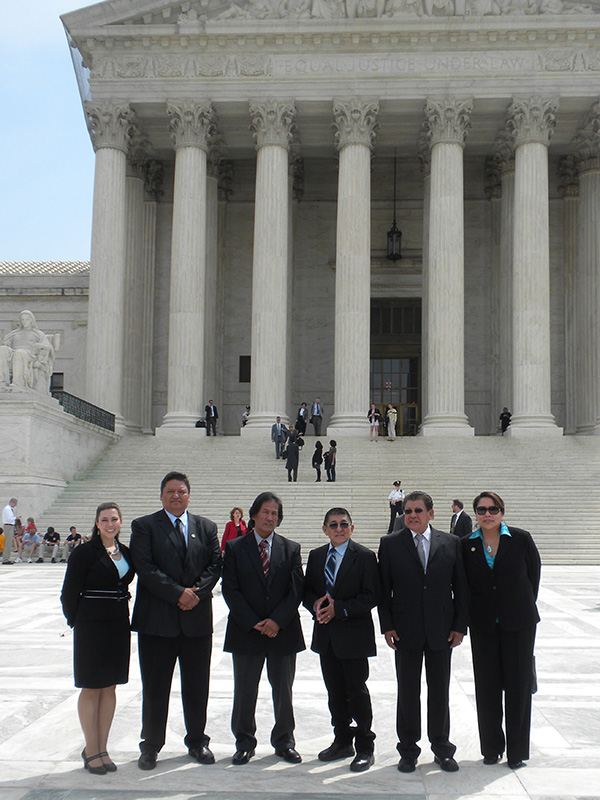
I’ve done so much in the 17 years that I’ve been an attorney. When I was in private practice, I worked as a general counsel for my tribe and for dozens of other tribes. This was back in 2008 when Congress was still taking appropriations requests. They’ve recently started taking appropriations requests again, but there was a long period of time when constituents could not apply to their congressmen for any funding.
But at the beginning of my career, I was able to fill out the forms for various congressmen and senators and ask for funds. Through those efforts and working with my clients, I’ve helped secure millions of dollars for Indian country. Some for suicide prevention facilities, some for water facilities (water delivery and water purification), some for schools. I’ve worked with agencies to get funding for medical buildings, whether it’s a joint venture between the tribes and the federal government, or a tribal institution trying to find funds for that. So what I’m most proud of is finding money for Indian country.
Thank you so much. That is incredible. Does the amount allocated or the difficulty of applying differ from administration to administration?
Every administration can put its own stamp on processes and procedures and even availability. Some administrations might even pull back funding altogether. It can differ, and I have seen it differ. It just depends on the administration. The pendulum swings from making sure that tribes with very little resources and funding still have a chance at receiving discretionary dollars—all the way to needing a professional grant writer to compete for these dollars (and a lot of tribes may not have the ability to hire a grant writer).
Right. Thank you for sharing that.
Transition into Comedy
I also wanted to ask about your transition into comedy. Am I correct that you first really started to enjoy comedy when you were doing standup with DC Improv while you were in DC? Would you mind talking about that journey?
Sure. In high school, while I was at my boarding school, I had the thought that I would like to be a comedian. So I told my parents that, and they were very scared for me because they didn’t know how I would make money if I were a comedian. So I went the long route, of course.
But I had been married to a man while I was a lawyer at a private law firm and I told him, “I think I want to be a comedian.” And he said, “No, you’re not funny.”
What? That’s terrible!
I held that with me. I held on to it. Luckily, he divorced me, which gave me all the space to pursue comedy, and I went for it!
In 2016, I took a class at the DC Improv. It was called “Five Minutes to Funny,” and basically you met for three hours for like four or five weeks with 12 other students. You came with what you thought was a five-minute routine, and you just performed it and got feedback in real time, such as, “Oh, that wasn’t funny,” or “That was funny, but I don’t know how you got from A to B. Can you walk the audience through this so that the audience can also laugh?”
So we went through that process, and then I performed. It was such a rebirth! I think my first performance was April 27, 2016, on the DC Improv stage. So I was on stage and I had my notes with me and it was like this the whole time [hands holding the notes shaking violently]. I thought, “I’m going to make this my job, as terrifying as it is.”
Aww, Gigi!
So I understand you work during the day now as an attorney, and then at night you perform, which is amazing. But you’re trying to segue into comedy full-time?
Yes. I’m still trying to be rich, Shiori! I have a rich life and I’m rich with family and friends, but money would also be nice.
So I am trying to figure out the LA comedy scene. I’ve only been here for about a year, and it’s a big scene.
I am trying to find my voice here in Los Angeles. I had a really great routine and set in DC, and I was getting booked and was actually making money doing comedy. And once you move to a new city, you’ve got to figure it all out again. But this is the city to do it in.
So did you move for comedy or for the Native population or for both?
I moved for comedy.
The Native population was just a bonus. In fact, I was really scared actually to move here because I felt like I’d just found my Indian community in DC. I was going to powwows there. I was meeting up with people. Things were finally happening for the Indian community in DC. And I was so scared to come here.
But it was worth it, I’m sure.
It was worth it, and I immediately found this organization called The Chapter House out here, which is a celebration of Native joy for artists. And that’s where I teach beading.
I realize that you’ve been doing a lot of interviews with other Native comedians and talking about this community. And I’m embarrassed to say that I didn’t know there were so many Native comedians. That’s so wonderful!
I know, right? We’re coming out the woodwork here. There are a few things that the pandemic helped cultivate. I’m not saying it was a good thing, but it cultivated an online scene for Native comedians and it helped connect us.
We are doing very well with our tribal values. With other comedy scenes, I feel like people are looking for who they can step on to get up. And with the Native comedy scene—not to do a “magical Indian” or “mystical Indian” thing—but I feel like it just has better people who figure out how to pull you up with them. So I really appreciate that.
A lot of my bigger breaks here in LA have been because of Native comedians and Black comedians. So that’s been very heartwarming. A lot of people will tell you LA is cold and cruel, and it’s all about who you know. While I’m sure that people have that lived experience, luckily I still have rose-colored glasses on. It’s glass half full, and a bunch of folks out here are helping me.
I think that’s one of your biggest strengths. You’re always so kind, helpful, and community-oriented. That’s why I was surprised to hear that you felt lonely as a child, and that there weren’t many people like you around. It sounds like you really found your home and your community now in both LA and DC, which is wonderful!
I’d like to ask you something about comedy. You mentioned that in the beginning [of your career], you were shaking and nervous. So many people have stage fright, but if you don’t get laughs when you want to, that’s also really difficult. How do you not get nervous? And if there are any jokes that the audience didn’t understand, or you didn’t quite get the reaction that you’re hoping for, how do you move on?
Good question!
As far as getting nervous, it really depends on the show. There are some shows where I can go in, do my set, come out, and we’re fine. The nerves tend to rack up if the minutes rack up. If I were asked to perform for 45 minutes, I would be nervous. I can do 30 minutes—I might be a little nervous, but I’ve done that before. I haven’t done 45 minutes yet.
It also depends on who’s in the audience. Being here in LA, if a booker from bigger clubs like The Comedy Store, the Hollywood Improv, or Laugh Factory are in the audience and I know about it, somehow I mess up my set because I’m so nervous. I’m still working on figuring out how to be cool all the time.
As far as when you deliver what you think is a brilliant joke to an audience who does not want that joke, the best thing to do is immediately acknowledge that nobody’s having a good time. Maybe this is also a thing in life as well. You didn’t like this, I don’t like what’s happening now, so let’s move on. I think having the ability to do that [is important].
Some comedians will pivot into what I think is hate. They’ll start blaming the audience and say, “You guys are a bad audience,” or “You’re stupid,” or “You don’t get it [because] I’m too edgy for you.” That is not my strategy. I would just say, “That was a little dark for you guys. Sorry!” So those are my strategies, and hopefully one day I’ll no longer be nervous in front of the right people.
That’s wonderful.
Laughter Bringing People Together
I also wanted to ask about what’s going on in the news. Recently, we’ve seen a lot of censorship in the comedy and talk show realm. How is the comedy community contending with this issue? Can comedy ever play it safe and still feel genuine? How do you walk that fine line between being funny and trying not to offend others?
Those are great questions. As far as reactions to what happened to Stephen Colbert and Jimmy Kimmel, what I’ve seen in the comedy community—at least here in LA—are petitions. Folks are circulating petitions that you can add your name to, denouncing the cancellation of these shows1.
I’ve also seen folks write their own messages about censorship and the importance of comedy as an art form for people. I feel like every country, and this includes Indian country, has their own sense of humor, their own inside jokes, and their own little hat tips to each other. We’re saying, “We share this experience together. This is how I’m communicating to you through humor, and we can laugh together. And if we can laugh together, we can be together.”
So putting out their own statements or petitions—that’s the tangible thing that comedians are doing. I think the more performative and more impactful thing is that comedians are still performing, and we are still discussing the topics that we want to discuss in the manner which we want to discuss them. We’re still exercising our First Amendment for our comedy, and I think that it would be disingenuous for comedians to have to put a finger on the pulse of censorship or [think twice] before performing. We’d lose a lot of art that way.
You can’t have good art if you try to confine artists. We all mostly have ADHD anyway and can’t stay on track for anything! It’s hard to contain folks who are uncontrollable.
I was really struck by what you said about laughter bringing people together. Right now, there’s so much anger in this country. It’s become so divisive. How can we find humor together in this sometimes quite depressing and chaotic age? How do we find humor in our day-to-day lives?
I’ve been thinking about this a lot. As far as supporting each other as community members, I try to check in on my neighbors and make sure folks have what they need, whether it’s groceries, a ride to the dentist, or just someone to listen to them for five minutes or 30 minutes.
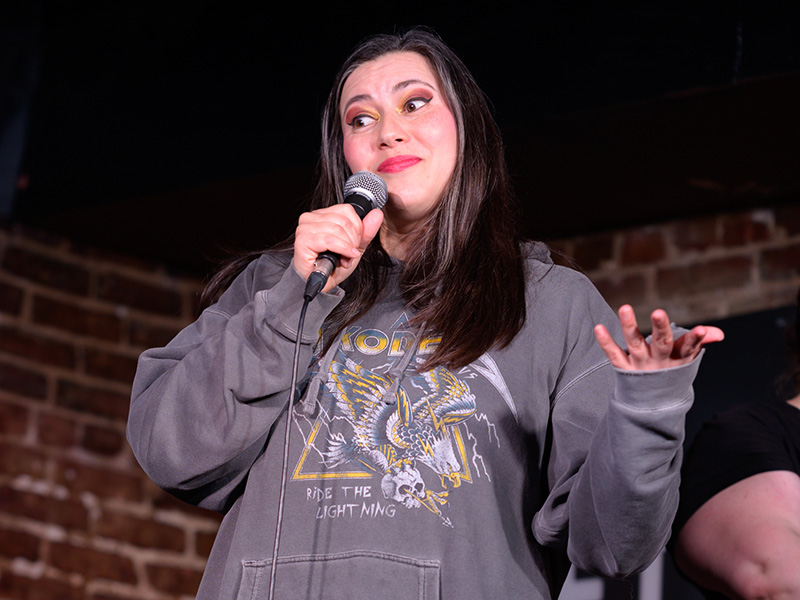
I think that’s where comedy also comes into play. It’s a vehicle. It doesn’t have to be topical or newsworthy or about the news to create a safe space for people to be together. I don’t know if you’ve ever been to a comedy show, but there’s a surprising number of people who haven’t. I always meet somebody at a show who’s like, “This is my first show.” I’m like, “How? This is my thousandth show!”
Yeah, I’ve been to a few.
It depends on the venue, but usually, if you go to a club, the ceilings are low, it’s very dark, and it’s in a basement. And psychologically, that is designed to be like a womb so that you feel safe and comfortable. So you can laugh at whatever you want to laugh because nobody can see you. Nobody can judge you for laughing at whatever joke it was. No one’s taking photos of you. It’s just very safe.
So you can use comedy to create those safe spaces for people. And if you [as an audience member] are laughing at something, and you look over and see someone else, you have that immediate connection of, “We have this shared experience,” or “We have this shared idea that this thing is funny.” And you can make friends that way. So comedy may not be the leading tool in the revolution to create community and to make people stronger together, but I think it is one tool.
Absolutely. Thank you so much for that explanation. I didn’t realize that [comedy clubs were designed as] a metaphor for a womb. I always think of the stereotype of a brick wall and this really harsh single spotlight on the comedian. That’s so interesting!
You didn’t have a spotlight in the womb?
Haha! I don’t recall, but I don’t think so. That’d be so funny!
I have so much respect for you for doing both comedy and being a lawyer. I’m sure [being an attorney is] already so busy as a full-time job, but you’re also creating this community among your audience members as well as your peer comedians. I think what you’re doing is so powerful.
Find Your People
Would you have any advice for people who might be struggling with their identity? This could be people who are growing up and trying to figure out their careers, or people who decide that they want to have a second career and are transitioning into it.
I think my advice is to find your people. Find folks who may have similar struggles or are open to hearing your story, because it is very cathartic to talk about what you are going through.
Two weeks ago, I had a call with one of my best friends who lives in Florida. And somehow it turned into me in tears talking about blood quantum, because I struggle with my Indian identity. Even though I only identify as Native, I can never have this piece of paper from the federal government or this enrollment card from my tribe. Talking to other folks about that is helpful because, outside of Indian country, a lot of folks don’t understand the legal complexities of Native citizenship.
So just being able to talk to someone, whether they’re in the community or outside of the community that you’re struggling with, helps a lot.
As far as pivoting careers, you probably know this, but follow your heart. I remember thinking a few months ago that everything that I have in my life today that I’m most proud of are not any of the things 18-year-old Gigi would have thought she would have been proud of. 18-year-old Gigi would have liked one husband, two kids, two cars, a house, and to be a partner in a law firm. Those were all my goals. And of those goals, I have a husband and we share a car. That is great. It works out for us.
I’m glad I didn’t get [the rest of] those things, because what I love about me now—and this is where you follow your heart for your career, your pastimes, and how you spend your life and your time—I love being a comedian. I love my second husband. I love my used [rescue] dog. I play roller derby, and I love doing that. I love my makeup. These are things that I would have never thought I’d love doing, but I just decided to let my inner child direct my second act.
I think that’s so wonderful. I also think your parents were wise to say, “Comedy is great, but try to pursue something else for now.” Because I think there are ways to follow your heart by keeping it inside, while focusing on something else that gives you the means to follow your heart. And I think you’re doing it in such a beautiful way.
Thank you. You’re absolutely right. We’ve wanted to move to LA since 2017, and I wasn’t going to do it unless I could find a lawyer job that I could do while here. I was not going to be a starving artist. Just artist [without the “starving” part] is fine.
Right. I also wanted to ask about something that you’ve been alluding to. You mentioned in one of the interviews you’ve done that you’ve had “three engagements, two marriages, one divorce, and zero regrets,” which I think is a wonderful phrase. Please teach me your ways, because I would love to have even one husband! I think you’re amazing.
You mentioned how your first husband was so cold and not understanding of your career that he flat out told you that you’re not funny (which is so mean, it’s definitely grounds for divorce!). But you seem so happy now.
In your journey to find someone that you really clicked with, did you find comedy first, and is that how you met him? How did these different journeys of following your heart for your career and meeting someone you really clicked with intertwine?
To talk about it chronologically, I went into big law and became a lawyer. Then my first marriage failed, thankfully, and that gave me space and time to pursue comedy. I started to go to open mics, and I saw this gorgeous man with beautiful hair. It’s still in the notes in my phone when I finally took down his number—it says “great hair.” He was funny and he was kind.
When you’re a woman in comedy, you are maybe one of up to three women in the room. I’m not saying I’m hot stuff, but there was a lot of interest in me while I was getting my divorce. And I just wasn’t in a space to receive that interest. And so this gentleman waited to approach me until I was divorced and ready to talk.
We’d known each other for about a year, and I finally did a set about being divorced. Apparently I was divorced for like two weeks, and I didn’t even know because I didn’t check my mail! When I [found out], I was like, “I wish I’d known about this earlier.”
That’s crazy! I didn’t realize it could be that one-sided. I thought you needed mutual consent.
No, I definitely got stuff in the mail. It’s fine. It worked out.
So I did a set on stage at the open mic where I met my husband, and he just came up to me afterwards. He was so sweet. He was just like, “I know we don’t know each other very well, but I feel like everything you said on stage is true. I got out of a long-term relationship. So if you ever just want to talk, just let me know.” And so I was like, “I definitely want to talk!” So we started to do comedy together. We do a lot of shows together.
For all you people out there [looking] for husbands, second husband energy should be kind. They are kind to you. They make you feel good. I cannot think of a foul word. I’ve been with Eric for eight years now. He’s only ever told me I’m beautiful, smart, and hilarious, and he’s only ever been my biggest cheerleader. So hold out for that!
Thank you so much. That’s so helpful. And I’m so happy to see you happy. And of course, you are all of the above. You’re incredibly smart and determined. You’re hardworking, beautiful inside and out, and of course super funny as this professional comedian.
I think that covered all my questions that I wanted to ask, but is there anything you’d like to add?
I don’t think so. I really appreciate you reaching out and I hope I wasn’t too chaotic or all over the place. I hope this is helpful for someone.
And if folks just want to find me, if this resonates with someone, especially for those who are unenrolled, disenrolled, or Native but adopted and never got to connect with their tribe—they should just reach out to me and I’ll be here to listen, because it’s tough.
Thank you so much. I’m sure that your story will resonate with so many people, both people who are Indigenous and those who are not—because there so many people thinking about career transitions and romantic relationships, too. So thank you so much for sharing your story.
Alright, I’ll talk to you soon.
Thank you!
Note:
- This was recorded on Sep. 18, 2025, before Disney announced that it would reinstate Jimmy Kimmel Live. ↩︎