
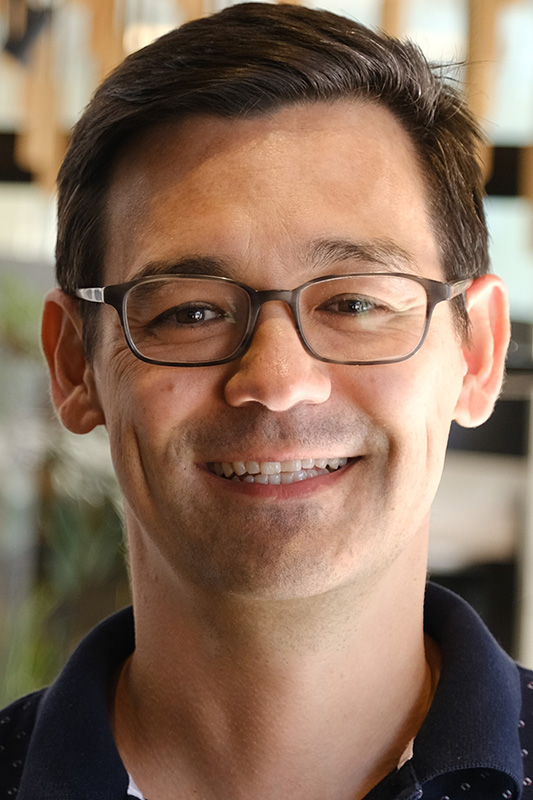
Sam Ushio is the Founder of Ikigai Lab, where he leads the social enterprise’s commitment to human sustainability and societal impact. Sam fuses a powerful combination of 10,000+ hours of Ikigai experience and 20 years of global asset management experience to design purpose-driven ecosystems for individuals and organizations around the world. Prior to founding Ikigai Lab, Sam was Director, Practice Management at Russell Investments where he led the award-winning team that coached approximately 1,000 financial advisors per year. He has an MBA from the Foster School of Business at the University of Washington, holds a Bachelor of Science from University of Nebraska in marketing and finance with an emphasis in psychology. Sam is a Council Leader of the U.S.-Japan Council and serves on the advisory board of the Clifton Strengths Institute at the University of Nebraska.
(Click on this icon to follow Sam:  )
)
Podcast
Transcript
Introduction
Hello, everyone. For this episode, I’m honored to welcome Mr. Sam Ushio, founder and head of Ikigai Lab. I met Sam through the U.S.-Japan Council. Ikigai Lab is about organizational leadership, employee engagement, innovation, impact, and so much more. I’d love to hear how Japanese values embodied in the word ikigai might inspire his work. What is ikigai to begin with, and how has his own life journey influenced his entrepreneurship?
I’m also excited to hear about his family history and what it was like growing up in an area without many other Japanese Americans, while having strong ties to his relatives, including those in Japan. We’ll also discuss the importance of mental wellness, community building, and people-to-people relations.
Thank you very much, Sam, for joining me today.
Thank you, Shiori. I’m very excited to connect with you.
Childhood and Upbringing
May I start by asking where you were born and raised?
I was born in Denver, Colorado. When I was less than a year old, my parents moved back to small-town Nebraska, where they were high school sweethearts. So I grew up in a rural community called Alliance, which is in western Nebraska with a population of about 10,000 people.
And you’re now based in Seattle, right?
Correct. So I’ve been in Seattle since 2004, with a stint in Canada for a couple years between 2004 and now.
You mentioned to me that there was only one other Japanese American family in town, but you also seem to have really strong ties with your father’s side—the Japanese side—of your family. This seems like an interesting contrast. How did you think about your identity while you were growing up in Nebraska?
There are layers of nuance here. In this community that I grew up in with 10,000 people, there was one other Japanese American family, at least with children that were around the same age as me. The vast majority of my friends that I grew up with were Caucasian.
I’m half Japanese and fourth generation (Yonsei). My father has three siblings.
My mother is of Irish descent. She was the 10th child out of 11 children. On that side alone, I have 29 first cousins of almost every age. Since this was a small-town community, my grandmother on my mother’s side had a grandchild graduating from [the same] high school every year.
And then on my father’s side—the Japanese side—my cousins were in other cities. So I didn’t grow up with them as much.
In terms of identity, my Japanese heritage was always there. My grandfather was a Nisei1 veteran; he served in the 442nd Battalion. My grandmother, who was Nisei as well, was an educator. I believe she got a degree from the University of Colorado as an educator in 1949. In rural Nebraska at the time, there were country schools for farmers that lived in remote areas. So my grandmother taught students from all grades at a country school. Eventually she opened up a preschool called the Small World Preschool.
But it never occurred to me until later stages in life that she was a woman of color—a Japanese American—who got her degree from university a couple years after World War II ended. The more distance that I get from that, I have an even greater appreciation for her, for who she is and [the role] she played in my life.
She and my grandfather were both very active in the community. So my understanding of Japanese culture was largely influenced by their civic engagement and how they contributed to the community.
But actual Japanese culture was somewhat distant. Over the holidays, in particular around New Year’s, it seemed like there was more of a Japanese culture influence. But growing up, I associated my identity with being a small-town Nebraska kid as much as anything.
Now, I was very aware that I was different. While I was growing up, that was pointed out often in a way that was difficult to process at the time. But I just had this very strong community of supporters that were either of Japanese heritage or just family members who had no Asian proximity beyond being a cousin to me.
Were there friends that you could turn to in terms of people who were also multicultural, even if they’re not Asian or of Japanese descent?
A little bit. The community was pretty homogeneous.
But I didn’t feel like I was othered. That’s probably the best way to describe it. I never felt like I was an outsider. In many ways, I felt very accepted within the community. Now I’m at a very different stage in life, and looking back, it really is inspiring. Given the state of the world today, it gives me hope that these communities can exist and cut through a lot of the filters through which we have a tendency to see each other.
Growing up in a small town, even when you don’t know somebody, you have the opportunity to build some form of relationship, whether it’s having parents who know each other or other little points of connection. That really strengthened my sense of identity at that stage in life.
It’s really encouraging to hear that you didn’t encounter a lot of othering or ostracization in the community that you grew up in.
From Fukuoka to Nebraska
You touched upon your grandparents—and your grandma sounds amazing!—but I was wondering if you could go a little bit more into your family history. I understand you’re fourth generation, but how did your great-grandparents first come from Japan?
Yeah. This story is on my grandfather’s side—the Ushio side of the family. And this really inspires what I do today.
My great-grandfather immigrated to the U.S. in the early 1900s. His name is Shigeo. He was the eldest son, next in line to be the head priest of a Shinto shrine in Fukuoka [called Iimori Shrine]. The shrine and the community were under duress. So when Shigeo was 18 years old, they put him on a boat and said, “You need to go to America to save the day.”
Where the shrine is in Fukuoka is somewhat rural, even today. Shigeo was an 18-year-old farm kid who grew up in the rural areas. I believe he left from Yokohama, and before the boat departed for America, he got swindled out of all this money. And that money was actually raised from by the community to bring him to the United States.
Oh no!
So he had to make an unplanned stop in Hawaii and work in the sugar plantations for two to three years. And eventually he made his way to Seattle.
My great-grandmother, Taka, grew up in the same community. She eventually came to America, I believe in 1909.
They ran a cleaner’s business. They started to form a family and had three children. Between child two and three, they made their way to Salt Lake City and purchased another cleaner’s business.
The demands of the family, the business, and supporting the legacy of a 1,200-year-old Shinto shrine and the community—all that was pretty significant. So they made the decision that they were going to take the three children (who were all born in America) to Japan so that they could stay with family. They wanted to focus on running the business with the goal of reuniting everybody. And that’s a pretty important inflection point in the family history.
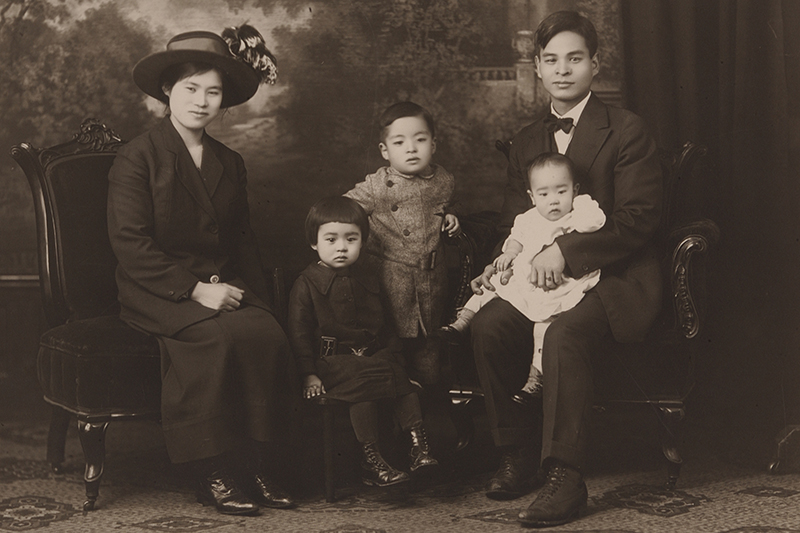
Taka boarded the boat in Seattle. This is in 1919, and she took the three children to Japan. At some point in that journey, Shigeo wrote a letter to Taka and said, “I miss the children. Can you please bring the oldest child back?” His name was Joy. So Taka and Joy came back to the United States, and the two younger children stayed in Japan. And there’s a picture of the family of five, capturing this inflection point in Seattle. And that was essentially one of the last moments that this family of five were together.
And then you fast forward, there’s another really important chapter in the story about 20 years later.
Taka and Shigeo had made their way into Alliance, Nebraska, the rural community where I grew up. They had purchased a cleaner’s business there. At this point, this is over 30 years from their initial immigration from Japan to the United States. They’re still sending money and food and clothing to Iimori and the community. And Shigeo dies.
So Taka is a widow in rural Nebraska, running a cleaner’s business with two children in Japan and now four children in America. And 18 months after Shigeo dies, the Japanese bomb Pearl Harbor. In the midst of all the swirl, Taka finds herself dealing with a lot. She has a son who gets drafted into the Japanese army. She has another son who enlists in the American army—this is my grandpa Sam, who joins the 442nd Battalion. And throughout all of this, she perseveres. She loses the son in the Japanese army at war. Grandpa Sam comes back a decorated war hero. And the Iimori shine still exists today as a result of all their sacrifice.
I think that those two chapters are really important in the family history. Those are the two chapters that really had an impact on me in terms of having a better understanding of this Japanese concept of ikigai and my personal journey. It fuels what I do and how I approach life in general.
Thank you so much for sharing that powerful story. I can only imagine how difficult it must have been, especially for your great-grandmother. And it’s incredible how much entrepreneurship they had, as well as an innovative and pioneering spirit.
Keeping the Family Legacy Alive
The last time we had this conversation, you shared that you traveled along with 35 other family members to Fukuoka to visit the Iimori Shrine. Would you mind talking about that?
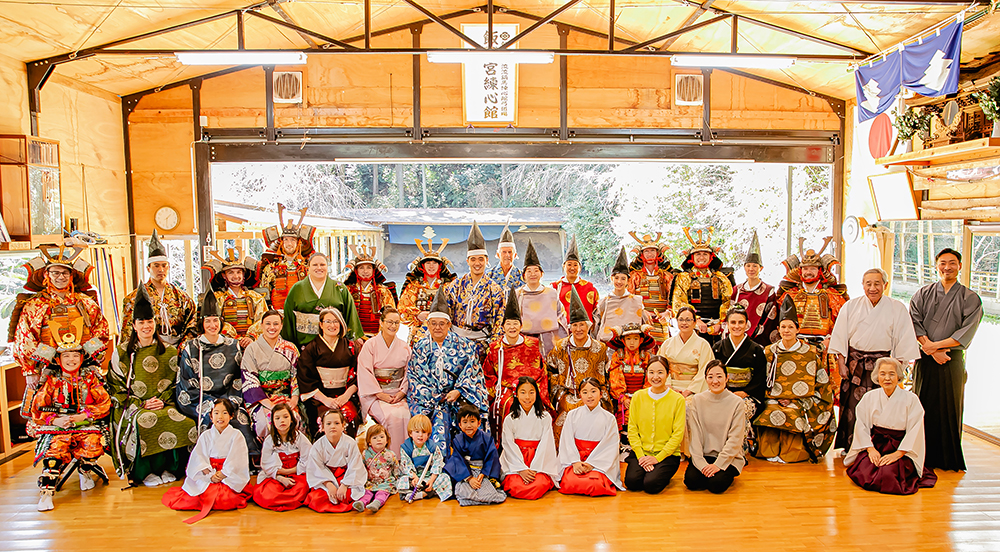
Absolutely. In 2024, 36 family members from 11 cities in the United States traveled to Fukuoka to participate in a Shinto ceremony in respect to our ancestral heritage, and Shigeo and Taka’s journey in particular.
Shuji Ushio is the current head priest at Iimori. He is the 49th consecutive generational head priest that they have on the roster. His son Kotohide will be the 50th. Kotohide is in his 30s. Kotohide and Shuji led us through this ancient ceremony. And then also we hiked to the haka2 to pay our respects and got to see the haka where I believe centuries of ancestral ashes are currently being held. So it was a very powerful experience.
That was only the second time that I had been to Iimori. Both times were very powerful, but this one was with my children, my wife, my father, and my siblings, and it had a different texture than the previous one. It was a pretty remarkable experience that I still get a lot of joy thinking about.
I cannot believe that your family members were [spread across] 11 cities and you managed to coordinate all of this! Somebody must have volunteered to make sure you’re in touch with each other and the shrine. Was it you?
No, it was not! That is not my skill set.
Actually, a really important person who I haven’t mentioned yet is my Auntie Julie. She is in Hawaii.
In the 1980s, Auntie Julie was exploring her identity. She grew up in small-town Nebraska. She doesn’t speak Japanese. My Nisei grandparents don’t speak Japanese. The Japanese language has never been a part of our life.
As Julie was exploring her identity, she made her way to Alaska and taught there, then made her way to Hawaii where she was a teacher as well. She eventually became a financial advisor.
When she was going through her journey, she wanted to explore her Japanese heritage. She asked Taka, who was alive at the time, if she’d be willing to conduct an oral history interview. And Taka said yes.
As Julie was getting prepared for this, a lot of family members were encouraging Julie to not ask about the children. So this whole story about that picture and in particular the children who were in Japan—there wasn’t clarity on that chapter of the story. Julie sat down with Taka and conducted a number of interviews. And Taka, at that stage in life—I believe she was in her 80s—wanted to talk about it. Through that conversation, Julie discovered that Taka wants to go back to Iimori one last time.
So Taka, Julie, and my grandparents (who were Julie’s parents), all went to Iimori in the early 80s. And this was my grandpa, Sam, my grandma, Sai, and Auntie Julie’s first trip to Japan. That experience brought the two families, the Ushios in Japan and the Ushios in America, back together for the first time.
Since then, Julie has taken on this incredible role and responsibility of uniting the two families. She organized this trip in 2024, but also has done much more. She’s conducted a number of different trips with a number of different family members and keeps in constant contact with our family and friends.
That is so wonderful. I was going to ask how you managed to keep in touch over the years, but it sounds like having someone like that who keeps everyone together and keeps track of who’s where, what their schedule is, who’s married to who and whatnot is really important. It’s wonderful how she brought your great grandma to Japan while she was still alive. I can only imagine how touching that was.
While we’re on family history, you mentioned that your mother’s side is Irish, but do you also keep in touch with that part of your culture in your daily life?
I do, but probably not as much. I definitely keep in touch with those family members, and they play a really important role [in my life].
What’s interesting is that I observe a lot of components [of different cultures]. Like the Okinawan social construct of moai3, for example. I see the moai come through in my mother and sisters. She has these four sisters that are a force of nature. That’s the only way to describe them.
Even though I have this construct of a moai that I incorporate into the work that I do at Ikigai Lab and almost everything that I do, my experience in that is thinking of my mother and her four sisters—my aunts—sitting around a coffee table, gossiping and giving each other a hard time when I was growing up.
So on the Irish side, [I’m in touch with the culture] a little bit. But those family relationships definitely play an important role in who I am.
It’s so interesting how you’re bringing all these different cultures together. I would love to hear more about how you incorporate not only the Japanese value of ikigai, but also this Okinawan value of moai in your work.
Beginnings in Finance
But before that, I want to take a step back and ask about your career. I understand that you first started in finance and you worked in that industry for about 20 years. When you graduated college, you probably had a selection of fields that you could go into, but why did you start in finance?
Auntie Julie played an important role. When I was young, I collected baseball cards. Baseball cards had an assigned value based on the player and how well they were playing. And there was this print magazine called the Beckett that was published on some type of cadence, and it would list the price of each baseball card. So you would go to the store and look at your baseball card collection, and you’d see that this one was worth 50 cents and now that one’s worth a dollar. So there was this link that I was making between the player and the value of the card.
At some point, there was a conversation with Auntie Julie that helped me make the link between that and stocks and securities. So I latched onto that at a pretty early age, probably around middle school. And as I went through college, I was a finance major and marketing major, and just really found that fascinating.
It was an interesting time as well. That was right around the early stages of the internet and moving into the dot com [boom]. The financial services industry was at an inflection point, where a lot of access was getting democratized. And that was especially interesting. So there was a lot of appeal and there was a lot of timing that was working in my favor.
It’s so cute how it all started with baseball cards. I never thought about how the price changes like stock. And it’s so wonderful how you have this angle in finance, thinking about not just everyday values, but about society and how, as you said, access is democratized. I think that really feeds into your later career when you think about people-to-people relations and helping others.
I also wanted to ask about how you transitioned into your own organization. Was there a particular motivation or trigger that made you want to go out on your own and perhaps leave finance for something different?
There was a lot. The last 10 years of my career in financial services was spent leading a management consulting team. And toward the tail end of that experience, we were consulting and coaching approximately 1,000 financial advisors per year.
And I was observing that everywhere in the industry was the word “growth” and that the definition of the word was always linked to money: financial growth, grow the portfolio, grow the P&L (profit and loss) and the enterprise value. And then simultaneously I was observing a lot of highly successful people in the industry who also seem very miserable.
So I was like, “Why is there an inverse correlation between financial growth and personal growth? Why aren’t those two in more harmony?” That’s how I had been thinking of it, too: that personal growth has to be compromised in the quest for financial growth. I really locked onto that.
In 2017, I went to an industry conference in New York City. I was grappling with a lot of this existential stuff. The last presenter of the conference was an ethics professor from the University of Denver. His name is Corey Chiocetti. And this was a room of about 700 people. This is in Manhattan. Everyone’s wearing Navy blue suits—it’s one of those types of conferences.
Corey opens his presentation by talking about meaning and money. And it just hits me like a lightning bolt. I felt like he was speaking directly to me. I still have this notebook I’ve written in.
Corey opened his presentation by saying that the world’s most successful Greyhound dog is named Cash. On the evening of Cash’s biggest race, the owner pats Cash on the head and says, “I’m really excited for your big race tomorrow, Cash. You’ve brought a lot of money and fame and fortune and power and influence, and you’re going to win tomorrow because no one can stop you.”
And Cash looks up at the owner and says, “I’m retiring right now. I’m not going to run the race.” And the owner asks, “Why would you retire? You’re going to win; you’re going to have more money, more power, more influence.”
And Cash says, “I’m retiring because I’ve been running on this oval track, not for money, not for power, not for influence. I’ve been doing it just to chase that rabbit. And I just found out that that rabbit is fake. And so I’m going to retire right now because I want to chase real rabbits in life.”
So Corey tells this presentation to 700 people and says, “This entire presentation is going to be about chasing real rabbits in life because society is built in a way where many of us are just chasing fake rabbits. And we don’t even realize that we’re chasing fake rabbits.”
And so right there was where I made this decision that I was going to depart the corporate [world]. And I started my journey from there.
Ikigai as a Framework
Thank you for sharing that. I think a lot of us struggle with self-discovery. You mentioned to me before that for the first year or year and a half, you were unsure about what you wanted to do exactly. So you went through meditation, talking to a lot of people, etc. I think typically that journey is very difficult, but you managed to have the courage to quit your full-time job, which I’m sure was very lucrative as well. Would you be able to share what that was like?
I was 40 years old, a month and a day [after my birthday] when this lightning bolt hit. I used to joke that it’s a midlife thing. As I’ve gotten more distance from that decision, I realized that there is some truth to that.
I started to research this happiness U curve that exists that comes from the field of economics. It’s not sociology or psychology. It’s economic research that tells us that around the midpoint of our lives, life satisfaction tends to dip. And it dips for lot of various reasons. There’s scientific research and anecdotal research. Jonathan Rausch wrote this book, The Happiness Curve. And he found some pictures or art in the Smithsonian, created in I believe late 1800s, that depicts stages in life that reflect that.
So I think that’s an important part of the journey that many grapple with when we get to this midpoint in life.
When I went through this experience, initially I had created enough resources to take six to seven months. At that time, I just flung myself at the mercy of the universe. There were things that I was always interested in doing, but I didn’t have the bandwidth of time. So I started to do those things, like go to startup hackathons and different networking events.
Then there were other things that I was curious about. Curiosity played a really important role. I just leaned into exploring mindfulness, meditation, and different elements of trying to figure things out.
I refer to it as the second adolescence. It’s like the second developmental stage in life where I just took myself out of the comfort zone to learn. Giving myself that opportunity to do that and explore was one of the most fulfilling gifts that I will ever give myself in my entire life.
How did you ultimately find what you wanted to do? You went through all these experiences, but was there one that hit more than the others and made you think, “This is it”? Or was it a gradual discovery?
It was just failure after failure after failure. There were failures, and learning lessons and crumbs of knowledge picked up in failure. 18 months’ worth of experiments.
I was learning all this new information on human-centered design, systems thinking, strengths-based positive psychology, emotional intelligence, and all these incredible topics. And I was thinking, “Where have these topics been?” I was 40 years old and running a management consulting group at a global organization. And if I never had access to this stuff, I’m sure that a lot of the population hasn’t, especially in the financial services industry that I was in.
So I said, “I’m going to take all this and start to create instructional design and some curriculum to bring it back into the industry.” This is pre-Ikigai Lab, and I was knocking on doors and going into a very difficult market. It’s very difficult to talk about why a very wealthy, typically male individual should consider emotional intelligence, mindfulness, and meditation to be a more successful leader and to be better in relationships, even with their clients.
At the time when I was knocking on these doors and making that pitch, I’m pretty sure at least one out of two people thought that I was completely crazy. They were just like, “This is way too out there.”
Here in Seattle, next to the Space Needle is the Museum of Pop Culture. And at the time, they had the world’s first Marvel exhibit. This is around when the Avengers had initially started. So I brought a bunch of financial advisors into that space and challenged them to think differently. Like, what can we learn when we immerse ourselves in creative environments? Why did the curator put Iron Man here and Hulk there? And what can you learn about curating a client’s experience? So it wasn’t so far-fetched. I think it was logical, but it was just too far out there [for them].
After that experience, I realized that this is not working. And that was when I found this picture of Shigeo and Taka and their three children. For me, it crystallized the concept of purpose. At the time, I had started to explore ikigai as a framework, as a methodology. And Shigeo and Taka’s story—especially Taka’s story—brought this concept of ikigai to life in a very personal and meaningful way. So that’s where I made the decision. This was seven years ago, and I had the first ikigai workshop with 11 willing guinea pig participants in a co-working space.
And how would you define the word ikigai?
The way that I define it is “reason for being.” And that comes with some nuance.
I think the best way to really describe it is “intentionality in the moment.” That doesn’t mean that we are always intentional. So, gratitude, presence, service beyond the self—these are all concepts and phrases that resonate with my interpretation of ikigai.
As you and probably most of your listeners know, it is not a four-circle Venn diagram—even though it has been westernized as such. I think that model has some value and some applications, but it’s definitely not the true definition of ikigai.
Absolutely. As a Japanese speaker, I first encountered it in a Japanese context, and was really surprised to hear that it came into the English-speaking vernacular about 10 years ago as a Venn diagram. As you said, it is useful, but I think there is some nuance lost because ikigai is not necessarily about your profession. For some people it’s about raising children or something else.
Thank you for that definition that refers to gratitude and presence and service for others. I think that’s a really rich and contextual way to look at it.
Ikigai Lab
Moving on to Ikigai Lab, would you mind talking about some of your goals and main activities?
Ikigai Lab is a social enterprise that focuses on human sustainability and societal impact. We do that through a number of different engagements.
There are individual journeys where we’ll take different segments of the population through an Ikigai Roadmap. It’s a process by which they have a foundation for “Who am I?” Because before we determine our “why,” we first need to figure out the answer to “who.”
I think oftentimes there’s that disconnect when we’re grappling with “What’s my reason for being?” There are multiple challenges, and one is that existential question. If we get stuck in that existential question, we’re not realizing the gift of presence and being in this moment right now. We’re so stuck in thinking forward or thinking backward that we don’t realize just the gift that is this moment.
There’s also work that we do with organizations. A lot of that work is rooted in fostering stronger organizational cultures, built on belonging, psychological safety, and improving employee engagement.
In both of these journeys, we incorporate strengths-based positive psychology like Gallup’s CliftonStrengths. It gives everyone a sense for what values are important to them, establishing a foundation that then extends into what themes of talent makes them unique. So those are two key areas.
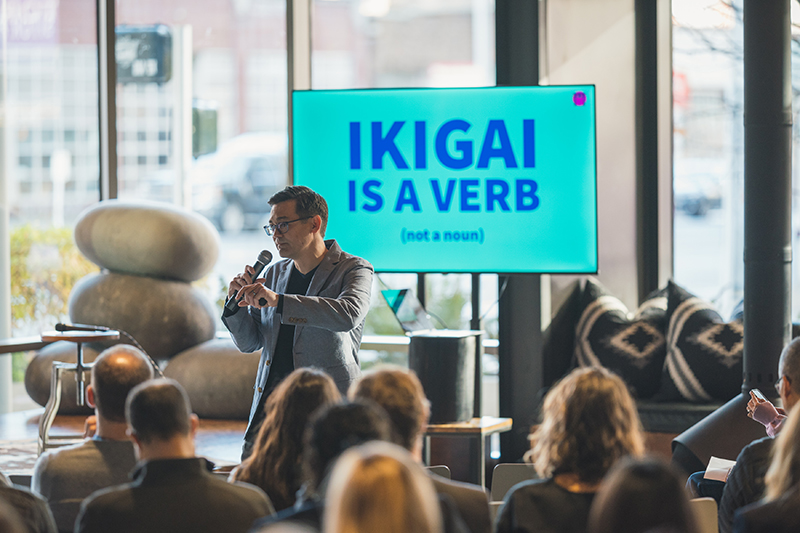
We also host an annual event. Historically it’s been called the Ikigai Summit. We rebranded it this year to be called (Re)purpose by Ikigai Lab.
And on the horizon, there is a new offering called the Ikigai Design Studio, which essentially is an operating system that integrates the world’s greatest R&D lab, which is nature. How do we get into the outdoors?
And on the other end of the spectrum, how do we successfully integrate regenerative, restorative AI in a productive way for exploration on the individual side, but also accelerating innovation for the individual or the organization? Those are the key areas where Ikigai Lab is dedicating its energy.
Qualities of a Good Leader
Thank you so much for illustrating all of that. It seems like you have a wide breadth of activities. I love how you appeal to the individual in terms of discovering that process and what makes them the happiest, but you also appeal to leaders who have to lead those organizations.
So we have all these different types of people within the organization and you also now have AI. What makes a good leader who’s able to orchestrate all of that and bring out the best in people?
I think it’s empathy, compassion, emotional intelligence, and human skills.
The way that I’m approaching AI from an Ikigai lab perspective is: this isn’t the first time we’ve had a technology that has transformed the world, but it seems like it’s transforming at a different level. How do you leverage that AI to innovate? That innovation can be in your professional or personal [life]. It could be in a lot of spaces, but let’s not lose sight of the fact that creativity and innovation are largely born from human beings coming together and having conversation.
Even before AI was mainstream, it was commonly accepted that 70% of employee engagement was [up to] the manager. Employees are people who join organizations, managers are people who lead. If you have a manager who doesn’t have the interpersonal skills for whatever reason, [that’s a challenge.]
And a lot of times people move into management at that midpoint in life, at the [bottom of the] happiness U curve. They’re dealing with some other existential stuff that’s beyond just their role in the office.
But I think a lot of it has to come back to emotional intelligence, interpersonal skills, and just presence. There’s so much data research on building and maintaining relationships.
I think oftentimes people think that it takes a heavy lift. I don’t think it takes that much, particularly in a workplace. It could be something as simple as just a quick Slack message saying, “Just checking in; how’s everything going?” That’s a low energy output, but there’s high value perceived by an associate that reports to a manager. That’s just making that intentional act on an ongoing basis.
There are also these values and themes of talent. If people have a better understanding of themselves, they are seen through that lens. If you said communication is one of your core values, now I’m starting to view every conversation with you through that core value. I can start to reciprocate through your core values or your themes of talent. I think it’s like a filter through positive lens. I think managers can do more of that to be more successful in building stronger relationships. You can help people understand who they are and reinforce that you see them through that lens.
Psychology and Building Connections
Thank you so much. And behind all of this, of course, is psychology. I wanted to ask about that aspect of your career as well. That was one of your majors in college. So it seems like you have had that interest for a long time, and you’re now the leader of the mental wellness affinity group at USJC. How did that interest develop, and how did you incorporate that into your career?
I recall that the first psychology class that I took in university was just very enlightening.
I think there were steps along the way on the journey that were interesting to me. When I was young, I played basketball, and I still remember a book that talked about visualization. If you visualize making the basket before you shoot, the probability goes up that you will make the basket.
And the mind was always interesting to me. I think that was a component of spending a lot of time with my grandma. As an educator, [she fostered] this curiosity that just did a lot of things.
Even in the professional world, when I was heavily involved in the portfolio of construction and investment selection and all of the finance stuff, where I was driving the most energy was actually on behavioral finance and behavioral economics. There’s this notion that we aren’t robots and people don’t always make the most rational decision. I always found that really appealing and interesting. I started my career through that path. So it’s always been foundational, whether [I worked] in financial services or not. I think behavioral studies and psychology have always been a constant [interest].
I think that’s so interesting and so important, especially now because I think there’s so many of us who are struggling with mental wellness.
One of the things that I really admire about you is that you have this ability to build a community. You do that through your work, of course, but also through USJC and other places as well. And when we first had a conversation, you were so well prepared. You thoroughly read my bio and background and made sure you were really present. So you really seem to embody all the values that you mentioned earlier that are important for leaders. Do you have any specific things that you keep in mind to create all these genuine and lasting connections?
First off, your bio is very appealing and interesting. So some of it’s just the genius that is you.
I keep on mentioning these CliftonStrengths, but individualization is a theme. Two themes I lead with in particular are connectedness and individualization. Going through that process and claiming those themes of talent that are unique to me was very informative and helped me have a better understanding of myself.
And I think a really big part of that was making space to understand it, to look at it from a number of different angles and then claim it. It’s not like as soon as I claimed it, it was immediately part of the identity. It’s very fluid. It’s just that I’ve decided that connectedness and individualization are innate. And so that just comes naturally. But how can I even be more intentional about that? If this is natural and easy to me, then how can I do that in an even better way?
So I think that’s a big part of how I’ve come to [build connections]. I think that leads into the question about identity that you asked in the beginning. That’s been a really critical part of me understanding who I am, regardless of whether I’m Japanese American or small-town Nebraskan or Seattleite or whatever. A lot of the foundational stuff kind of comes back to these core values and themes of talent.
Perpetually Unlocking Your Potential
That leads nicely into the next question that I wanted to ask, which is whether you have any advice for others who are struggling with their identity. How do you discover yourself and who you are? This could be about cultural and ancestral roots, or it could be about what you want to do with your life. Would you have any advice on that self-discovery process on what people should do?
Time and space have premium value these days. I think there’s an increasing value on giving yourself the luxury of time. We are in a fast-paced society that is not slowing down. Notifications and alerts are everywhere. And oftentimes I think they drive our decision-making more than we realize.
Making the time and trying to do [the self-discovery process] with all that noise is pretty challenging. But sometimes that noise is just a factor of life. So even if it’s being intentional about carving out 15 minutes a day, [that’s effective.] Every morning when I have my tea or my coffee, that is my 15 minutes where there are no notifications and I’m just going to write down what’s in my mind.
So I think there’s introspection, prompts, and a lot of stuff that you can do in terms of [finding out things like] what are your core values, who’s an important person in your life, what did you learn from them, what’s an experience [that’s important]. There are prompts for all that and they’re great. But if you haven’t invested in the time to process that, it becomes more challenging. So that’s a really important first step.
Here’s the second step. So many will get to that space where they will say, “I did it. I went to a workshop; I went to a retreat. I did the thing, and am still grappling with it.” Feedback loops are really important. Doing the thing is important, but coming back, revisiting it, and thinking, “What did I learn?” [is crucial.] So a really simple framework of doing it, making space, thinking, introspection, and then taking this very small step out of the comfort zone [is good].
So how do I take myself out of the comfort zone with the goal of learning? That learning could be “the thing that I just did is something that I never want to do ever again.” That’s okay. That’s growth. But we often don’t think of it that way. We think we have to engineer toward perfection. And if we’re engineering toward perfection, we would never have the courage to take a step into something that is unfamiliar or uncomfortable. And that limits our ability to transform.
I think of it in terms of like, “How do you build and construct these mini-experiments?” Even if it’s a seven-day experiment. It could be like, “I typically put my head down when I’m walking and don’t say hello to anybody. The next seven days, I’m going to try to say hello to strangers as I’m walking the street. Between Monday and Sunday, I’m going to do that. And on [the following] Monday, I’m going to revisit what I like about it.” Maybe I decide I never want to do that ever again, because there’s a lot of grumpy people in my neighborhood. Maybe I decide [to make it a habit.] I think that’s really important in the exploration process: investing time, introspection, and feedback loops.
There’s one more thing. I think the most important part of all this, of everything, is best captured in a story or metaphor. When Michelangelo created David, Michelangelo said that David was in the rock and he just had to release him from the rock. This is very different than the mindset of going in and having to chisel to create David. His perspective was that David was there and he just had to unlock the potential. I think that’s a very subtle, but very significant mindset shift in every person’s journey that is perpetual throughout life. It is not one and done.
By no means do I have any of this stuff figured out. I do have a foundation that I can constantly come back to. So when we find ourselves in these spaces of grappling with existential [questions] and wonder, “Who am I? Am I doing the right thing? Am I making mistakes?” we want to give ourselves that grace to come back to [thoughts like] “I’m unique. I have gifts. It’s a gift that I’m even here.” There are Takas and Shigeos in everyone’s life that have made sacrifices to get you here. So I think that sense of the big and small in the moment is especially important when you find yourself grappling with those bigger existential questions.
Thank you so much. That is so inspiring, because I was going to ask about the mental aspect of it. How do you stay strong when, as you mentioned earlier, you have one failure after another, nothing fits, and everything is uncomfortable—how do you keep going? And I think that change in mindset and taking one step at a time, deciding on a certain period like the next seven days, is super helpful.
Finding Common Ground
There’s one last thing I wanted to ask about. I’m sure that self-discovery process for a year and a half was painful for you in many ways, but you persevered. [There are times] when it’s clear that there’s happiness out there and you just have to take an extra step, but you have to let go of something that was previously important to you, or you feel like you invested so much time and money in a certain career and it seems too important [to abandon], or you feel like you might disappoint others. In that sense, it takes a lot of courage to move on or to let go. Would you have any advice for people like that?
I think this is about perspective as well. When I initially made the decision to go down this Ikigai path, I’d launched a podcast. At the time, I launched that podcast largely for personal reasons to rationalize what I believed was a crazy decision to go into this wisdom tradition. I wanted to find stories of people who brought that concept to life.
Going down that path, for a very short period I did what I call a “purpose speakeasy.” It was called Midlife. It was like this underground purpose speakeasy where people who professionally have everything right—their resume is perfect, they’re running this business line, they’ve gone to these schools—they could come into this sacred space and share.
Because what I realized is, when I was saying “I’m going to this Ikigai route,” I was terrified. What I realized simultaneously was that a lot of people [felt the same way.] It opened a door for people to come in and say, “I’m terrified.” And a lot of the people who were coming through that door were people that I did not expect. Some were former colleagues. Some were people that I knew just from social media. There were people who were doing some pretty remarkable things according to society’s measures.
And when I launched this purpose speakeasy, they would come in and have these conversations. It was illuminating for me that we’re all grappling with some version of the same stuff. I don’t want to discount that some things are bigger than other things. But I think our ability to give ourselves grace and have confidence in who we are so that we can move through these difficult moments is everything.
That comes back to the definition of ikigai being not “What am I on this planet to do?” but more about presence in the moment. So it gives us agency and control, and it brings us into this moment and into the now. That doesn’t mean that we’re always intentional in every single moment. There are plenty of moments where I make mistakes, but I have this foundation that I come back to. That’s especially relevant as a partner, as a parent, in every form of identity that I have out there.
For those that are grappling with [these issues], I wonder what the world would be like if those thought bubbles that exist in cartoons were reality, and there was also like an energy or happiness meter on top. I think we would find a lot of common ground with people that we wouldn’t anticipate finding common ground.
The main point there is you’re not alone. We’re not alone.
Thank you so much. It’s so comforting to hear that. I think that the speakeasy is such a wonderful concept. I think it’s because you create this safe space and people find you really comforting to talk to. The fact that you’re doing this is a huge service to all of us.
[I also appreciate how] you said that the self-discovery process or thinking about who we are is perpetual and that we need to continue to do it. It sounds like a muscle that we need to train. There’s no use running away from it because we have to face it in our lives anyway, in one way or another.
I think that covers all the questions that I wanted to ask, but is there anything you’d like to add?
I’m very grateful to connect with you, Shiori. I value our relationship that we established through USJC and look forward to continuing that relationship with you through USJC and beyond.
I listened to a couple of the podcast episodes that you’ve done in the past and I think the way that you are putting yourself out in this world has tremendous value as well.
Thank you! You’re very kind.
Notes: