
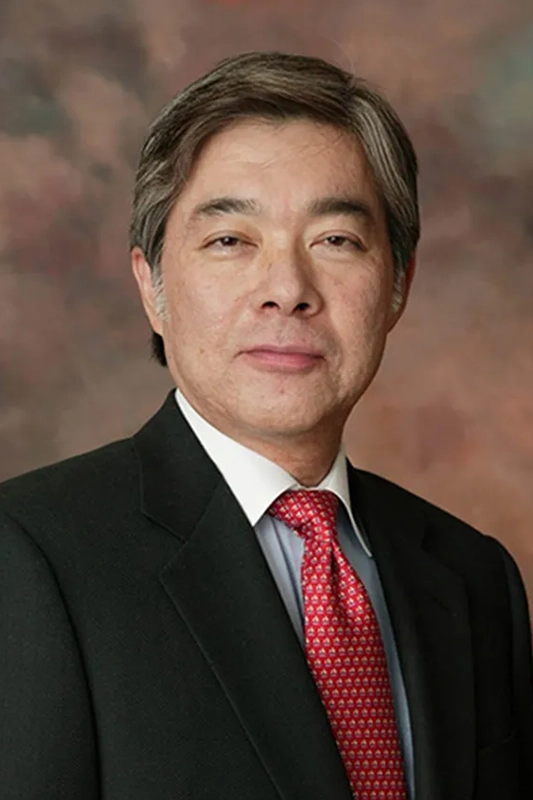
Glen S. Fukushima is a bilingual and bicultural Sansei (third-generation American of Japanese ancestry) raised in the United States and Japan. He is a Visiting Fellow at Stanford University, Senior Fellow at the Center for American Progress, and Vice Chair of the Securities Investor Protection Corporation. After law practice in Los Angeles, he served in Washington, DC as Director for Japanese Affairs and Deputy Assistant USTR for Japan and China at the Office of the U.S. Trade Representative. He was later a senior business executive in Asia for one European and four American multinational corporations and was elected President of the American Chamber of Commerce in Japan. Long active in the Japanese American Citizens League, Japanese American National Museum, and the U.S.-Japan Council, he is also a member of the Council on Foreign Relations and of the Global Council of the Asia Society as well as co-founder of the Asia Society Japan Center. He is a philanthropist to music, art, film, and education, especially programs promoting U.S.-Japan ties. He was educated in the U.S. at Deep Springs College, Stanford University, and Harvard University, and in Japan at Keio University and the University of Tokyo, where he was a Fulbright Fellow.
(Click on these icons to follow Glen: 


 )
)
Podcast
Transcript
Introduction
Hello, everyone. I’m incredibly honored to welcome today Mr. Glen Fukushima, who I believe many of you know. He’s currently a Visiting Fellow at Stanford University, but his decades-long experience as a government and business leader include his roles as the former Deputy Assistant U.S. Trade Representative for Japan and China, as well as the President of the American Chamber of Commerce in Japan. He’s also a philanthropist and leader in U.S.-Japan relations. He served on numerous boards, including the U.S.-Japan Council, where I had the good fortune of meeting him. He’s established scholarships under his name, including a Fulbright Fund, supporting the next generation of leaders for the U.S.-Japan relationship. He also belongs to several think tanks and is a frequent commentator, speaker, and moderator in both English and Japanese, with topics ranging from security to business to politics.
Today, I’m excited to ask Glen about his unique upbringing going back and forth between the U.S. and Japan, his career spanning government, business, and academia, as well as how his identity has developed over time.
So thank you very much, Glen, for joining me today.
Sure, thank you for inviting me.
Childhood and Upbringing
May I start by asking where you were born and raised?
I was born in Japan, but I was never a Japanese citizen.
My father, who was a second-generation Japanese American, or Nisei, was born and raised in the Los Angeles area. During World War II, he and his family were interned in an internment camp in Colorado. Then he joined the U.S. Army, and ended up in post-war Japan.
So I was born in Japan, but as a U.S. citizen on a U.S. military base, at a U.S. military hospital.
I grew up primarily in Japan and in the United States, mainly in California. But because of my father’s work, when I was in Japan, I was mainly growing up on U.S. military bases. I went back and forth so much as a child that, by the time I applied to college as a senior [in high school] and had to list the schools I had gone to, I listed 12 different schools. On average, altogether, it was one school per year.
Different Types of Japanese Americans
Wow! I’m really fascinated because I think we hear so many stories of Japanese American military personnel who go back to the United States after they fight in wars abroad. Were there a lot of Japanese Americans in the U.S. military who were based in Japan at that time? Did you know others who were like you?
Yes. There are a number of others. In fact, I knew quite a few people like me whose fathers were Japanese Americans in the US military or civilians who working for the US military in Japan and had married Japanese women. [These children] grew up with a Japanese mother and a Japanese American father. So I think there’s a sizable population of Japanese Americans like me.
I think there are at least four varieties of Japanese Americans. And that is one variety. Another is those who were born and raised in Hawaii. Then a third would be those born and raised on the West Coast. And then those who are born and raised in other parts of the United States.
But that one category is those who have American fathers and Japanese mothers, and grew up partly in Japan because of the father being in the U.S. military.
It sounds like you were able to grow up with others who were like you. Were you able to confide in them about any struggles you may have had with your identity and things like that?
Yes and no.
When I was in Japan, the Japanese Americans I knew were primarily those who were like me. They had fathers who were Japanese American and mothers who were Japanese. Many of these people could speak Japanese but couldn’t read or write it. Often they spoke Japanese with their mothers and English with their fathers, like I did.
Then when I went to high school in Los Angeles, I met quite a few Japanese Americans. Actually, the high school I went to at that time, Gardena High School, was a school where, at its peak, about 24 % of the graduating class was Japanese American. So Irene Hirano [the late founding president of the U.S.-Japan Council], for instance, was one year ahead of me at Gardena High School.
Wow, really?
Yeah. And that’s where I got to know her. Dale Minami, a very prominent Japanese American attorney, also was a Gardena High School graduate. There’s a guy named Warren Furutani, who is very active in California politics. And another guy named Garrett Hongo, a rather well-known poet.
So there are a lot of Gardena High School graduates, but the Japanese Americans I knew there were primarily those who were born and raised in Los Angeles, and had never been to Japan. They may have studied Japanese maybe on the weekends, but they couldn’t speak Japanese very much. The Japanese they knew was minimal. So that was the second variety.
Then when I went to college at Stanford, for the first time, I really got to know Japanese Americans from Hawaii. Because at that time, about half of the Japanese Americans at Stanford were from Hawaii. They were mainly from Iolani and Punahou, very elite prep schools in Hawaii.
Then when I went to Harvard [for graduate school], I ran across a whole group of other Japanese Americans, like Francis Fukuyama and others who were primarily raised on the East Coast in a totally non-Japanese American environment.
Each of those Japanese Americans have a very different outlook on the world and towards Japan. So I often find it very frustrating because Japanese professors or Japanese journalists spend like a year at the University of Hawaii or UCLA, and they write a book saying, “This is who Japanese Americans are.” But Japanese Americans are extremely diverse. There are all kinds of Japanese Americans, as you know from your experience in the U.S.-Japan Council.
So when you ask the question about identity, I suppose there are some Japanese Americans who had a similar experience of growing up partly in Japan or on the West Coast that could understand some of my experiences, but in some ways I’m kind of unusual.
I haven’t come across too many Japanese Americans that have had similar experiences to me, that is, growing up in the U.S. and Japan, basically in a military base environment, especially in Japan, and then going to school partly on the West Coast. And having a lot of experiences with Japanese Americans from Hawaii, but also spending eight years at Harvard, where many of the Japanese Americans had no experience with Japan or the West Coast.
Then I went to a place like Deep Springs College, which nobody’s ever heard of. I turned down Stanford and Pomona and Reed and others to go there. Then I worked at USTR and Airbus, a European company, which very few Japanese Americans have done. So I guess there aren’t too many people who I share life experiences with.
Growing Interest in U.S.-Japan Relations
Did you think about U.S.-Japan relations from a very young age because you had to go back and forth? Was that something that you were interested in, bringing the two countries that you know so well closer together?
No. Until I went to college, going back and forth between the U.S. and Japan was kind of a natural thing. I just saw it as a byproduct of my upbringing. So I never really thought of Japan as a subject of study or the subject of a profession.
When I was going to college, first at Deep Springs College and later at Stanford, I thought I wanted to become a medical doctor.
But because I got involved in political activity during the war in Vietnam, I switched. I got much more interested in politics. So I studied history and economics. At that time, I thought I wanted to go to law school and be a lawyer. Being a civil rights attorney was something that I found very attractive.
Then I was introduced to a program at Stanford to spend time studying at Keio University. So in 1969, I spent a summer with 11 other Stanford students at Keio in Japan.
And that’s when I got my first exposure to Japan apart from my father’s work being on U.S. military bases there. It was my first contact with the real Japan.
During those two months, I stayed with a host family in Japan. They had three sons, and all three went to Keio. The eldest had already graduated and was working, but the younger two sons were Keio students at the time. We became friends and the family treated me very well.
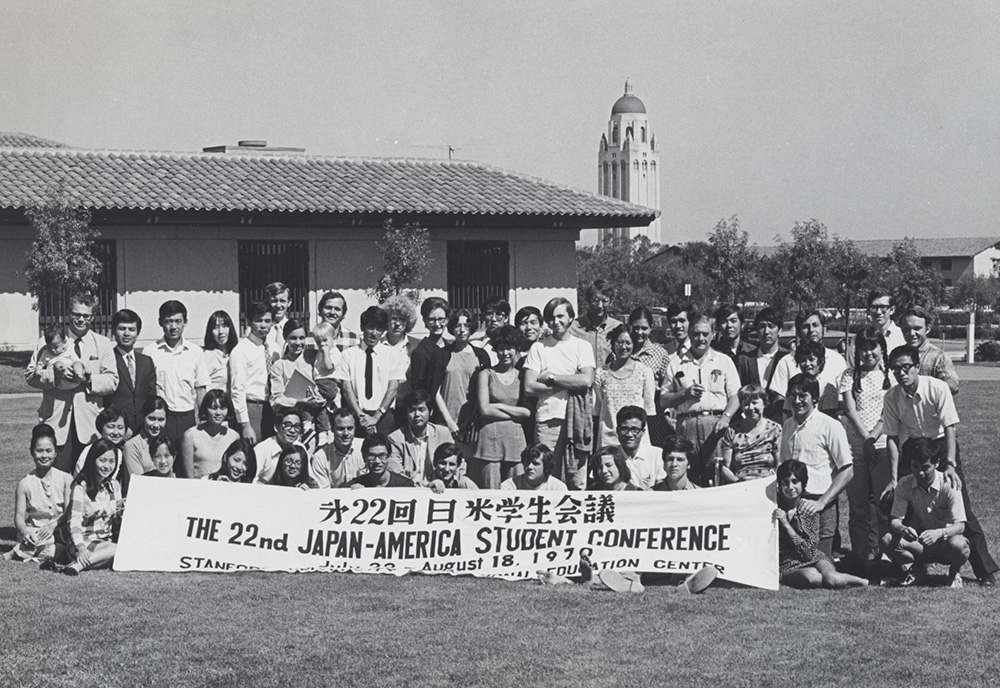
So I started getting more interested in Japan, aside from having just been brought up there and the U.S. Then in 1970, I was invited by some friends to apply and participate in the Japan-America Student Conference. This was a 22nd annual Japan-America Student Conference.
The conference started in 1934, went until 1940, and then it was disbanded during the war and restarted after the war. But at that conference, I made many Japanese friends. I met a woman from Japan [Sakie Tachibana-Fukushima], and we got married two years later.
Then aside from that, in 1971-72, I studied for a year at Keio University. Although my main time was spent studying Japanese language, I sat in on two seminars at Keio. One of the seminars was on U.S.-Japan relations, and it was taught in Japanese. But that year there was a professor named Gerald Curtis who had just gotten his PhD from Columbia in 1969. He was a visiting assistant professor and was co-teaching the course with Kamiya Fuji, who was the professor at Keio who usually taught the seminar on U.S.-Japan relations.
I sat in on that seminar and that prompted me to think, “Maybe Japan is a subject that I might be involved in as a profession”—as opposed to just kind of being a hobby or [the place where] I happened to grow up in part.
The subject of that seminar was the [American] occupation of Japan from 1945 to 1952. And we didn’t actually study this, but I learned at the time that one of the organizations during the occupation of Japan was what was called the American Council on Japan. This was a group of American business people who were interested in Japan [and I first learned about them in 1971-1972].
In 2009, when the U.S.-Japan Council began, some people involved in it wanted to have “Japanese American” in the name of the organization. But I thought about the Committee of 100, the Chinese American organization. I thought that the U.S.-Japan Council, the organization being created by Japanese Americans like Irene Hirano and Frank Sogi and Henry Ota and so forth should have a more neutral-sounding name. And thinking about the American Council on Japan, which I had studied about in 1971, I proposed the name “U.S.-Japan Council,” and Senator Inouye and Irene Hirano liked the name. So that’s how the organization was named U.S.-Japan Council.
Wow, it’s incredible that it’s all connected. You went to high school with Irene, studied under Gerry Curtis [who is also a member of the USJC Board of Councilors], and named the U.S.-Japan Council. Thank you for that incredible story. And I’m really fascinated too that your study abroad experience really shaped how you are committed to U.S.-Japan relations today.
Yeah, Gerry Curtis was the one who said, “There aren’t too many Americans studying U.S.-Japan relations. Why don’t you consider going into as a profession?” And that’s what prompted me to think, “Well, maybe.”
So after that, I went back to Stanford to graduate, went to Japan and got married, and then spent two years working and studying and preparing to go to graduate school. And when I went to graduate school in 1974 at Harvard, I went there originally with the plan to get a PhD and go into teaching.
Then after getting a master’s, [entering] a PhD program in sociology, did everything except the dissertation and becoming a teaching fellow for Ezra Vogel and David Riesman and Edwin Reischauer, I decided I really didn’t want to be a professor. So that’s what led me to go to law school and business school through a joint JD/MBA program. I ended up spending eight years in graduate school at Harvard: one year for my master’s, three years in a PhD program, and four years in law school and business school.
So then I finished at Harvard, and then I had a Fulbright grant to study at the University of Tokyo. After that, I joined a law firm and I thought I was going to just practice law.
Then in 1985, I got an offer to work for the Office of the U.S. Trade Representative (USTR), first as a Director for Japanese Affairs. Later, I was promoted to be Deputy Assistant U.S. Trade Representative for Japan and China.
If I hadn’t gotten that offer to work at USTR, I probably would not have ended up focusing so much on Japan. I probably would have ended up being a regular corporate attorney. But because of that experience [at USTR] for five years, very intensively working on Japan in the U.S. government, that kind of naturally led me to work on Japan-related activities after I left the government.
For 22 years after leaving USTR, I worked for four American companies and one European company, primarily based in Japan. The environment at the time in the 1980s and 90s and into the 2000s, I think Japan was considered such an important market, both to sell products and services to and in some cases as a competitor. There were many opportunities to work for American and European companies that thought Japan was important.
As a Trade Negotiator
Going back to your years at USTR, I think the U.S. government was incredibly lucky to have someone like you at the helm when there were so many trade frictions and a lot of tension. I was wondering if you could talk about some occasions where your thorough knowledge of Japanese culture, society, and language was able to lower the tension a little bit and help you negotiate in a peaceful and cordial manner with Japan.
Most of the discussions and negotiations between the U.S. and Japan on a government-to-government level are done in English and Japanese using interpreters like you. But there were some cases, for instance, with U.S.-Japan legal issues where [officials from] the Japanese Ministry of Justice didn’t speak English by and large. So I had many informal discussions with them in Japanese. I think that was helpful in moving the discussions along in a more direct and straightforward manner rather than having to use an interpreter and spend a lot of time.
One specific example of how my knowledge about Japan I think really helped me is this. Often, when the two sides would start with negotiations in Tokyo, after the first day of negotiations, the Japanese government would often ask, “What should we tell the press?” And the U.S. side would say, “We’re still negotiating and haven’t reached a conclusion. So we don’t plan to tell the press anything.” And the Japanese government would say, “No, no, we have to tell the press [something] because they’re all outside, waiting for us to tell them what kind of progress we’ve made.” So sometimes we would spend 10 minutes, or sometimes an hour, negotiating what we would tell the media.
And then the next day, you look at the newspaper, and it’s completely different from what we had agreed to. Many of my colleagues in the U.S. government thought, “Oh, the Japanese screwed us again. They stabbed us in the back. They made these promises and they reneged. They lied to us.”
Well, what I realized is that the way that Japanese media works is that there are so many levels of contact between the Japanese media and Japanese government officials. There’s the official press conference, then there’s an informal press briefing. And then there’s this [custom called] yomawari, where Japanese journalists wait at the homes of officials at 11 or 12 o’clock at night, waiting for them to come home and they grab them. And sometimes the wives allow them into the living room to drink while they’re waiting for the officials to come back. And officials [return and] give information to these journalists in time for the deadline of one or two o’clock in the morning for the newspapers.
These journalists would feed that information to the editor, and often the person writing the articles has no notion of what’s actually going on. He or she gets information from different journalists and all sorts of places and puts them together. And then someone else puts on a headline.
So it’s not necessarily that the Japanese government lied to the Japanese media. The reason these articles were completely different from what the governments had agreed to is that the way the media works in Japan is completely different from the way it works in the United States. But because I had studied in Japan and I had many friends who were Japanese journalists, I understood how they worked. And so I wasn’t happy about what happened, but I didn’t hold it personally against the Japanese government officials. I didn’t accuse them of lying because I don’t think they usually did.
There are many other examples like that, where the fact that I knew about Japan helped me to understand what was going on and led me to be, I think, more neutral and objective and less emotional in dealing with Japan. Some Americans got very emotional because they didn’t fully understand how Japan worked.
Thank you for that example. I think that’s super helpful. And you’re absolutely right about how the way journalists work is very different. And I think things are changing now. It’s more becoming similar to other global and Western media. But I think especially during that time, it was so much about nominication1 and time spent after work and whatnot.
Yeah, this was a long time ago.
Recently, more articles in Japanese newspapers have bylines. They have individual writers. So there’s one person who’s responsible for the article.
In those days, it was often the case that various people would submit information. It was a mishmash of information from all sorts of different sources. So the articles often ended up being inaccurate or certainly being different from what the two governments had agreed that the Japanese government would tell the Japanese media.
That’s so fascinating. I had no idea about that, thank you.
How to Choose Companies to Work For
Moving on to the private sector, so you mentioned Airbus Japan and you’ve also worked for companies like AT&T. I think working for these companies that have such technical expertise is quite challenging. What were your criteria in choosing specific companies to work for?
Well, one criterion was, is it a successful company? Is it a strong, competitive company? And is it an interesting company where I could learn something?
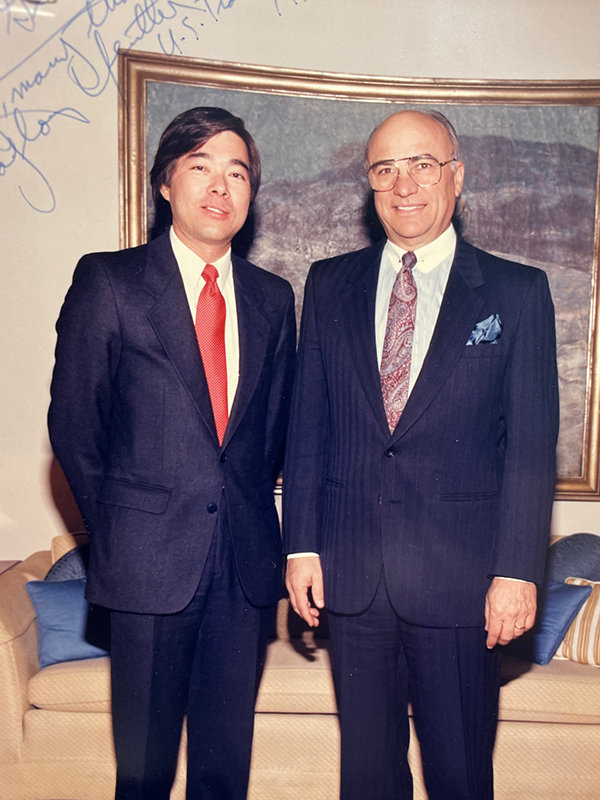
[I worked for] four American companies. The first was AT&T. The second was Arthur D. Little, a management consulting firm. The third was Cadence Design Systems, a Silicon Valley software company. A fourth was NCR Corporation. The fifth [company I worked for, which was European] was Airbus. In each of those, there was some special attraction.
I had several other offers that I turned down. In some cases, it was fortunate that I turned them down. In other cases, I probably would have been better off taking the offer.
I’ll give you examples. When I was leaving USTR in late 1989 and early 1990, I had offers from Intel, AT&T, and Motorola. I was interested in Intel because I had done a lot of work on semiconductors when I was at USTR.
But many friends of mine, including in Silicon Valley and places like Stanford, said to me, “Intel may have done pretty well up to now, but their days may be numbered. The large vertically integrated Japanese semiconductor companies like NEC, Hitachi, Fujitsu, Toshiba, and Mitsubishi Electric are almost certainly going to overtake Intel. Maybe they will acquire Intel. So if you’re to go into international business, you should go to a company that has lots of resources, technology, and money.”
And at that time, AT&T had about 300,000 people. They had Bell Laboratories with seven Nobel Prize winners. They did have a lot of money, technology, and capital. And I was interested in telecom.
I went to AT&T and worked there for eight years. But when I left AT&T, the shares that I had gotten from them were worthless because the Telecom Act of 1996 changed the telecommunications market in the United States so much. AT&T went through a trivestiture voluntarily into AT&T (the services company), Lucent Technologies (the manufacturing firm), and NCR Corporation. The telecom market was in turmoil.
As for Intel, during the 10-year period between 1989 and 1999, their shares grew by 39 times. So, if I had ignored the advice of the experts and joined Intel, I probably could have retired in my 40s as a multimillionaire and set up a couple of foundations. That was an experience where maybe I should have gone to Intel rather than AT&T.
But here’s the counter example of that. In January 1993, [President Bill Clinton recommended me, and] I was offered a job by Ron Brown, Secretary of Commerce, to be Assistant Secretary of Commerce for International Economic Policy. And I asked him, “Who’s going to be my boss, the Undersecretary [of Commerce for International Trade]?” And he said, “I just offered the job last week to Bob Hormats at Goldman Sachs. I’m sure he’s going to come.” So I said, “I know Bob. I think I can work with him.”
But then the following month in February, Hormats withdrew because he wanted something in Treasury rather than in Commerce. It took Brown another several months to come up with Jeff Garten to be his undersecretary. And by that time, I had been promoted to vice president at AT&T. My wife had been promoted to partner at her firm. It wasn’t that attractive for me to make a move back to the government at that time. So I turned down the offer.
The person who took the job I turned down was a guy named Chuck Meissner. He was in the airplane with Secretary Ron Brown that crashed in Croatia in April 1996. So if I had taken that job, I almost certainly would have been in that airplane, and I would have died in Croatia. That was an example of a job that it was good I didn’t take.
My goodness. You never know how these things [turn out], both the way technology moves as well as the fate of everyone’s lives.
Be an Actor, Not a Bridge
I wanted to come back to the Japanese American stories that we talked about. And thank you so much for illustrating the different types of Japanese Americans that you’ve encountered over the years. One of the things I wanted to ask about is the word “bridge” that you’ve mentioned in other interviews. Many people say that they aspire to “bridge” the United States and Japan, and you’ve said that that’s not the best word because it’s an infrastructure that people step on. Could talk a little bit about your thoughts on that?
So many Japanese and some Japanese Americans say that “Japanese Americans can be a bridge between the U.S. and Japan.” And when they say this, most people mean it in a positive way. They’re referring to someone who can be an intermediary, smooth linguistic and cultural differences and so forth, and who can adjust between differences between the U.S. and Japan.
But in my own experience, I see others—to some extent the U.S. side too, but especially older Japanese people—look at Japanese Americans as vehicles or instruments through which they can accomplish things.
For instance, Mike Masaoka is someone I knew when he was working as a consultant in Washington, DC. And in 1980, when I worked in Washington, DC at a law firm during the summer, he took me out to lunch.
And he said to me, “These Japanese companies and government officials come to me and ask me for advice. So I give them advice and they want me to introduce them to people. So I introduce them to important people in Washington, but they don’t pay me. They don’t have any appreciation. Whereas the Caucasians that they use as consultants—even if these Caucasians give them much less important or valuable information and introduce them to people who are much less influential than those I can introduce them to, they’ll pay these Caucasians. But they don’t necessarily pay me, or they pay me much less. They don’t value what I provide.”
Basically, his message to me was, “Don’t sell yourself cheap.” Because I think some Japanese people look at Japanese Americans and think, “We can use them to get access or do things.”
A friend of mine who is in the Japanese government told me that he realized this only after he became a Consul General of Japan on the West Coast. When he recommended several Japanese Americans to receive the Emperor’s Award, he was told by Tokyo that, “Japanese Americans have to do much more than Caucasians to justify getting an award.” Because the logic of some of these people is that Japanese Americans are kind of expected to contribute to U.S.-Japan relations. Whereas if you’re not a Japanese American, then you should be rewarded.
I think that logic is still operating. I’ve often had the experience myself when I’ve introduced [Americans] who I think are pretty influential, whether in Washington or elsewhere, to Japanese people, especially government officials. And once I introduce them, they will establish those relationships and then totally ignore me. Because I was a bridge that allowed them to make the connections or the entree that they wanted.
That’s why I say that Japanese Americans should not relegate themselves to being a bridge. We should be actors. We should be people who actually have agency to do things. And we shouldn’t just be used as a convenient bridge for other people to take advantage of.
What you said about Japanese Americans needing to be actors and leaders in the U.S.-Japan relationship is really helpful. But do you have any specific advice on how they would go about that? Perhaps trying not to be too modest or have too much humility?
I think the most important thing is to have expertise. Have expertise, whether it’s tax law or cybersecurity. You need to be a real expert and be very knowledgeable about a subject.
Hopefully it’s a subject that people in Japan would be interested in, because I think people in Japan, especially leaders, are very instrumental. They’re very results-oriented. So if you happen to have something that they value, then they’ll pay attention to you. And if you don’t have something that’s of value, they’ll ignore you. So I think it’s important to have something that they think is useful or of value to them.
I’ve been involved with [many Japanese American organizations:] the Japanese American Citizens League (JACL) in the 1970s and 80s, the Japanese American National Museum in the 1990s and 2000s, and more recently the U.S.-Japan Council. But I often think, too many Japanese Americans think that just being Japanese American is enough to be able to get involved and play a useful role in U.S.-Japan relations. And I think from a Japanese point of view, that’s wrong. It doesn’t compute. It’s only if you have something of value that people in Japan think is useful to them that you can play a role.
Thank you so much for that. I think that’s really inspiring as well that we should be more active in whatever we do and try to aspire for leadership roles and not just connect the U.S. and Japan.
The Growing Ties between Silicon Valley and Japan
I wanted to ask about your current activities at Stanford. Would you mind talking a little bit about what you do as a Visiting Fellow?
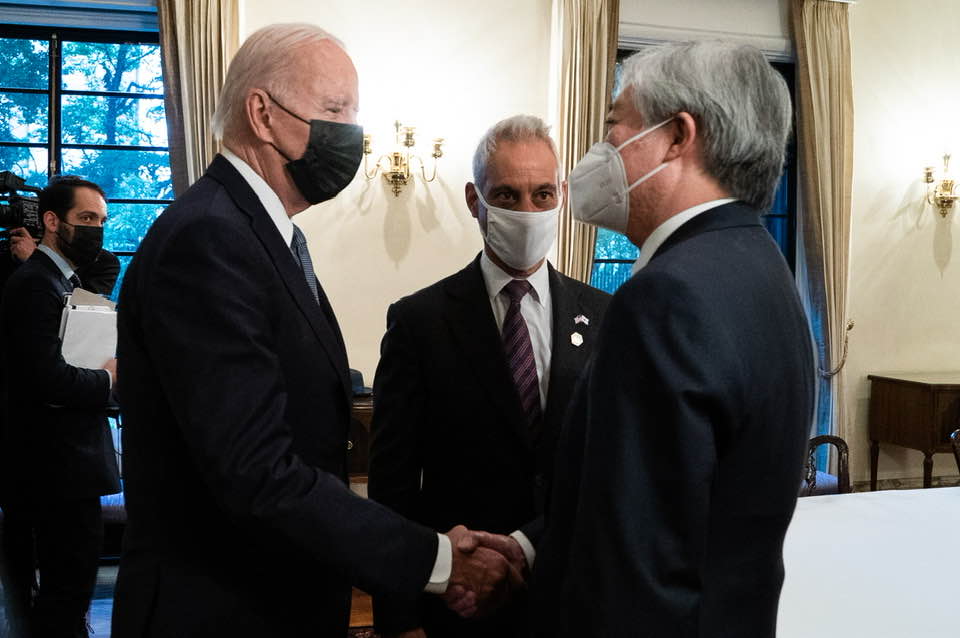
Sure. After leaving Japan in 2012, I went back to Washington and worked at the Center for American Progress. Then during the Biden administration, I was nominated to be Vice Chair of the Securities Investor Protection Corporation. I had to go through a six-month process to get Senate confirmation.
But I guess I’d have to say that since last year, I’ve felt that the environment in Washington, D.C. was turning in a direction that didn’t feel that comfortable. I happened to be meeting with a former president of Stanford University. And he encouraged me to apply for a program at Stanford, which allows people who have had a career to spend a year on campus making a transition in their career.
I think generally people between the age of 50 to 80 can apply for this program. And it only started about 10 years ago, but it’s become very popular. I think Harvard, Notre Dame, Chicago, Northwestern, Duke, and several other major universities have started similar programs.
What I’m working on now is to write a book about the ties between Silicon Valley and Japan. I think there’s been a lot of activity between Japan and Silicon Valley, but to my knowledge, there’s no book in English that explores that. And I think the ties between Silicon Valley and Japan will grow over time [in two aspects:] artificial intelligence being one, and the other is dual-use technology. And I think in part because of the competition between the U.S. and China, China’s activities in Silicon Valley won’t necessarily grow.
So I think that there’s an opportunity for Japan and the United States to cooperate more in technology, especially with AI and the services and software that Silicon Valley produces. And Japan is still very strong in hardware and manufacturing. So I’m doing lots of interviews now in Silicon Valley and Japan, and hope to write a book about this.
That’s really exciting and also timely because there are so many different technologies that I think Japan can contribute to the US and not just the other way around. I’m really looking forward to [your book].
Supporting Study Abroad Activities Between Japan and the U.S.
Speaking of academia, I also wanted to talk about the Fulbright-Glen S. Fukushima Fund that you established in 2022. You also created the Glen S. and Sakie T. Fukushima Visiting Faculty Fellowship at your alma mater that you mentioned, Deep Springs College, which is really wonderful.
Looking at interviews [and articles] where you talk about why you decided to establish these scholarships, you discuss your concern for the decline of Japanese students studying in the U.S. This has been an ongoing trend, but I feel like now that’s even more of a challenge with all the political turmoil that’s going on, as well as [the current situation] being really hard for academia in the U.S. in general, especially for foreign students. How can we continue to encourage Japanese and other foreign students to come study in the U.S.?
I think the easiest way is to change the attitude and policies of the U.S. government toward foreign students. So I think the main thing is to vote. That’s the answer to your question.
But aside from that, it is a fact that 1997 was the peak of Japanese students coming to study in the United States, at least for one year on the college level. At that time, there were more than 47,000 students. And since that time, it’s been on the decline. By 2012, I think it had gone down to about 18,000.
With the most recent data I’ve seen, only about 11,500 or 12,000 [Japanese] students are studying in colleges in the United States for at least one year. The data is very tricky because the way Japanese data is collected [changed] a few years ago. I think if a Japanese student spends like one week in the United States, they count that as a Japanese student studying in the United States. So I don’t trust the Japanese numbers very much.
I think the numbers compiled by the Institute for International Education (IIE) in New York are much more reliable. And those numbers indicate that Japan was number one in 1997. Now I think they’re about number 12 in terms of the number of students studying in the United States. So India, China, South Korea, I think Saudi Arabia, Korea, and Vietnam have many more students studying in the United States. And Korea, with less than half the population of Japan, has more than three times the number of students studying in the United States.
So the number of Japanese students studying in United States has declined precipitously over the last number of years. And all my friends in American universities talk about how the presence of Japan is almost non-existent in American universities these days.
That’s really concerning. I think we have been talking about Japanese youth becoming more inward-looking for quite some time now. But now we see that in politics as well, like a harder stance on foreigners and immigrants in Japan, which I think is really worrisome. So I very much hope that this trend will reverse itself at some point.
I also wanted to talk a little bit about short-term study abroad opportunities. You talked about how even week-long study abroad programs are counted [on the Japanese side], but I think those are also important. You mentioned how spending two months in Keio was life-changing, and led to a longer stint at Keio later on. You also talked about the importance of the Japan-America Student Conference. Going forward, do you think the U.S. and Japanese governments can focus on short-term opportunities [to improve student exchange]?
Yeah. I have many friends in both the U.S. and Japan who talk about even being involved in a short-term program has really changed their lives for the better. And I do think the U.S. and Japanese governments have had all kinds of initiatives for at least the last 20 years to try to encourage and promote students studying in both countries.
But there are all kinds of counter incentives. One is simply tuition. A couple years ago, Professor [Takatoshi] Ito, who was teaching at Columbia at the time, said the tuition differential between one year at the University of Tokyo versus Columbia University was 17 times. Tuition is 17 times more expensive for one year at Columbia versus Todai.
Wow!
So cost is certainly one issue. You could say that it’s the same for everyone, like the Koreans and the Taiwanese and the Vietnamese, and that shouldn’t be such a disincentive. But now with the yen being as weak as it is [it’s even harder for Japanese students].
And I think until recently, the rewards for studying abroad were less in Japan than in other countries. If you’re from Korea, China, Taiwan, Vietnam, or India and you go to a selective school in the United States and do well, then you’re going to be rewarded when you go back to your home country. Or even if you don’t go back to your home country, you may have opportunities in the United States to work and you’ll be rewarded.
Whereas, until recently, most Japanese organizations didn’t reward people for studying abroad. In fact, in some cases, [students] were penalized for having to spend time abroad. 12 years ago, Drew Faust, who was then the president of Harvard University, visited Japan. And after a week in Japan, she said, “Young people in Japan are acting in their rational self-interest. They realize they’re not going to be rewarded for going abroad. So why go abroad?”
There’s another view that I find really interesting. A certain Japanese foreign ministry official told me this in 2012 when I saw him in London. He said, “We in Japan have created the perfect society. The trains run on time. There are more Michelin three-star restaurants in Tokyo than any city in the world. It’s safe. It’s clean. It’s comfortable. If we go abroad, it’s dirty, it’s dangerous, there are diseases, we have to speak foreign languages, there’s racial discrimination. Why should anyone want to go abroad?”
It’s interesting that a foreign ministry official told me this. But it’s not entirely untrue. If you don’t have to go abroad, why bother? It’s more comfortable being in Japan.
Right. I guess you have to have that innate interest to go explore other worlds, even if it’s more of a risk to you.
Yeah.
It is encouraging that in the last few years, [Tadashi] Yanai of Uniqlo, [Masayoshi] Son of Softbank, and Sasakawa Peace Foundation have all created scholarships for Japanese high school students to have four-year fully funded scholarships to study if they get it accepted by certain selective universities in the United States, I think in Britain as well. So there are some changes taking place, but it’s probably 30 years later than it should have been.
I still think scholarships like yours are incredibly important, especially with the weaker yen. If a lot of Japanese students cannot come for financial reasons and, this is really helpful. Also, as a former staff member of USJC, I really appreciate your support for all the TOMODACHI [study abroad] programs too, [including those sponsored by] Yanai-san and Son-san. So thank you for that.
Supporting the Arts
Related to that, I wanted to talk about your sponsorship of the arts, which I think is really wonderful as well. You’re on the boards of the Mori Art Museum and the Washington Bach Consort and others. Is art something that you’ve always been personally interested in, and is that why you sponsor them?
Music has been an interest of mine. I used to play the violin when I was a child, for only about five years. I gave up and I don’t play anymore, but I love music.
My home in Tokyo is a five-minute walk from Suntory Hall. So I go to concerts a lot in Japan. In Washington, DC, too, my home is about a 10-minute walk from the Kennedy Center—now the Trump Kennedy Center—so I go to a lot of music concerts.
Until a few years ago, I was on the board of the Washington Bach Consort and PostClassical Ensemble. And in Japan, I’ve been supportive of the Bach Collegium Japan that Suzuki Masaaki created.
On the [visual] art side, I picked up this hobby of when I would go to various cities around the world for business meetings, I would set aside one day, usually a weekend, so I could visit the museum. When I was at Airbus, for instance, I would go to Toulouse, but on my way there, I would stop in Paris. So I got [to see] all these museums in Paris. And then I would go to see all kinds of museums in London and in Berlin and Rome.
I think my interest in wine and art really developed as a result of working for these five multinational companies that would have meetings around the world. Going to a museum is a great way to understand the history and culture of that country.
In Washington, DC, I was on the board of the National Portrait Gallery at one point. And in San Francisco, I’ve been involved with the San Francisco Museum of Modern Art and the Asian Art Museum. I’m currently on the board of the Mori Art Museum in Tokyo. And just the other day, I went to the de Young Museum in San Francisco because I’m a sponsor of an exhibition there on the art of manga. It’s the largest exhibition of manga in the United States so far. It’s a really impressive and popular exhibition. It’s going to be in New York in October of this year, I think.
Recently I’ve gotten involved in films. I’m supporting a film called Diamond Diplomacy, about 150 years of baseball history between the U.S. and Japan. I’m also supporting a film on the life and work of Tezuka Osamu, the father of manga and [the creator of] Astro Boy or Tetsuwan Atom. And recently I’ve gotten involved in supporting a film called Sadako’s Gift. Have you heard about it?
No, but is it about the thousand cranes?
Yeah. So I’ve gotten involved in films recently too.
I didn’t know that you used to play the violin. That’s so awesome.
Yeah, I love violin music. All kinds of performers from around the world come to Tokyo because Japanese listeners are very well informed, attentive, quiet, and polite. Performers love to come to Japan. Having lived in Japan for 22 years, I think I’ve heard probably 70-80 % of the world’s top violinists.
In a week, I’m going to be in Japan to support Suwanai Akiko when she performs at Suntory Hall. And last November Shoji Sayaka was visiting, so I hosted a dinner for her after her concert. And Steven Isserlis, a cellist, is a good friend. I’ve hosted him many times for dinners in DC, San Francisco, Tokyo, and London.
Incredible! I do believe that Japanese people have a really high appreciation for the arts. I think this is evident whenever we visit museums in Japan versus other countries. And granted, Japan has smaller land, so things tend to be crowded to begin with. But every time I go to a museum or even to a tiny exhibit at the top [floor] of a department store, they tend to be so crowded that you can barely see the [art on display]. It’s really irritating actually, but when you think about it from a long-term perspective, I think it’s so wonderful that people love the arts so much and are passionate about everything that comes by.
One of the problems in the United States is that arts education and music education in the schools has really declined over the years. And I think one of the reasons that there’s such an appreciation for music and the arts in Japan is that the Japanese educational system still devotes some time to music and art. That’s why I think education is so important.
When I go to a lot of concerts, especially with classical music, many of the people are over the age of 40 or 50. They may be in their 60s and 70s or 80s. There aren’t that many young people. I think part of it has to do with education. Supporting artists is important, but supporting education in the arts is really important in the United States.
Speaking of age range, I think it’s really interesting when we look at Japanese culture, too. It depends on the type of culture—if it’s manga or anime, it tends to appeal to a lot of younger people—but when we look at the traditional Japanese arts, I think audience members tend to be a lot older. I think it’d be really nice if we could appeal to younger audience members. Some kabuki artists are trying that with modern kabuki like One Piece and whatnot. But I think there’s a lot more to be explored in that area.
Right. There are a lot of traditional arts in Japan where they’re facing a lot of issues because there aren’t many successors. There are some non-Japanese people who are trying to create support organizations for traditional Japanese culture because, in the view of many outside observers, the Japanese government doesn’t put as much support for traditional arts in Japan as they might. And so I think some of the more traditional arts in Japan are having difficulty finding successors and carrying them on.
Right. That makes sense.
Decide Who You Are and Stick with It
One last thing I wanted to ask is, would you have any advice for people, including Japanese Americans, who might be struggling with their identity or trying to find a career that they want to pursue in U.S.-Japan relations?
Hmm. At one point, maybe when I was in high school, maybe a bit in college, I did think pretty deeply about these identity issues. But I guess because I’ve spent so much time going back and forth between the U.S. and Japan, the identity issues don’t really bother me very much. I feel very strongly that I’m a U.S. citizen.
And it’s really interesting. When Irene Hirano asked me to join the board of the Japanese American National Museum in 1992, and she asked me for advice, the first advice I gave her was to change her meishi2 from using kanji for “Hirano” to katakana3.
And I’m probably one of only maybe 5 % of Japanese Americans I know who insist on using katakana for their last name. Because I’m not a Japanese national. I don’t have a koseki tohon4.
There’s a famous American journalist whose name I shouldn’t say because he’s very prominent and even now he’s quite well known. He wrote an article in The Atlantic Monthly in which he said something like, “Japan is so exclusive that even for the famous trade negotiator Glen Fukushima, they use katakana for his last name.” I said, “Wait a minute; I’m the one who wants them to use katakana! I don’t want them to use kanji.” So in that sense, my identity is clearly as an American.
But for me, one of the biggest compliments that I received in Japan was this. About 20 years ago, when I was working in business in Japan, I was with a very prominent Japanese business guy at the German embassy in Tokyo. About five of us were having a discussion at this big party: this Japanese business person, myself, and a German, an American, and a Japanese person.
And the German guy said to me, “Mr. Fukushima, you really seem to know a lot about the U.S. and about Japan. Are you American or are you Japanese?” And before I could answer, this prominent Japanese business leader said, “Mr. Fukushima is more American than Americans and more Japanese than Japanese.”
And I thought that was really a compliment because I think what he meant was that I could adjust myself so that if I needed to be in a Japanese environment, I could be polite and deferential, and respect seniority and do things that are necessary in Japan. And if I’m in the United States, I don’t necessarily have to worry whether someone is older or younger than me, and I can pretty much speak my mind without worrying so much about rank or seniority or that sort of thing.
When I grew up, my parents told me, “If there’s someone in the room who’s older or more experienced than you, you shouldn’t speak up. You should listen.” So that’s how I was raised. But after going to college, I realized that you get a higher grade for speaking up and for challenging not only your fellow students, but also your professors in most cases. I think the two cultures have such different values and priorities, and I feel like I have to adjust to each of those cultures. I feel I’m definitely an American. And it’s from that basis that I deal with the United States and Japan.
In that sense, I don’t really have too much to offer to people on the identity issue. Although my advice would be, decide who you are and stick to it, and don’t be misled into thinking that you can be someone you’re not.
For me, the code switching gets to be really complicated after a while. And I feel like there are only a few people who know both sides of who I am in terms of the U.S. side and the Japan side, because there are only a handful of people that I can speak to in both languages fluently. American friends don’t necessarily know my Japanese side and vice versa. Have you ever felt that sense of wanting to be fully authentic [with others], but having trouble finding people like that?
It’s interesting. I guess I take pride in or actually like the fact that I’m different. The fact that people don’t fully understand me is actually kind of fun to me. I know so much about the two societies and two cultures, it’s very difficult for Japanese people to fully understand me. It’s really difficult for Americans to understand me. Like you, it’s because I have these two aspects of my life that it’s not easy for people to understand.
I’ve talked with highly intelligent [Americans who] don’t have a clue about what I’m trying to explain to them about Japan because they don’t understand what it is to be immersed in a different culture. And one of the things I find very disturbing is that in the U.S. government, there are so few people at senior levels—and by that I mean Assistant Secretary and above—who have spent time working or studying in Asia or can read or speak Chinese or Korean or Japanese.
In the world of business, law, academia, or journalism, there are quite a few Americans who spend time in Asia and can speak or read languages in Asia. But in the U.S. government, there are hardly any people like that. It’s a real tragedy and a real danger, I think. We’ve had a war with Japan, a war in Korea, a war in Vietnam, and now we’re having these conflicts with China. But how many [senior] people [political appointees] in the U.S. government really understand what’s going on in Asia? It’s amazing how little diversity there is and how little understanding of Asia there is in the U.S. government. That I think is a real issue.
Thank you very much for that valuable advice. I think that covers everything I wanted to ask, but is there anything you’d like to add or?
I want to thank you and really appreciate the work that you’re doing as an interpreter and as someone who has grown up in the U.S. and Japan, but also spent time in England. I think you really bring valuable perspectives and [it’s good that you’re] giving the opportunity to people like myself and others who grew up in not only bicultural, bilingual environments, but in some cases in a multi-cultural, multilingual background with very complicated life experiences.
I think many of those people don’t often have people that they know personally that they can share experiences with. I think they’ll find your program to be of use because they’ll be able to hear about the experiences and thoughts of people who have experiences that are not exactly the same, but there may be some hints because of the analogous experiences based on growing up in a multilingual or multicultural environment.
Thank you so much. That is definitely my hope.
And same—I learned so much from talking to you just now, especially what you said about how it’s okay if people don’t fully understand you, and it’s actually more fun that way.
I find it really fun. I know some people that like to give the impression that they know more than they do. But I’m a person who actually likes to take pleasure in knowing what others don’t know.
Thank you so much for your time. I really appreciate it.
Sure.
Notes:
- Nominication: Spending time with colleagues and building rapport with them over post-work drinks and meals. An important aspect of Japanese workplace culture and tradition. A portmanteau of nomu (to drink; often referring to alcohol) and “communication.” ↩︎
- Meishi: Business cards. ↩︎
- Katakana and kanji: Katakana are typically used for loan words and foreign words, while kanji (Chinese characters)—as well as hiragana—are used for Japanese words. ↩︎
- Koseki tohon: Japanese family registry. ↩︎