

Shiori Okazaki grew up in Honolulu and Tokyo, and is currently based in Washington, DC. She is the President of Shiori Communications, LLC, where she connects her two home countries through interpretation and writing services. She previously worked with the communications team of various organizations, including the Embassy of Japan in the U.S.A., the Embassy of Japan in the UK, and the U.S.-Japan Council. As an interpreter, she has supported dozens of high-level meetings and people-to-people exchange programs throughout the U.S. and Japan. She writes a column in Sakura Shimbun, a Japanese language community paper in DC; maintains a blog called Tabula Sarasara; hosts/produces a podcast called CrossWorld Puzzles; and is a recurring guest on the podcast Washington Weekly with Japanese broadcaster TBS. She holds a Master of International Affairs and an M.S. in Journalism from Columbia University, as well as a B.A. in English Literature from Dartmouth College.
(Click on this icon to follow Shiori:  )
)
Podcast
Transcript
Introduction
Hello, everyone. This is Shiori Okazaki, host and producer of the podcast CrossWorld Puzzles. Thank you so much for listening.
Today I wanted to do something a little bit different, because it’s been exactly a year since I started this podcast and we now have 12 episodes. And thanks to my recent appearance on a podcast with the Japanese broadcast company TBS, I’ve had a big boost in listeners.
So I wanted to take this opportunity today to talk a little bit about myself. I wanted to address some of the same questions I’ve been asking the other interviewees—about identity, the struggle of moving between countries and the life decisions I’ve made so far—and talk about why I started this podcast. I also wanted to take this opportunity to discuss what I’ve learned from each of the 12 episodes so far and thank all the interviewees. This time I’m going to be talking on my own, but hopefully this will still be interesting.
Childhood and Upbringing
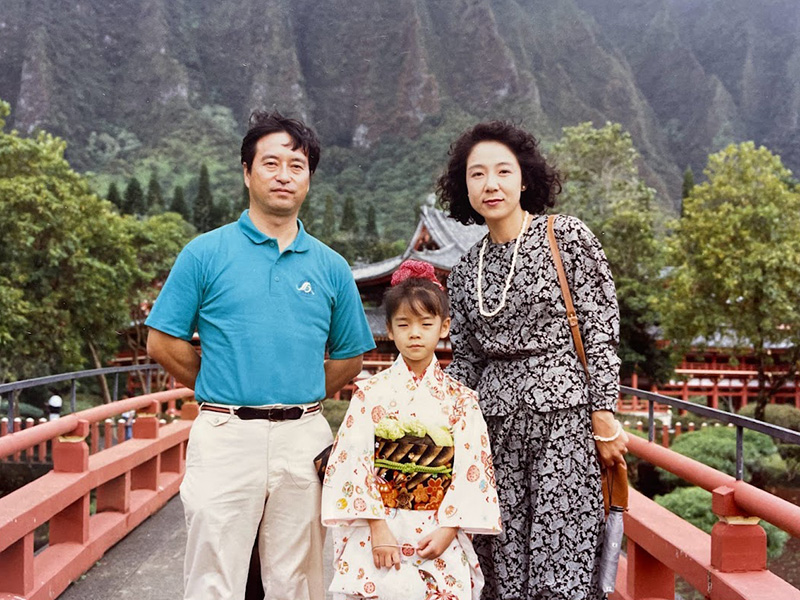
I was born outside of Seattle to Japanese parents. My father was working for a Japanese construction company on an urban planning project outside of Seattle. And I’m super grateful to my mom, because she had the option of giving birth to me in Japan, but she decided to stay in the U.S. to give me U.S. citizenship. It’s all thanks to her that I’m now able to live and work in the U.S. and have more options in terms of where I want to be based.
When I was eight months old, my father was transferred to Hawaii. It’s the same construction company, but they were working on a hotel on the island of Kauai, which had just been destroyed by Hurricane Iwa. My parents and I moved to Honolulu. We were initially supposed to stay like 3-4 years or however long it took to get the hotel up and running, but we stayed nine years, which is very long and unusual.
I had a blast. That was the happiest time of my life. I went to a public elementary school, preschool, kindergarten, and all that. In third grade in elementary school, I was able to meet a wonderful teacher who taught me the joy of writing. She’s a poet herself. Since then, one of my biggest dreams has been to be a writer. So that was a really important period of my life.
In terms of Japanese language education, aside from speaking Japanese at home, I also went to a Japanese language school on Saturdays. They only had teachers for Japanese language and math. So for social science and the regular sciences, I took correspondence courses. This was pre-internet. I would receive a packet in the mail, handwrite all the assignments, and mail the packet out. It was very analog, but a fun way to keep up with Japanese. My parents also got me books in both languages.
I also got to visit my grandparents. What was cool is that my father’s parents lived in Sapporo, which is in the northern part of Japan, and my mother’s parents lived in Kagoshima, which is in the southern part of Japan. So every time we went to Japan, which was maybe once every 3-4 years, I got to visit the north and the south, which have very different cultures and climates. I really enjoyed that.
And Hawaii is culturally, geographically, and demographically in between the U.S. and Asia. The population is half Asian, and there are a lot of Japanese expat families like us, as well as Japanese Americans, and a whole bunch of other ancestries like Korean Americans, Chinese Americans, Native Hawaiians, and people of European descent. Many people have like five or six different ancestries and they would have multiple middle names, each with a different language that represents those cultures.
Growing up in that environment really shaped who I am. I really appreciate and love diversity and I love learning about different cultures and customs and languages. So I feel really lucky to have that childhood.
A Familiar but Foreign Country
When I was nine, my father was suddenly called back to Japan.
This was a huge shock for me, because until then, Japan was still a foreign country. It was a familiar country—the homeland of my parents and where my grandparents lived. But it wasn’t my own country in terms of identity. My parents decided to enroll me in a public elementary school rather than an international or American school. And there was a big difference in culture between the U.S. and Japan.
In Japanese, there’s a word called kikokushijo, which refers to Japanese children who came back to Japan after spending some time abroad. That’s what I was called. But I was uncomfortable with the word, because kikoku means returning to your home country, and Japan was not my home country. So I felt a bit boxed into a category that I didn’t quite belong to.
This was the beginning of my identity crisis and a lifelong pursuit of trying to figure out who I am. I looked Japanese and spoke Japanese like a native speaker, but I was American inside. So every time I spoke, the content of what I was saying was pretty American.
Challenges in Elementary School
In the beginning, things were fine. People were curious about me. A lot of my classmates had Sanrio stationary with random English phrases (or Japanese phrases in rōmaji [Japanese written in alphabets]) written on it, and they would say, “Can you read this? What does it mean?”
But around the time I was in fifth grade, I began to lose friends. I didn’t know why. It was shocking because I thought I was getting along with my classmates, and suddenly they stopped speaking to me or just ignored me. Towards the end of fifth grade and sixth grade, it got a lot worse, and I was bullied.
It would be minor things like being kicked from behind when I’m walking or sitting, or having my belongings hidden. But the most painful thing was to be told that I had germs. Some of the boys would play tag by passing along these germs if they accidentally touched me.
But the girls were more hurtful because they were actually grossed out. I remember being paired up with a girl during gym class. She was furious because she really didn’t want to touch me, but we had to physically support each other during gym class. Every time she touched me, she would say, “Ew!” And then she would actually wipe her hands on the gym floor, which is crazy because obviously the gym floor has like millions more actual germs.
Those are moments that are hard to forget, because they make you feel like you’re actually dirty inside and out. Anyway, I don’t want to make this episode too dark, but that year and a half until I graduated elementary school was a really hard time to go through.
However, I did have some friends who would treat me in a friendly manner and be kind enough to invite me to hang out after class. And so I asked them, “Why do you think they dislike me so much?” And I found that it was because I had been talking about cultural differences.
Back in Hawaii, it was so diverse that we gave “Show and tell” presentations about our different ancestries, like what we did at home that was different from other homes, etc. So when I moved to Japan, I thought it would be interesting to point out things that were different from where I grew up.
School life is so different. For example, you have to change your shoes so many times. You have to change your shoes once you arrive. You have to change your shoes for gym class. And you also have to serve lunch and clean the classroom yourself. These are really great things. But I’d ask, “Why do we have to clean the classroom? Don’t you have janitors?” It was just an innocent question, but it sounded really offensive. I didn’t mean to be looking down on anybody. Apparently, every time I said, “In Hawaii, we did this. In the U.S., we did this,” it sounded like bragging.
I also found out that in Japan, at least at that time, students didn’t really raise their hands during class. And I didn’t know that. So I kept raising my hand. It’s not that I had really astute insights, and I would raise my hand for really stupid things. So I think people thought that I was a bossy know-it-all.
But by the time I found out the reason this was happening, it was way too late. There was nothing I could do. I guess I had the option of transferring schools. But I’m a very stubborn person. And I felt that transferring schools would be like admitting defeat. I understood why this was happening, but it didn’t feel rational. I didn’t feel like I had to be the one to transfer schools. So I decided to just count the days quietly until I would graduate school. I just dug in my heels.
I also didn’t want to tell my parents. I really respect my parents. I love them [as family,] but aside from that, I think they’re wise, upright people with a strong sense of justice. And I was just so ashamed that this was happening. I’m an only child, and I felt like they were really unlucky to be stuck with someone like me. I didn’t want to disappoint them. I felt that their love for me was because I happened to be born in the household, and not because I personally deserved it.
So every recess, I just spent time reading in the library. I became known as the quiet, nerdy kid who rarely spoke.
As a side note, my parents did eventually find out. And I think it was even more devastating to them that I didn’t tell them, because it seemed like I didn’t trust them. But that was not the case. I was just ashamed and I blamed myself.
So that was the darkest period of my life. And there were two lasting impacts from this.
First, it left a strong impression on me that Japan often doesn’t welcome those who are different. I learned later on that that’s not always the case. But because this was my first experience living in Japan, this really shaped my perception.
Second, it took a huge toll on my self-esteem. Although it’s been decades, I’m still struggling with personal relationships. I’m still working on trying to be better at it.
Happier Days in Middle School
I graduated elementary school, and was much happier in middle school.
This middle school was created by Kumon, an after school self-learning program. (I know it also has branches in the U.S., which is really exciting.) This school was so new that I was part of the second class ever. And I’d fallen in love with the campus.
What I also loved is that this school has a really international focus, and because it’s a boarding school, the students come from all over, including some whose parents are living abroad. And I’ve made some lifelong friends and I’m so grateful for that.
During this time, one of my homeroom teachers did this fun assignment, where he created a table with our names in each of the cells. And then he printed and distributed the table to all of us. He told us to write down what we think of each of our classmates. (Good things only, of course.) Once that was done, he collected all the sheets and cut out each cell. So every student got a collection of these little pieces of paper that said what our classmates think of us.
And when I received mine, the vast majority said, “Shiori Okazaki is good at English.” And that’s a great thing. But I was a little bit sad, because my English language skills were thanks to the fact that I spent the first nine years of my life in the U.S. It didn’t have to be me [and others could have received the same compliment]. It wasn’t an observation that was really about me personally. So I started to think, “If my English skills were taken away, what will remain? What else can I do? What else do I have?” That’s a question that got stuck in my head.
Also during this time, my father was called back to Hawaii because it just so happened that another hurricane, Hurricane Iniki, completely destroyed the same hotel on Kauai. So he had to [move back to Honolulu to] rebuild it. And because I was staying in the dorms at that time, it didn’t affect my day-to-day life, but now I was going back to Hawaii to visit my parents during long breaks.
During one of the long breaks, I was trying to fly back home to Hawaii. And I ended up going to the airport having forgotten my passport. I called my dorm, and they were kind enough to [look for my passport and hand it to] an upperclassman, and send him my way. This upperclassman was asked to do this because his parents were in Brazil and he was used to going to Narita Airport, which is the airport right outside of Tokyo. He kindly came all the way there, which was about two hours out. He gave me my passport, and I was able to get on the flight.
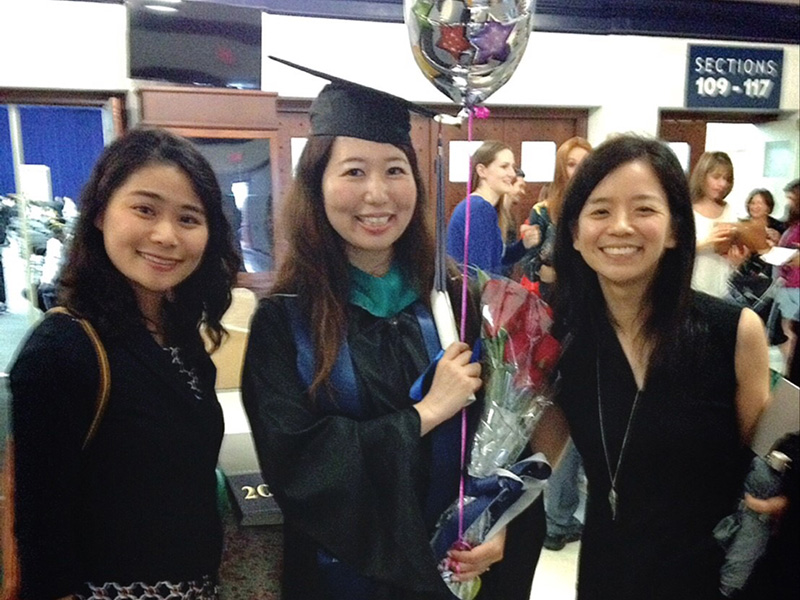
I inconvenienced so many people, and it was so embarrassing. But once I was safely home in Hawaii, my mother just said offhand, “My gosh, it’d be so much easier if you just went to school here.” This made me think about the question I was talking about earlier: aside from English language skills, what do I have? So I thought that maybe I could go to high school in Hawaii, challenge myself, and see what happens once I go to a place where speaking English is the norm. So that led to my decision to move to Hawaii and join my parents once I graduated middle school.
Bullying as a Phenomenon
As a side note, I wanted to mention something that’s really important to me. While I was in middle school, I was reading an in-flight magazine at home in Tokyo. And I came across this feature about how some kikushijo were bullied. That was eye-opening because I didn’t know that that was a thing. I didn’t know that there was a phenomenon where more kids who had lived abroad like me were being bullied once they moved back to Japan.
I had a myriad of emotions. First, I felt a huge sense of relief that I was not the only one. And second, I felt anger at the injustice that this was happening to a whole bunch of kids. Because we have so many assets that we can bring to the table, and yet, a lot of us were struggling and having such a difficult time fitting in. So that really was a watershed moment for me, looking back.
Academic Challenges
My second time in Honolulu was vastly different from the first time. I transferred to a private school that’s known for its rigorous academic program. And my English speaking and writing skills were very rusty. I had been taking English language classes in middle school and going to after school programs [in elementary school], but I wasn’t speaking in English on a daily basis. And my vocabulary has stopped at the third-grade level, whereas everybody else was gearing up for college, studying for the SATs.
The hardest part was participating in class. In Japan, the custom was to just listen to the teacher, and a lot of the kids weren’t raising their hands, especially in elementary school. So I had gotten used to that. But in the U.S., participation was part of the grade.
I was so nervous that I would stutter and stammer and I couldn’t really get the words out. And so I would write all the questions ahead of time on pieces of paper, but because that would take a while, by the time I would raise my hand, the topic would move on. So things were really awkward.
During this time, I was lucky enough to meet a wonderful teacher in English Literature. And he really taught me how to write essays. I had to start from scratch, like: “What is a thesis? What is a topic sentence? How do you do citations?” He also understood my personality as an introvert. I could consult him about personal things, like, “I feel so awkward speaking during class; what should I do?” So I feel really lucky [that I was able to have his support].
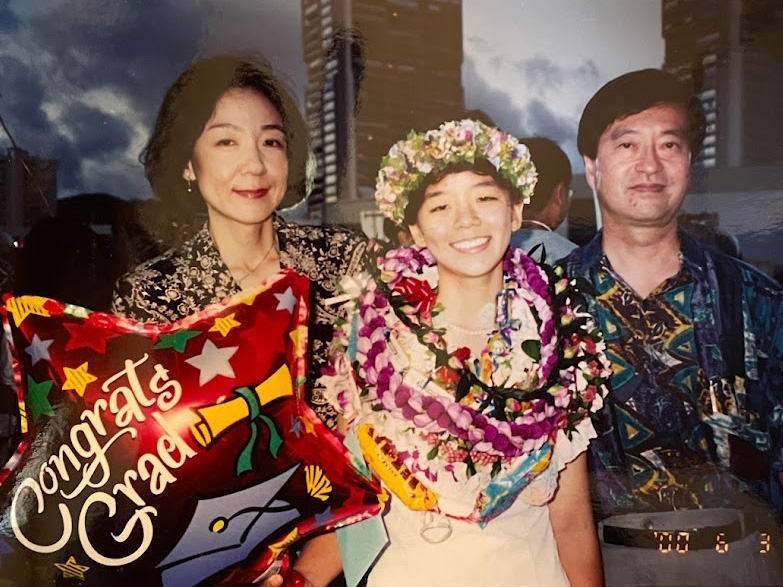
So academically, I did struggle, but I also had this strong sense that I had chosen this path and couldn’t go back. I had been the one that said that I wanted to study in the U.S., and so I had to stick through it. So I was able to graduate high school, and I’m really grateful now for the academic rigor that we went through.
College and Beginning of Communications Career
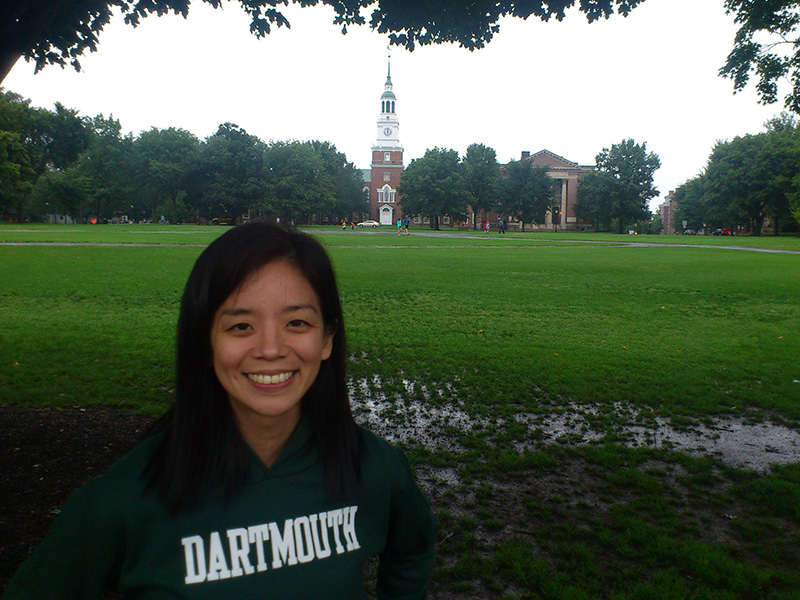
For college, I really wanted a change of scene, and decided to go to Dartmouth College in New Hampshire.
Unlike many other people, I didn’t tour the school before going there. I guess it started with a surface-level love for the school. Dr. Seuss [Theodor Geisel] is an alum. In high school, we would receive a lot of promotional packets from different colleges [to encourage us to apply]. And Dartmouth’s promotional packet was so cute. It was Dr. Seuss-themed, and it was really colorful, whimsical, and joyful. And I was like, “My gosh, this is it. I really want to go there.” And I’d never been to New England, but I loved the European feel, the brick buildings, the ivy. I had this image of students surrounding the professor around a fireplace and talking about books.
I really loved it because it was exactly as I had imagined. At that time, though, I had this mistaken feeling that in order to succeed in the U.S., I needed to build some distance from Japan. Even though I had a wonderful time in middle school, back then, my image of Japan had now solidified as my time in elementary school, as something that was painful and not really diverse or welcoming. But when you dislike part of your identity, it’s really painful. And so I still felt lonely and unable to fit in 100%. I was more comfortable having conversations in English, so compared to high school, it was better in that sense, but I felt like I was still a little bit of an outsider.
I didn’t quite know at that time what I wanted to do for my career. But I loved reading and writing, so I majored in English Literature.
I was interested in journalism because I had this notion that you get to write but also travel around the world. So I applied for some journalism internships but didn’t quite get in. But I did get an internship with Dartmouth at the Office of Public Relations. This was a newswriting internship, so it was very close to journalism. I got to interview fellow classmates and other students about what they were studying and their various accomplishments. So that was really fun.
I graduated from college and didn’t quite know what I wanted to do. I was applying to all these journalism jobs, but because I didn’t have any internship experience, I wasn’t getting in at all. I graduated without a job, and my parents were super worried, but I asked them, “Could I please just stay in Hanover, New Hampshire (my college town) for a couple months and see what happens?” And they let me.
Reexamining Japan
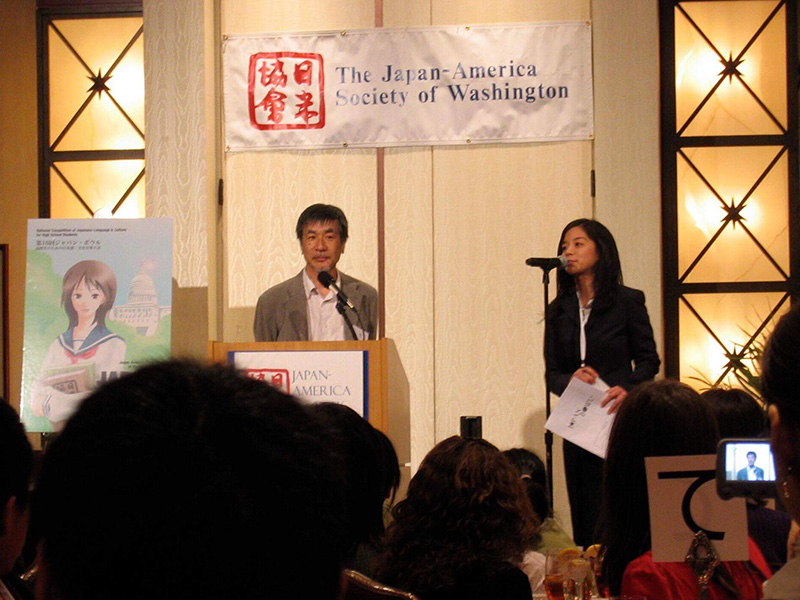
I was lucky enough to get a job at the Embassy of Japan in the U.S. It was one of the very first jobs that I got. Again, this was after I felt like I had to distance myself from Japan. [Applying to the Embassy] was like a last-ditch effort. But this turned out to be a dream job, because I would be working with the Embassy newsletter. So I got to keep the communications and writing part of the job that I wanted to do, but it was also about promoting Japan in the U.S., which, as it turns out, I loved doing.
I worked there for four years, and gradually learned more about the wonderful aspects of Japan that I’d forgotten about. This was the information and culture center of the Embassy, and we had a lot of artists coming in. And I got to see all these exhibits and meet artists, including those I had known about even before working at the embassy. These were artists that you wouldn’t normally get to meet if you were just living and working in a different job, even in Japan. So I felt really lucky.
Some of the artists would come and give lectures on stage. And one of my bosses told me, “Why don’t you just go up stage and interpret?” So that was my debut [in interpreting]; it was baptism by fire to stand on stage next to the artist and try to interpret. But I really loved it. I loved being able to help communicate between American and Japanese citizens, especially talking about arts and culture. So that was something that left a strong impression on me. I felt that this is something that I love to do and maybe want to pursue.
Journalism vs. Communications
After working for four years at the Embassy of Japan in Washington, DC, I wanted to go to grad school. In DC, so many people have master’s degrees in various areas. I was also inspired by a colleague who wanted to work in international organizations. I was passionate about U.S.-Japan relations, but I also became interested in multilateral relations—I wondered, “What happens when you think about other countries as well?”
Looking at the job descriptions [of positions at international organizations], they always required master’s degrees. Some jobs in communications required journalism or communication degrees, and other jobs would say a degree in international relations was needed. So I thought, “Why not both”? And Columbia University happens to offer a dual-degree program where you can get both a master’s in international affairs and a master’s in journalism in two years. So I decided to apply there. It was the only school that I applied to, but thankfully I got in. So I decided to pursue that.
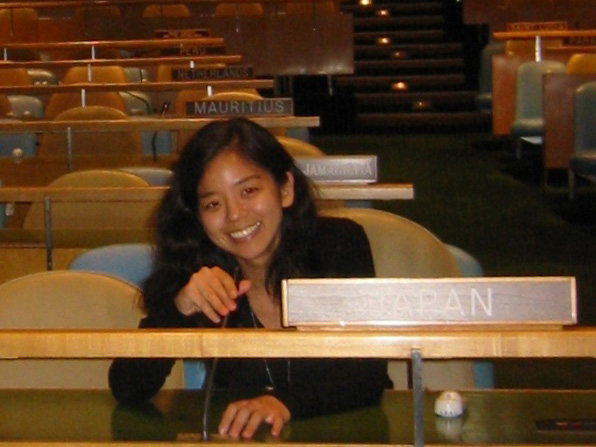
I was lucky enough to get internships at international organizations at the United Nations Development Program (UNDP) in Pristina, Kosovo, and the UN headquarters in New York. And I had a wonderful time.
But I really struggled with my identity and my career prospects. When I was in journalism school, I enjoyed the day-to-day assignments. We’d be sitting in front of a computer and pretend we’re writing this wire service, being told to report about this helicopter crash that just happened. Or we’d think about how a newspaper is laid out online, like where to put the article that you want to feature the most prominently.
But there was this Journalism 101 class where we were all tasked to go out into the streets and interview people. These were man-on-the-street type interviews. And it was really difficult for me as an introvert. Luckily, I ultimately found people who were kind enough to respond to my questions, but it was just a lonely experience standing in the streets, approaching people one by one and being ignored or being scoffed at. I thought, “I’m not sure if journalism is the path for me.” So I started to focus more on communications for international organizations, which is why I did those internships with UN organizations.
After I graduated, I applied to all these UN organizations. But I found that I didn’t have enough field experience, which really means being in developing countries and knowing the culture, language, and the needs of the local people. I was lucky enough to obtain the internship in Kosovo, thanks to the wonderful people who kindly gave me that opportunity. But it was for a month and quite short. And Pristina is one of the most developed areas in terms of the various posts.
I also didn’t have an expertise in development, like water, sanitation, or education. I was more of an expert on U.S.-Japan bicultural communications. So I really struggled with jobs. I think I was jobless for about three months.
Media Relations in the UK
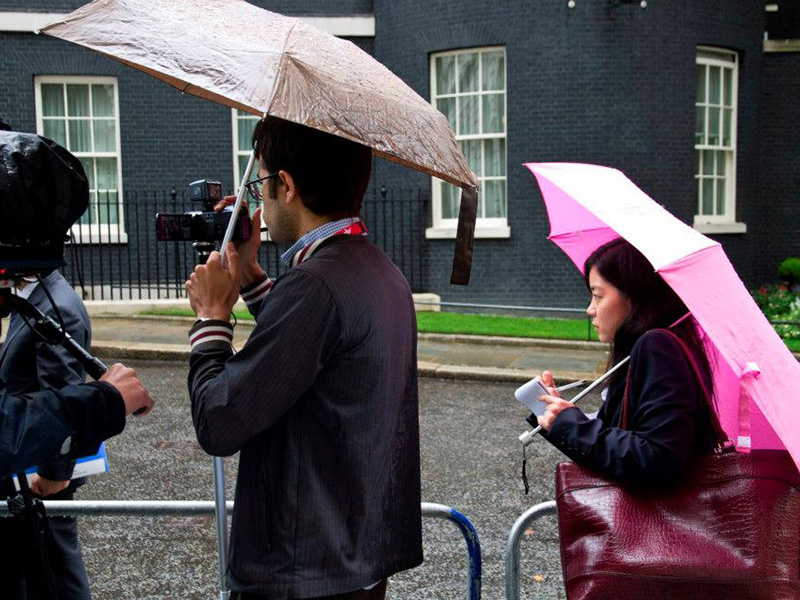
But at the very last minute, I got a job at the Embassy of Japan in the United Kingdom. This was another last-ditch effort because I was trying to distance myself from Japan. But again, it was a Japan-related opportunity that turned out to be good for me. I worked as a press attaché there for two years. It was a timely opportunity because I had just graduated from journalism school.
So I liaised with many different media outlets in London, and it was really nice because most of the major television networks as well as newspapers from Japan had a bureau there. And of course, all the prominent British media like The Guardian, BBC, and The Daily Telegraph are also based there. So I got to work with them as well and I learned so much.
But I also missed the U.S. Before living in the UK, I thought it would be similar to the U.S., but it’s not at all. It’s a very different culture. And because it was such a busy job, I was just basically commuting between my home and the embassy. I thought, “For my next job, I’m definitely going to move back.”
The London job was a two-year contract opportunity. So once the two-year term was up, I was jobless. But I was so determined to be back in the U.S. that I moved to New York without having any prospects. And I just kept applying to jobs, living in a temporary arrangement with other roommates.
Working Among Japanese Americans
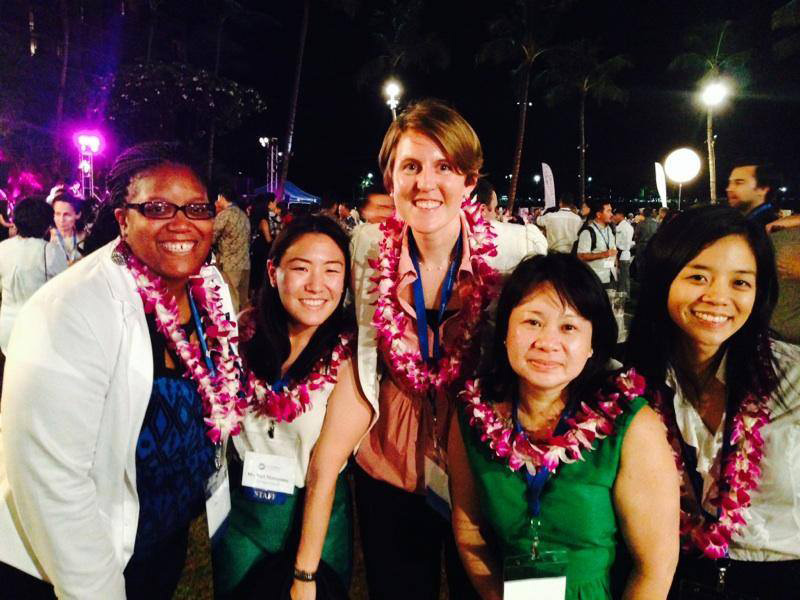
One of the first jobs that I got was with the U.S.-Japan Council (USJC). I am so grateful that I got this opportunity, because this is an organization founded by Japanese Americans. In that sense, it was really right up my alley. Among all the different workplaces that I had, this was where I felt the most comfortable because I was surrounded by people who were like me.
I worked in communications, starting as the manager there, and then I was promoted to director. It really helped me learn about the Japanese American community, and I was able to build such a great network thanks to this workplace.
Having said that, after being promoted to director, because I was now mid-level management, there were so many strategic meetings that we needed to attend. And I felt that I really missed getting into the nitty gritty and writing, like speechwriting and drafting press releases. Writing was what led me to a career in communications. And I didn’t get to do much of that at all. In terms of working in communications for an organization, I felt like I had gone as high up as I could, and that maybe I needed to branch out into different opportunities.
That’s when I turned to interpretation. I had always loved interpretation ever since I had encountered it at the Embassy of Japan in Washington. And I got to do it a lot when I was working at the U.S.-Japan Council, even though my full-time job was in communications.
Aside from that, I was also on a roster [of interpreters registered] with the U.S. State Department. I was using my vacation time [at USJC] to gradually gain interpreting experience. Through the State Department, I had the opportunity to travel around the U.S. for 2-3 weeks at a time, accompanying delegates coming from Japan on different themes like clean energy or women’s leadership.
Becoming Independent
After a while, I told my boss at USJC, “I’d like to leave in about half a year.” And at the end of 2019, I left and became a full-time interpreter.
It turned out to be terrible timing because COVID started like two or three months later. I did have interpretation gigs lined up before I quit, but those were quickly canceled one after the other, because interpretation at that time was mostly in-person.
But luckily enough, online interpretation became more major. Now that I think about it, it turned out that there were a lot of positives with this difficult timing. Online interpretation was new for almost everybody. So, not in terms of interpretation skills, but in terms of online interpretation, I was almost on par with everybody else and really got to learn alongside everybody.
And the DC interpreter community was kind enough to let me in. We had monthly meetings about how to deal with specific online interpretation tools and had discussions on what to do when there’s a power outage while you’re interpreting online—like how do you get back on and how do you build redundancy? So I’m really grateful for the network that I had.
The other thing is, while I was out of jobs before online interpretation became a thing, I was really struggling for a couple months. So many people supported me then, including members and former colleagues at USJC, former colleagues at the Embassy of Japan in Washington, and other friends and acquaintances. It’s really thanks to them that I was able to survive COVID.
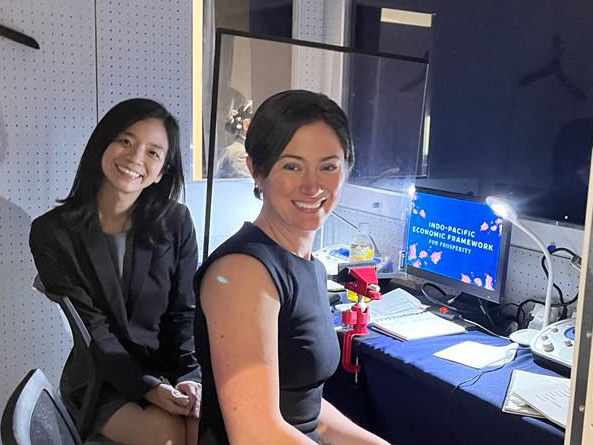
At the end of 2020, I decided to establish a company called Shiori Communications, LLC. And my goal really is to connect the U.S. and Japan through words. It’s primarily interpreting for now, but I want to expand beyond that. In recent years, I’ve been doing a lot more writing. I have a column with a DC-based Japanese community paper called Sakura Shimbun. I am trying to blog when I can. I’m podcasting with CrossWorld Puzzles. And recently I’ve been working with a podcast hosted by the Japanese broadcasting company TBS. I am really grateful to have these opportunities.
Pursuing Multiple Careers
I feel like a career is something that is not set for life. I used to think you only have one career, especially as a child. So many people ask you, “What do want to be when you grow up?” And you give one-word answers like “astronaut” or “firefighter.” Now I know that it can be many different things.
It can also be different depending on the stage of your life. I think what’s important is that you continue to keep it in mind and continue to pursue it, even if it’s just little by little. I feel lucky that I was able to pursue interpretation even while I was working full time, because that helped me become independent now.
Why I Started CrossWorld Puzzles
I wanted to talk about why I started this podcast. It’s because I’ve stood at a crossroads so many different times. I’ve been jobless so many times because I’ve been struggling with questions like, “How do I pursue happiness? How do I fulfill both my Japanese and American identity?” Because, as I discovered, if I ignore one of those two identities, I’m always going to be unhappy. So I really need to fulfill both. And how do I do that?
I wanted to ask others not just about careers, but also where they want to be based. Right now, I’m happy in DC, but I’m an only child, and I’m worried about my mom in Tokyo. And how do you build a family?
So I really wanted to interview my friends and mentors and so many other people that I look up to. I didn’t begin with the notion of wanting to start a podcast and then think about the topic. It was the other way around. I really want to interview the many amazing people around me. But it’d be a waste if [I’m the only one who gets to hear it] because so many others can be inspired and learn from them as well. So I wanted to make it public and thought, “Why not make it a podcast?”
I also wanted to make this podcast in English. Because even though, especially starting out, most of my friends and people that I’m interviewing are related to Japan in one way or another, I feel like there is so much in common with people who have ties to other countries as well. This includes international marriages, having parents from different countries, raising multilingual children, overcoming discrimination, finding your community, finding our identity, and celebrating diversity overall, especially now that we have so many divisions, political and otherwise, even within the U.S. And so I really want to tackle those issues with other interviewees as well.
I know it is really amateurish in many ways. But I knew that the more I thought about how to make it fancy, the more I would delay it, making excuses to myself like, “I’m not ready.” And so I needed to just suck it up. I feel really lucky that I have had so many wonderful interviewees. And I am really hoping that I will be lucky enough to have more.
Episode Insights and Recommendations
I wanted to talk about each of the episodes briefly and what I learned from them.
Episode 1: “Always Adaptable” with Sayuri Romei
When I considered who I wanted to interview, Sayuri is the person that I thought of first. She is so incredible. First, she speaks four languages at minimum. She grew up speaking Italian, French, and Japanese, and now she’s based in the U.S. and speaks native-level English. She’s an artist, but she’s also a nuclear deterrence expert. And now she works at the German Marshall Fund, connecting Europe, the U.S., and Japan. So in that sense, she found a job that really connects her three different identities.
I’m really grateful to Sayuri for having the courage to be the first interviewee. I didn’t have any archives or past episodes to show, but she was kind enough to trust me and do this. Her positive attitude is so infectious. What was surprising to me is, when I asked her about the struggles she’s had going back and forth between all these different countries and cultures, she said that she hadn’t really struggled.
That was a big surprise because I had based my whole podcast on the premise that we needed to heal. Especially in Japan, people like us are considered lucky. And of course we are. We are so lucky to have the opportunity to grow up in different cultures and countries. At the same time, we don’t really have the opportunity to talk about the downside of things, even though sometimes it’s hard to form our own identities, find a career, and find a place we want to be based in. And so, I was thinking, “This podcast is going to be all about healing.” And then, bam! In the very first episode, she says that she didn’t struggle much. It was so wonderful to hear that there are people who are positive and strong enough to think about things in a completely different way.
She also said that identity is something that can change. Of course, I should have known that; [now that I think about it] my identity has also changed. But in my mind, I’d thought that there’s only one true self, and that finding that is a lifelong journey that we all need to struggle with. When she said that your identity can change, I felt such a big sense of relief. Now I feel more comfortable with who I am now, because identity is not this solid thing, and you can be comfortable with change in the past and in the future.
Episode 2: “Embracing Our Own Differences” with Grace Kim
Grace grew up in Korea and Japan and the U.S. She now runs an event planning company. I really wanted to interview her because it’s so fascinating to have an identity with ties to three different countries.
Because she grew up mostly in Japan, she’s more comfortable speaking Japanese than Korean. Her older sister also lived in Korea, Japan and the US, but she’s more comfortable speaking Korean than Japanese. And so it really made me think that It’s not just the circumstance of which country you are in. Age, personality, and experience also shape your identity. This was super fascinating.
Grace is a lot younger than me. And so I’m so grateful to her for being open and talking about the business that she had just launched as well as some things that are still a work in progress. She is so inspiring, and I’m always learning from her.
Episode 3: “A Privilege and a Power” with Mari Kuraishi
I was so honored to be able to talk to Mari, who grew up in Japan, Italy, and West Germany. She’s now based in the U.S. as the President of the Jesse Ball DuPont Fund, but she’s also the co-founder of GlobalGiving, which is one of the premier online giving platforms.
She is such a wonderful entrepreneur that I learned so much about the confidence to found your own organization. She left a prestigious job at the World Bank and decided to pursue her own interests by founding GlobalGiving. She expanded that for close to 20 years. But she decided to leave for the good of the organization because she wanted to make sure that the organization was able to stand on its own.
I think it takes a different kind of courage to have this wonderful project—which you gave birth to and nurtured with all your time and energy—and pass it on to the next generation. So that’s something that I learned from her.
She also talked about how she’s an introvert and how she built her own leadership style from there. So if there’s anyone who’s an introvert and unsure about founding your organization, Episode 3 is the one that I recommend listening to.
Episode 4: “Culture as a Foothold” with Robert Holloway
Robert is a Korean language interpreter. His mother was adopted from South Korea. Robert did not grow up speaking Korean and learned it afterwards because he was fascinated by his family history—and he became so good that he’s now a simultaneous interpreter!
Listening to him is like watching a documentary. I learned so much. And I have so much respect for him as someone who’s so in touch with his own family history and has done the research. So I highly recommend his episode in terms of just learning about [Korean adoptees]. It’s almost like an academic episode.
It’s also heartbreaking. I didn’t know how many of the Korean adoptees struggle with language. They learn Korean because they really want to connect with their country of ancestry or where they were born. But when they struggle with that, it becomes intertwined with identity. That was such an eye-opening thing for me to hear about.
Robert also talked about culture as this foothold for figuring out your identity, which is really helpful for those of us who have immigrant parents or who think about our family history.
Robert himself is also a role model for me in the sense that he’s an interpreter, but also has expanded his career beyond that. He built this community called Speak with Seoul, where he teaches the Korean language to Korean adoptees and they talk about identity.
We also talked about how to build confidence and speak in a natural way without using filler words like “um”—which I am today, but hopefully, I will be better!
Episode 5: “Finding Joy in the Struggle” with Yuko Watanabe
This was a hilarious episode! Yuko is such a wonderful, engaging, and funny speaker with an amazing sense of humor. If any of you feel sad or want a pick-me-up, Episode 5 is hands down the one that recommend.
Aside from being a community builder, Yuko’s completely okay with plans changing. And listening to her career, I’m very sure that that’s not how she originally started because she’s so accomplished. After coming to the U.S. for the first time for college, she had a wonderful career working at the Gates Foundation, went to Harvard for grad school, etc. She decided to pick up yoga, I think during COVID, and is now a yoga instructor. Whatever she does, she’s amazing at it. You have to be a meticulous planner to do all of that.
Despite all of that, she is now comfortable with plans changing. She’s so laid back. We talked about how we both have family back in Japan and thinking about how to go back and forth, making sure our parents are okay and things like that. She says she’s still figuring it out and that she’s okay with that. She’s okay with taking it day by day, year by year. And so that was super inspiring and comforting for me.
Episode 6: “Hometowns Everywhere” with Yuri Akahira
Yuri is a friend I’ve known for a long time, about 20 years now. She’s one of the friendliest people I know. She seems super confident.
So it was really surprising to me when, maybe 15 years ago, she told me for the first time that she was bullied back in school. She was even featured in magazine articles talking about it.
The fact that she opened up about this made me comfortable talking about my own experience being bullied. I was hiding it until then. I was ashamed of it. I thought people would judge me or think less of me, and say, “No wonder she was bullied. It’s because she’s so weird.” But here was this amazingly accomplished, confident, beautiful, smart lady—and even someone like her had an experience like that. That was so eye-opening for me. And I’m really grateful for that.
During this episode, we talked about how to recover from that experience. If there are any listeners who are being bullied or trying to digest an experience like that—and I hope there are very few of you—please listen to Episode 6, because it is super powerful.
She also shared tips on how to make friends from people all over the world. That was really helpful as well.
Episode 7: “The Bottom Line is Respect” with David Caprara
David is a multimedia journalist based in Japan. He lives in a rural area in Nara Prefecture. And he’s doing so many interesting things that I absolutely wanted to interview him as an American expat in Japan.
It’s incredible that he only started learning Japanese once he started the JET program, which was prior to his journalism career. Now he’s freelancing for American media outlets.
One of his passion projects is researching a B-29 crash during World War II that just happened to be at a mountain really close to where he’s living. So he’s been talking [on media] about what happened to the American soldiers who crashed, as well as the hospitality and kindness of the locals who helped the American soldiers before they were unfortunately sent to [a POW camp] and ultimately killed. But it’s been a really touching story to follow because David has become like a goodwill ambassador of this project, even bringing in family members of the deceased American soldiers to Nara Prefecture. It’s been a wonderful journey learning more about that.
David is definitely part of the community [in Nara]. There are all these festivals and events that even people in Japan, if they’re in an urban area, are probably not too familiar with. But he participates in them, records them, and then shares that with us [on social media]. It’s wonderful to see.
He said that it’s really important to have respect for other cultures. And that’s the foundation of his work in journalism, as he talks to people from different countries. I loved learning about [his experience interviewing people around the world].
Episode 8: “Building Empathy Through Nuance” with Natalia Quintana-Feliciano
Natalia is Puerto Rican and Colombian, and I met her through a writing group in the DC area.
This was a really fascinating and deep discussion because Natalia is a journalist, but also a creative writer and poet. I don’t know that many people who straddle the line between those two fields. And so getting to talk about both aspects was really cool.
I also learned a lot about the many commonalities between Puerto Rico and Hawaii. Both are parts of the U.S., but with a very different identity, history, and language. And so we talked about the many different layers of American identities, and how to deal with what’s going on politically.
We also talked about how anger is a reminder that you deserve better. We talked about the phenomenon of the “vengeful woman” in creative writing: a woman who’s completely wronged by others and has to face injustice, but is able to take revenge by various means. I thought that was a really powerful way to think about things now that there’s so much injustice going on, especially in the United States. I think anger is a great way to channel our thoughts and find ways to take action.
Episode 9: “Beauty Not Loudly Told” with Mari Yobp
Mari is an artist and poet raised in Japan, and I always enjoy talking with her. Among the 12 interviewees that I’ve had so far, she’s the person who’s known me the longest. Maybe she’d be the longest ever, even considering future episodes, because we’ve known each other since middle school—something like 30 years!
We became such good friends because we’re both interested in writing and art. It’s really cool to see how we’ve both evolved and changed over the years. And she’s one of the friends who [I met in Japan but] is now based in the U.S. It’s nice to see that as well.
We talked about the challenge of international marriages and raising multicultural children. This includes having to contend with some medical issues for her children, which is really difficult in a foreign language.
But she’s so strong. She’s always been a quiet and calm person, but she has such a quiet strength. And she’s also very a positive person who’s able to see beauty in everything, especially nature. So I’m always inspired by her.
Episode 10: “Towards Perfect Effort” with Lefteris Kafatos
Lefteris is a Japanese language interpreter, and he has had an amazing career as a diplomatic interpreter interpreting for President Trump, Prime Minister Abe, and others.
Now he’s expanded his career with a project called The Japan Lens, where he analyzes the U.S.-Japan alliance and Japanese politics and all these other things. What’s amazing is that he’s able to do this analysis in both Japanese and English, interviewing people and writing articles in both languages. So he’s another role model for me in that he has multiple careers.
He was also kind enough to open up to me about his Greek heritage and how he thinks about that [and the Greek language] in addition to his work in the Japanese language.
We also talked about “perfect effort,” which I think is such a wonderful phrase. It’s mostly about simultaneous interpretation, about doing the best that you can at that moment. I think it’s such a great metaphor for life in general, as we think about our own careers and such.
Episode 11: “Leading Step by Step” with Kazuyo Kato
Kazuyo is a great friend of mine, also based in DC. Among the 12 interviewees, in terms of childhood and upbringing, and the struggles of going back and forth between the U.S. and Japan, she’s the most similar to me.
We talked about the struggles of learning languages and fitting in, etc. If you’re studying abroad in a different country and having trouble making friends, I encourage you to listen to Episode 11 because it is highly inspiring. This is true especially considering how, [after that experience in school] Kazuyo has become the leader of a nonprofit organization here in DC. I can only imagine how difficult her job is, especially now with the changing [political] climate towards people-to-people exchange, all the funding cuts, etc. She is such a strong, wonderful, and wise person, and I really look up to her.
She also talks about what she learned about leadership from great people like Richard Armitage. So to anyone who’s interested in leadership, please do listen to this episode.
Episode 12: “Cultivating Our Humanity” with John Onoda
John is a principal at IQ360, which is a communications and consulting firm. It was a huge honor to talk to John, because he’s one of the wisest people I’ve known.
I got to meet him through my communications job at the U.S.-Japan Council. So I always thought of him as this Japanese American leader [and assumed he grew up in a Japanese American community], and I was really surprised to learn that his family was the only Asian people in the town where he grew up in Indiana.
And it was really fascinating to learn how that identity later played a role in his communications career, being in corporate America and surrounded by Caucasian Americans.
He is so insightful when talking about what might happen in the future. We might be overtaken by AI, but even if that’s the case, values like empathy, loyalty, and integrity are what make us human, and what would help us thrive in our individual careers as well as humanity as a whole. I think that was a wonderful lesson that I learned.
This is an episode that is inspiring if you are interested in communications, but it’s also a little bit philosophical and academic too, if you want to think about humanity in general.
He also talked about “finding your tribe,” which is a great expression. And your tribe may not be where you’re born or where you grew up. I think that’s so important. Because I grew up going back and forth, I wondered, “Which one of the two countries can I find my home in?” I was really narrow minded in that sense. But some people may not grow up or be born in a culture that they feel super comfortable with. They may find it afterwards. So that was a really great thing to think about.
Overall Observations and Looking Ahead
What I learned overall is that there’s no one answer in how we approach things, and life decisions are very much a combination of circumstances, timing, our own personalities, and even consideration for others like family members. So it’s really hard to say, “This is what I learned. I now know how to make this one specific decision.” I don’t. If anything, I’ve learned that there more choices out there. But it’s helpful to think about how, it’s so diverse and varied that there is no right answer, but there is no wrong answer either.
And identity cannot be defined by anyone but that person. This is something that I have been struggling with logistically, in terms of how to make the episodes easier to access for people looking at the website and seeing the multiple episodes that we have now.
Even with tags, it’s really hard, because who am I to call someone “Japanese American” if they haven’t said so themselves? Even if they have Japanese ancestry and have lived in the U.S., maybe they still consider themselves an immigrant. I also have had friends who say that they don’t want to use the word “Japanese American” because there’s such a strong connotation of having ancestors who were incarcerated during World War II. They feel like they shouldn’t use that word. Some people say “Shin-Issei,” but I personally have not yet warmed up to it. I consider myself like 1.5 generation because I was born in the U.S. but also lived in Japan for a time as well. And so identity is really hard to put a tag on unless they say that themselves. I’ll continue looking for ways to categorize or find ways to make it easier for listeners to find episodes.
Going forward, I want to expand in terms of people who have ties to different countries or different regions. And I’m interested in interviewing maybe multiple people at the same time.
I apologize for this very long episode; I look forward to your feedback if you have any.
Please follow CrossWorld Puzzles on YouTube, Spotify or Apple Podcasts!
That’s it from me. Thank you so much. Bye-bye!