
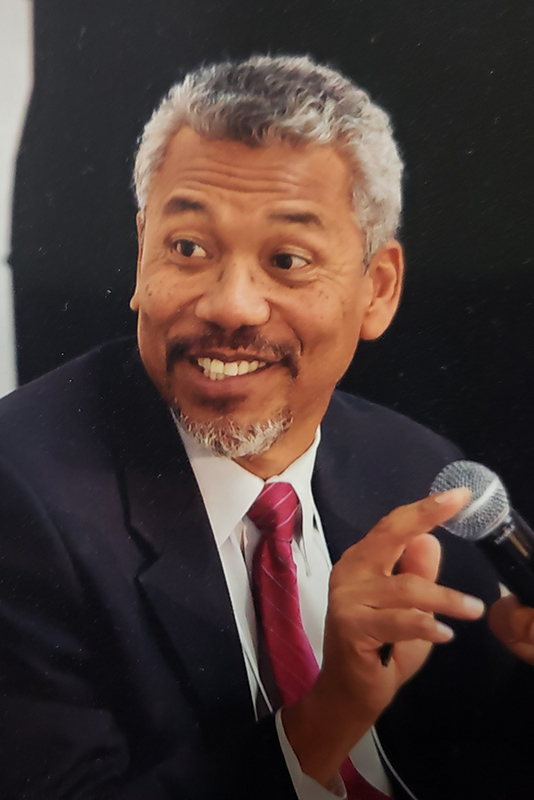
Curtiss Takada Rooks, Ph.D., is a critical race and ethnic studies scholar in Asian and Asian American Studies at Loyola Marymount University (LMU). He previously served at Pomona College as Dean of Residential Life & Associate Dean of Students, Project Coordinator for Community University Enrichment in the schools at UCLA, and as an NCAA assistant football & track coach at Penn State University and Trinity College. Currently, he teaches courses in multiracial identity, contemporary issues in APIA (Asian Pacific Islander American) communities, and systems thinking. He is also a Senior Research Associate in the LMU Psychology Applied Research Center and directs LMU’s Kakehashi TOMODACHI Inouye Scholar Program in international leadership. Dr. Takada Rooks’ scholarship spans transpacific identity; diversity, equity & inclusion; global Nikkei identity; chronic disease, wellness, health disparities; and civic engagement in BIPOC (Black, Indigenous, and People of Color) communities. He has also been called on to speak at numerous public education forums addressing Asian Black Kinship & Solidarity, anti-Blackness, anti-Asian violence and the intersectionality of Black-Japanese mixed identity.
(Click on these icons to follow Curtiss: 

 )
)
Podcast
Transcript
Introduction
Hello, everyone. Welcome to Cross World Puzzles. Today, I’m honored to welcome Dr. Curtiss Takada Rooks, Assistant Professor of Asian and Asian American Studies at Loyola Marymount University (LMU). Curtiss researches mixed race identity and is a highly respected speaker and thought leader. He’s also a beloved professor who’s led multiple student exchange programs between the U.S. and Japan and supported many communities with issues on identity and diversity.
As this podcast focuses on multicultural individuals, I’m especially excited to speak to him about his personal and professional experience as an Asian American and Black individual, as well as his academic perspective on it.
Thank you, Curtiss, for joining me today.
It’s my pleasure to join you. I think what you’re doing is fantastic and really needed in terms of how all of us need to figure out how to walk through the world at this point—particularly in the United States where things are very difficult in terms of feeling divided.
Thank you, Curtiss. That’s something that I’m also struggling with, and I’d love to talk to you about that.
Childhood and Upbringing
Please tell us first where you were born and raised.
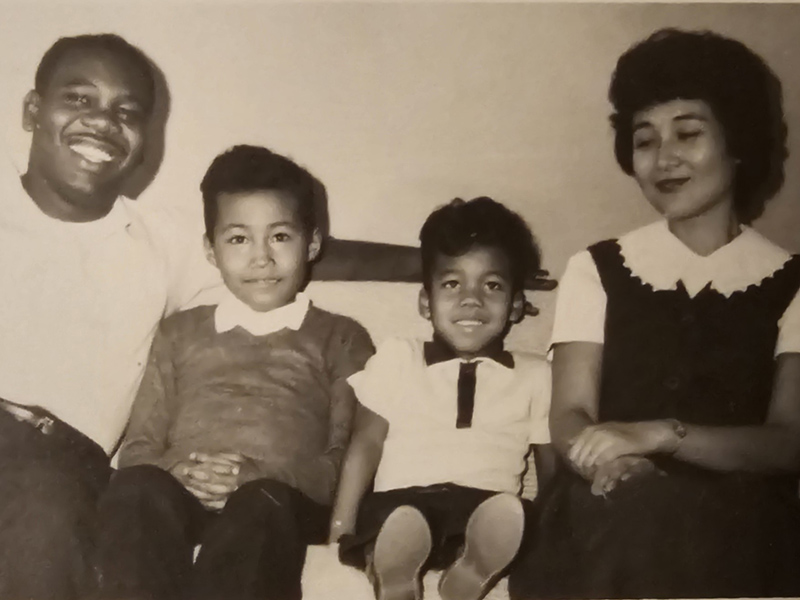
I was born in Camp Zama, Japan, in 1957. When I was a toddler, we moved to Fort Riley, Kansas. From there we moved to Manhattan, which is about 21 miles east of Fort Riley. I started my kindergarten years there.
As a military family, we moved [everywhere]. We lived in Philadelphia, Pennsylvania. We lived in Wilmington, North Carolina when I was in third grade. My father was in Vietnam. My mom had some medical issues and was in the hospital. So we went to live with my paternal grandparents in Wilmington. Then we returned to Kansas once my mom was out of the hospital. Then we got stationed at San Antonio, Texas. From San Antonio, we went to Okinawa. Those were my junior high years.
Then we returned to Fort Riley when I was in the middle of eighth grade. I stayed there through high school. So my erstwhile hometown in the United States is Manhattan, Kansas, because that’s where I started school and that’s where I ended up graduating from high school. It’s also where my mom made an important home for herself among the Black women’s community.
That is fascinating. I was going to ask you where your hometown is, so thank you for explaining that it’s Kansas.
Maintaining Ties to Japan
Did you visit Japan on occasion to see your mother’s family or speak Japanese at home?
We did speak some Japanese at home. My brother, who is three years older, was born in Yokohama. So his predominant language was Japanese.
After the war and during the Occupation period, both governments did not want the [citizens of their countries] to marry. So they really put up roadblocks. Stephen Murphy-Shigematsu talks about this in his book When Half is Whole. During that period, when non-officers were not getting permission to get married, couples would marry in a civil service that was not recognized by either government. Once a child was involved, then suddenly all the bureaucratic red tape would disappear, because it could become an international embarrassment for both countries.
So my brother was born a Japanese citizen, and he is on my mom’s koseki1. Then they got married, and I was born as a U.S. citizen at the U.S. Army Hospital.
When we got to Kansas, we spoke both Japanese and English. One day, when I was in kindergarten, we were doing flashcards. You know how [the teacher is] puts up animals and everybody goes “Cat! Cow!” and all those things? The teacher put up a squirrel.
You can imagine how difficult the word “squirrel” would be for someone who grew up speaking Japanese. It could come out as something like “skuwaaru,” but I couldn’t pronounce it anyway. I wasn’t going to be embarrassed in front of the class. My brother and I made up our own word for squirrels and called them “kun-chan.” There was a squirrel by our house that we used to feed nuts and stuff to during the winter. So [as we were responding to the teacher] we got 24 “squirrels” and one “kun-chan.” The teacher goes, “No, it’s ‘squirrel’; say ‘squirrel’!”
That’s cute!
It may have been cute, but the school then called my parents into the principal’s office. This was in 1962, and they said, “You’re going to hurt your son’s chances of doing well in school if he keeps speaking that foreign language.” So with that, my mom quit speaking [Japanese] as much. Of course, when I got in trouble, I still heard a lot of Japanese!
In that sense [the school] almost made us illiterate in two languages for a little bit. I had a childhood that’s typical of an immigrant family. My father had three tours in Vietnam. So a lot of the time, we were raised by just our mom.
My mom was not confident in her English. If we got sick and needed to have an excuse note, she would ask us to write it, copy it in her own handwriting, and sign it. It’s a story of many immigrant kids who come from bilingual families. My mom spoke “Japanese English” and had studied it in school. That’s how she was working on base at Camp Zama. But she didn’t have confidence in her English, especially with school. So that was part of our upbringing.
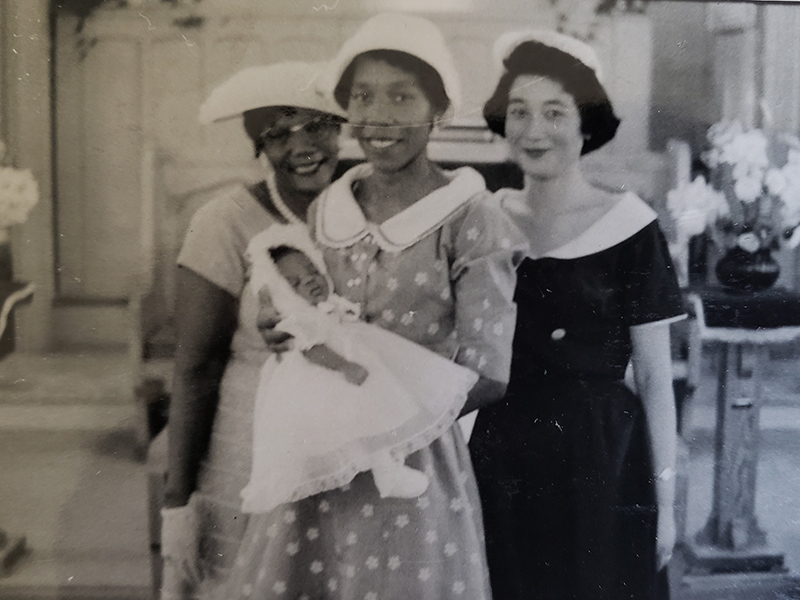
In the 1960s, transpacific phone calls cost an enormous amount of money. There weren’t a lot of commercial airplanes going back and forth. So the experiences that I see of Japanese nationals [in the U.S.] today, where their kids keep their language by going back to Japan in the summers to stay with family and go to school—that was really shut off to us. We just did not have the income for that. And [opportunities to access Japanese] just wasn’t as available. You couldn’t turn on NHK on cable television or stream anime on Prime Video or anything like that, so it pretty much isolated us from the language, and we lost a lot of it. My brother lost it completely.
I see. But I think it’s great how you stay connected to Japan. You’re currently in Yokohama studying Japanese, right? That’s wonderful!
Yes.
At home, we were very much Japanese with Mom. Coming into our home, shoes came off at the door. I remember once when she gave us mashed potatoes, I joked, “What did I do wrong?” Because we had gohan2 at every meal. We had eggs at breakfast and onigiri at lunch. So if we got mashed potatoes, I thought, “Man, I must have done something wrong!”
That’s funny!
Learning about Race
What would you say your identity was growing up? Because you moved around so much, did you constantly have to rethink who you are, vis-à-vis your community?
When you’re a kid, it’s a lot simpler than when you’re an adult, right? We certainly grew up surrounded by the Black community in Manhattan, Kansas, but our school was integrated. My identity probably was more about my family and my big brother. Because when we ended up [moving around], he and I [only had each other].
We got to know my father’s family very well. Our first stop was in Philadelphia, where we lived with my father’s youngest brother and his family for that summer, as my paternal grandparents got ready to receive us down in North Carolina. That was a blast.
Then we got to live with my paternal grandparents in Wilmington, North Carolina. We lived in East Wilmington. This was the 1960s. It was right after the Civil Rights Act had passed, but that really didn’t mean a whole lot in terms of every day on the ground in North Carolina. It was highly segregated. They had taxis that were for Black people and those for white people. A white taxi wouldn’t pick up a Black person. Black taxis knew better than to pick up a white person. In that sense, the schools were still segregated, too.
For me, that turned out to be a benefit in two ways. One was that the teacher that I got had been a friend of my father’s. She recognized that me and another kid, a girl whose name was Deborah, were different. She allowed us to accelerate as fast as we wanted, whether it was in reading, math, or other things. That kept me from getting in trouble, because I think I would have been pretty bored otherwise.
At the same time, I learned the realities of the way race worked in the United States. I got in a conversation with another teacher, and I said, “I’m going to go to college.” And she said to me, “Baby, don’t think about that.” At the time, I thought, “Okay, you’re telling me I can’t do something. Now I’m definitely going to do it!”
But as I’ve learned and studied race and other things [later on, I realized that] she was trying to protect me. A lot of young men in Wilmington had gone to college. They often went to an HBCU (Historically Black Colleges and Universities). But they came back and they couldn’t get jobs with their degrees. They end up being custodians and other stuff, and quite a few people self-medicated. So she was trying to save me from frustration. Because in the world that she had seen, all these bright young men came back and were extremely frustrated.
I think that is why my dad joined the army—to get away and do some other things. His older brother had been in the service during World War II, and he had heard stories about that. I think that gave him enough curiosity. He also read all the time. [Reading is] the gift he gave to me, and it’s a gift that we’ve given to our daughter.
But the time with my grandparents was really important in terms of understanding myself and what it meant to grow up Black. In the United States, the “one-drop rule” applied in the 1960s and still applies today in a lot of different ways. But I was being swaddled in my community. This community really took care of us. My grandfather was a carpenter by day and a minister on the weekends. So we had middle class status in the Black community. Not economically, but in terms of social status.
On the one hand, that meant you couldn’t do anything wrong because anything you did got reported back to your grandmother before you got home. But you also knew that you were cared for. You were protected, and there were people around who cared enough to tell you to stop when you were doing something that you shouldn’t be doing. And you never felt unsafe, at least in the Black community.
You have to understand that at that time, there weren’t a lot of places that were integrated, particularly in the South. Even when we went to San Antonio, Texas the next year, it was segregated. The school that I went to in San Antonio were all Black and brown—Blacks and Mexicans. My best friend was a Mexican kid. We were the two fastest runners in our class, so we formed a bond pretty quickly.
But in between North Carolina and Texas, I was in Kansas for a semester. Manhattan, Kansas was integrated, and so I went from being in an integrated setting to a segregated setting again. But when you’re a kid who’s eight and nine years old, you’re playing Four Square, and you could compete in that and baseball and track and choirs and all those sorts of things. We had really good teachers who cared about us. That meant that you didn’t think about the bigger issues. You felt it and you knew what was going on, but it wasn’t part of your everyday thinking. That would come when we got to junior high, when we got older and more cognitive.
Camouflage Green
Would you mind talking about your junior high experience and how you overcame any struggles?
In the middle of fifth grade, we moved to Okinawa. I was there from the middle of fifth grade to the middle of eighth grade. Okinawa was a very important place for me in terms of identity and some other things.
First, I think it was important because my mom was able to be in a situation where she could speak Japanese, even though [the local people] had strong Okinawa-ben. (I actually started learning that, so she made sure I knew standard [Japanese spoken in] Tokyo.) All the food that she had grown up with was available to her.
My mom was part of the NCO [Non-Commissioned Officers] Wives Club. She was teaching Japanese crafts and other things. She was a seamstress. And she took a Japanese doll making class and made a series of dolls that we still have.
As a kid, I saw my mom be fully herself. Not that she wasn’t [in the U.S.], but in a different way. She got to visit her sister a couple times. She was in a lot of ways just a different person. Not that she wasn’t happy where she was, but I think she could breathe while she was in Okinawa. That was very evident. I saw my mom in that realm. She wasn’t foreign anymore. There were more people who looked like her than didn’t the moment we stepped off base.
And my brother and I spent a lot of time off base. A lot of my friends were Okinawan. Other folks whose parents worked [on base] got to play on our baseball teams. This was at the height of the Vietnam War. Okinawa, which was still U.S. territory, was completely immobilized to supporting the aggression in Vietnam. So it was also important to be someone who could speak a little bit of Japanese or felt comfortable [in Japan].
Whether I was on base or off base, I was home. For my friends who were only American, when we went off base, it was foreign to them. And for my Japanese American and Asian American friends, when they were on base, people always thought they were not supposed to be there. They would get questioned. So in some ways, I got to be an arbitrator wherever I was.
This was 1968. The other thing that happened then is, the Black Power movement had come. The Black community went from “Colored” to “Negro” to “Afro American,” just trying to find the right nomenclature. [In school,] I was fortunate to be in what they called a “gifted program,” and we had our own little study rooms and were all sitting around acting like we know something. We’d read the newspaper a bit and we’d been watching the news.
At one point, I said, “I wonder what I am?” Because there were African Americans and there [were Japanese Americans]. And one of my friends from Hawaii says, “I know what you are!” And I say, “Okay, what?” He goes, “You’re hapa3 afro.”
Now, when you’re 11 or 12 and you get a name that you feel fits you, it’s powerful. I was fortunate. A lot of other people wrestle with identity stuff. But I had something.
Plus, I had parents who didn’t shy away from that conversation. While we were in Okinawa, we were around some of the GIs [who were back from] Vietnam, and they would use the term “gook.” And one day I said something about “gook” at home. And my dad picks me up by the back of my neck. He was a first sergeant. My feet don’t touch the ground. He takes me into the bathroom, and I’m just dangling. And he’s got my face in front of the mirror and he says, “You want to see a gook? I’ll show you a gook. Because if they’re a gook, then your mom’s a gook. If your mom’s gook, then you’re a gook. So if I hear that again, you won’t make it to your next birthday.”
So he was very clear that any kind of slur was not welcome in the house. Of course, the N-word would have been completely out. [My parents] didn’t shy away from allowing us to be both and making sure we knew we were both. It’s also because we had other Black Japanese families [around].
And there were a lot of hafu4 folks around. So seeing hafu was not strange. In social science, we call that a “critical mass.” And even though we didn’t necessarily talk about it, there was that sense of knowing. It also helped that a lot of my friends who were Asian American were from Hawaii. All the hafu stuff just made sense to them. And my white or American friends were cool with it.
I think in that time period and that moment in history, all of our dads going in and out of Vietnam [shaped our way of thinking]. Even when we were stationed on Okinawa, people would get sent on TDY (Temporary Duty Travel) and would be gone for six weeks. We weren’t sure if they were coming back. My last year in Okinawa, my dad was actually stationed in Vietnam, and we got permission to stay in Okinawa because of family reasons.
I think for us as kids, when you have a parent that’s constantly in harm’s way or is going to be in harm’s way, some of the other stuff just doesn’t really matter. Even though Martin Luther King and Bobby Kennedy were assassinated, and different uprisings were happening, for us, in a lot of ways, the color was camouflage green. Because that was what bonded all of us together.
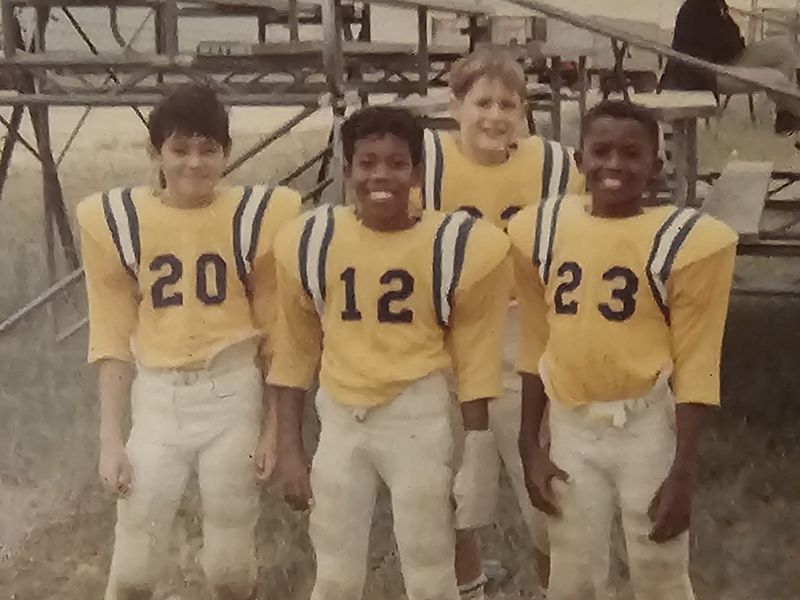
I’m really touched by how open your family was in terms of talking about all these different identities. And it’s heartwarming to hear that you had this community of people who grew up in a similar environment or had similar family makeup and could be a role model for you. And what you said about your color being camouflage green rather than Black or white or Asian—that’s such a powerful statement.
College Years
I wanted to move on to your college years. You’re my senpai5 from Dartmouth, which I think is really cool because you mentioned earlier how some people discouraged you from even thinking about college. You went to New England, which is a really different region from all the places that you grew up in. I’d like to ask about that experience as well.
Dartmouth was my first choice. I played football and baseball in high school. I did pretty well in both of those sports. Dartmouth had a really good football program and a pretty decent baseball program. I was recruited in football and got opportunities in baseball to try out for professional teams.
I wanted a rural setting. I didn’t want to be in the big city. I’d lived in cities like Philadelphia and San Antonio. So I wasn’t in a hurry to go back to a city at that point. And when I went up for my [campus] visit, it just felt right. It felt like a community. It was a new adventure.
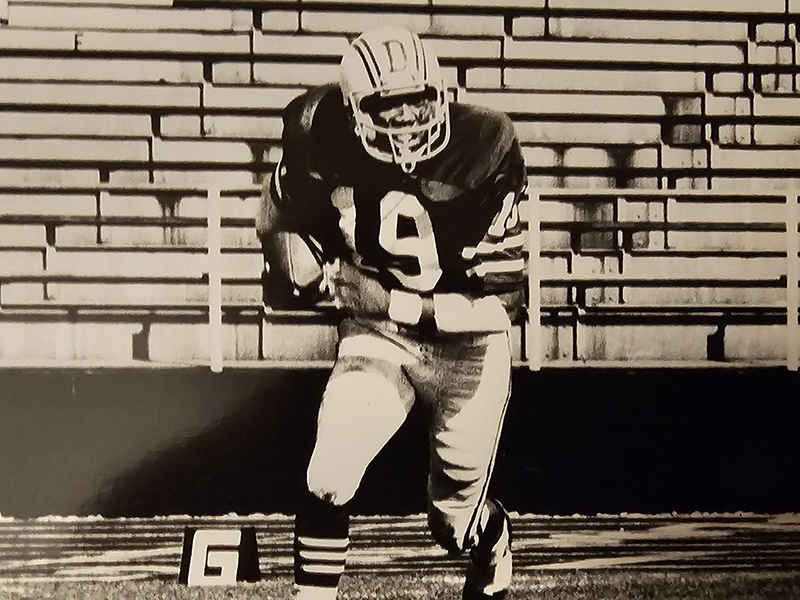
People have always asked me, “You’ve lived so many places; where did you like best?” And my answer is always, “Where I was at the time.” I learned to figure out what was good about where I was. I learned to try to avoid what was bad about where I was. If it’s really cold there, then you get another coat that actually works.
I know it’s not the same for all the kids who grew up in military families. But growing up in a bilingual, bicultural, international family that moved around, had to find community, and make community continuously, we became adaptable.
Dartmouth was interesting because in some ways I rediscovered myself as a Japanese person.
We had a Freshman Dean when I was there: Dean Ives. He met with every freshman one-on-one. When the day came for my appointment, we sat down, and Dean Ives and I chatted a little bit. And he goes, “Have you ever thought about going to Japan for study abroad?”
I’m the first to go to college. Study abroad is not even in my vocabulary, let alone something I think about. He said, “I read your file. It said that you’re born in Japan and your mother’s Japanese. You ever thought about going back to Japan?” And I said, “No, but that sounds interesting.”
He said, “If you really want to think about it, there’s this [Japanese] family in town, the Itagakis. You should reach out to them and talk to them.” We didn’t have a Japanese language program at Dartmouth at the time. But that stuck with me my freshman year.
Dartmouth has a huge study abroad culture. Particularly for the European languages, almost everybody spends a quarter someplace other than at Dartmouth. So I started to think about it, and decided I really wanted to go. I start looking into it in my sophomore year.
I don’t even know how I found Sophia University. But I wrote to them, we exchanged letters, and next thing I know, they’re accepting me. I meet the Itagakis and say, “I’m going to Sophia. My Japanese isn’t very good and I haven’t been able to use it. Could you help me? Can I come and speak Japanese with you?” And Mrs. Itagaki says, “Why don’t you just move in with us for your junior fall?”
Wow!
Because I played football, I wasn’t going anywhere in the fall. Their oldest son was my age. He was going to Yale. His younger brother and sister were still there and in high school.
So I said, “Okay.” And I move into [the eldest son] Haruhiko’s room. Mr. Itagaki’s father, Ji-chan6, was living with them. Ji-chan spoke absolutely no English. And my job after dinner was to entertain Ji-chan.
Ji-chan sat with me and taught me to play Go. If they had a reality TV video camera filming us, it must have been hilarious. He whipped my tail every night. He was older, so he mumbled in Japanese. I think even if I spoke Japanese, I wouldn’t have been able to understand it. But we had our way of hanging out together. He’d whoop my tail, do his Ji-chan chuckle, and shuffle off to bed. That was our nightly routine.
That’s so cute!
And we had traditional Japanese food. Mrs. Itagaki made sure that I got used to what the food would be like. They came to [my] football games that they’d never gone to. They became football fans. Their acceptance of me allowed me to have a lot of confidence.
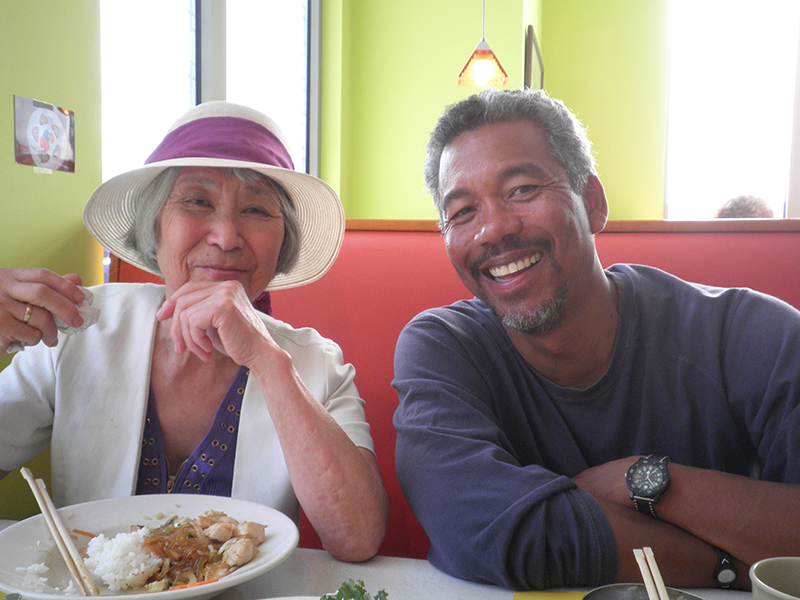
Then when I went to Japan, my family in Japan who I hadn’t seen since I was little had already found a place for me to stay in Higashi Jujo, which is closer to Sophia. They lived out in Abiko, Chiba Prefecture, and thought that would be too long of a commute because there weren’t as many express trains back then. This was in 1968.
[When I arrived,] my uncle, my mom’s older brother, met me at the airport.
I tell this [story] to my classes to show how language, culture, and primary reference are ego-centered. In the Japanese language, you often call family members not by name, but by birth order. So for my mom, her brother was always “Ni-chan.”7 So my brother and I, putting that together, called him “Uncle Ni-chan” our entire lives.
So I’m getting ready to go to Japan. My mom’s all excited and gives me this card. It has a name in Japanese writing and romaji8. I read the romaji, and it says, “Kenzo.” I said, “Who’s Kenzo?” She goes, “That’s your Uncle Ni-chan.” I said, “You mean his name isn’t Ni-chan?”
Hahaha!
He’s there to meet me at the airport with a cousin I didn’t know I had. I get set up in Higashi Jujo. So during college, I get to have this whole experience in Japan. I go to visit my family a couple times a month, but I’m living independently from them. So Japan really becomes my own place at that time. It became home and it still is home. I’m blessed with having more than one home, but when I come [to Japan] I just feel comfortable. In a lot of ways it’s effortless, and in other ways it’s a lot of work.
But I think the Dartmouth experience, which was so encouraging of going abroad, made it financially feasible for me to do it.
Dartmouth can be very difficult because of its isolation. It was a very interesting place in terms of identity, because I really began to experience how race worked.
I had in Kansas, too, but not necessarily in the same way. As a university town, Manhattan is a little more progressive, but it’s also a small town. I had a classic, all-American, “mom and apple pie” high school [life]. I sang in show choir, I was on the football team, I played baseball, I was in a musical. I had friends from all different backgrounds. Some parents wouldn’t let me date their daughters, and there were some frustrations, but I found workarounds.
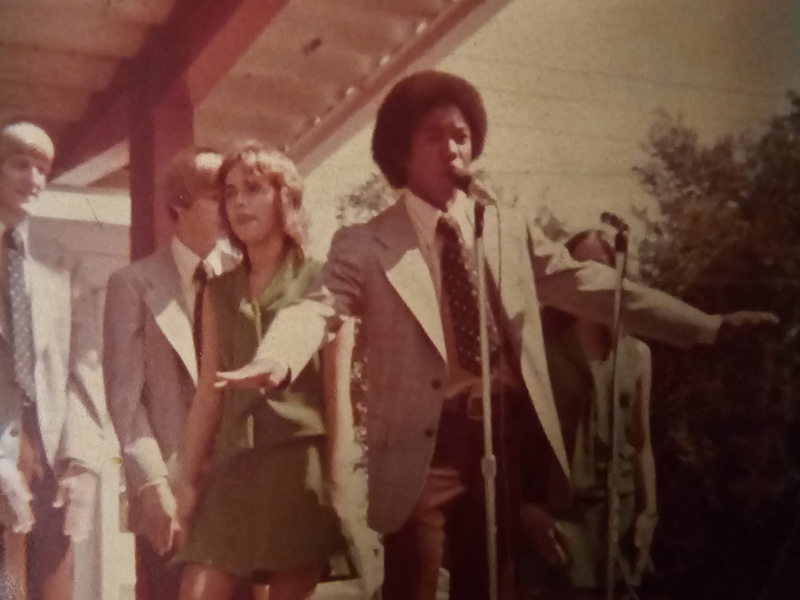
Culturally, Okinawa had put the Japanese in me very clearly. At home, mom and I could be who we were.
I think more of the challenges came after I left for college. Things happened in college that were specific more to being Black than they were to being Japanese. Because in the United States, the one-drop rule really applies. That I was Japanese didn’t matter to some people. That I was Black did.
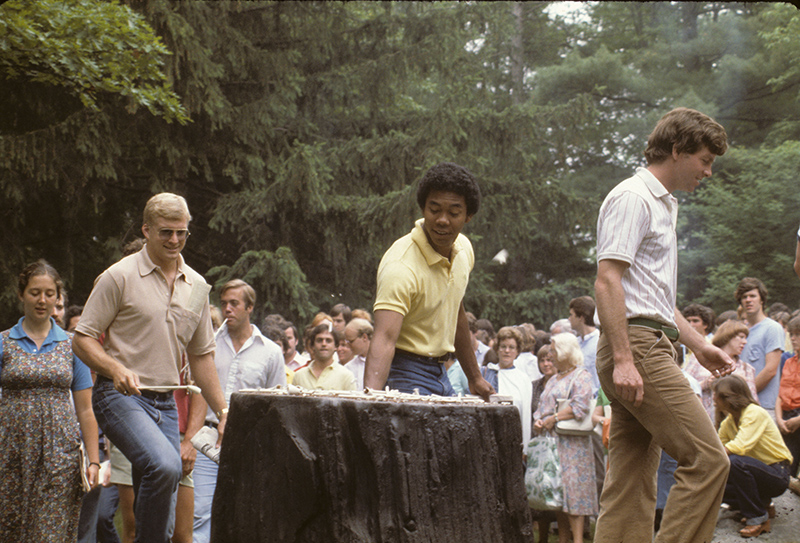
When I left college, I went to State College, Pennsylvania, where I coached at Penn State. Then I ended up going to Trinity College in Hartford, Connecticut, getting my master’s in public policy, coaching football and track there, and then working in the Dean of Students Office. I went to California to Pomona College, where I was eventually Associate Dean of Students and Dean of Residential Life in Student Affairs. That’s where I thought my career was going to be.
Mixed Race as an Academic Field
It’s when I got to California with its diverse population that things started flying off the walls. [Some people] talk about historical competition between different groups and pit them against each other. There were times some people wanted me to choose sides, and I wouldn’t. That just wasn’t going to happen.
That’s when a number of us [scholars] bumped into each other again. In the early 80s we started the Amorasia League, which was really interesting. We thought about the name for about four days, trying to figure out how to organize ourselves. Christine Iijima Hall did her dissertation on Black Japanese at UCLA around that time. Michael Thornton did his sociology dissertation on Black Japanese families. Stephen Murphy-Shigematsu did his work on individual therapy. George Kich [was another one]. So these four major dissertations were published right around that time.
And Amy Hill and other folks began to start to do work in expressive forms. Velina Hasu Houston and her plays were rolling out at that time. I think one of her strongest plays is Asa ga Kimashita, a story about her parents meeting in Japan. But [another play of hers] Tea won international awards. Velina Houston, her sister Rika, and I had known each other as kids in the Black Japanese / Japanese wives’ communities in the Fort Riley area.
A number of us ended up in Los Angeles, and so we pulled together and started doing some other work on mixed race.
A lot of interracial marriages happened in the Japanese American community in the 60s and early 70s. So just about this time, in the 80s and 90s, their kids are starting to become teenagers, and they’re asking questions about identity as they’re getting older. So we were doing all these panels on interracial families, interracial dating, and interracial this and that. I did panels all over the state on interracial relationships and mixed race kids, because the parents weren’t sure how to navigate this.
So there was this group of us who were in our 30s and 40s: the war baby kids who had grown up and were putting time and effort into really thinking about this. What does this mean? How does how can we understand ourselves? How do we talk about ourselves? How do we understand our families?
We had the academics that had come out at the start of it. I did much more in public education and spent a lot of time doing talks at different places and with smaller groups. In the beginning of these talks, I said, “Whatever you’re dealing with is real. And it’s legitimate.” I would even argue that there’s some righteousness in there.
It was a really interesting and important time. The multiracial movement caught fire in the 90s, going into the U.S. Census change in 2000 [where respondents could report two or more races for the first time]. The Hapa Issues Forum was formed at UC Berkeley.
But there was a glass bottom to that boat in some ways. Because what came out is the thought that we had erased racism going into the 2000s. I can still remember teaching Ethnic Studies in 2012 and having students telling me that the stuff that I was teaching was just old and people didn’t think that way anymore. Obama had been elected twice. And some of those same students were crying in my office in 2016.
The West Coast can be its own bubble. But luckily, I did not grow up in a bubble.
To this day, when someone in Japan asks me about American culture, I refer them to the Zac Brown Band’s Chicken Fried. If you want to really understand Middle America, it’s not complicated, it’s wholesome, and unfortunately can be led in some bad directions. The lyrics to that song say that you want a beer on Friday night, a pair of jeans that fit just right, a mom that loves them and a wife too. It’s not a complicated existence. And I think that’s just fine.
I think sometimes in academia and in other places, we can intellectualize things so heavily that we lose our ability to talk to people who don’t want overly complicated lives.
I grew up with a father who was a first sergeant and a mom who was a seamstress. We didn’t have a lot of money, and my brother and I worked all the time. I was cleaning bathrooms, shining shoes, and bussing tables at the country club while my schoolmates’ parents and families ate their dinners. So I understand that that sometimes we have to be able to communicate things.
Understanding Power
You said that you were the first to go to college. I’m just curious how you ended up deciding that you wanted to obtain a PhD and join academia.
Purely as an accident. I’m an accidental and global scholar. I went to college with the intention of probably going to law school or working at a bank. I studied economics because Dartmouth didn’t have a business degree. I found out I actually liked it. I did a double major with Asian Studies: Japanese and Chinese culture as seen through vernacular literature, theater, and translation. And economics was more about money and banking, so both the left and right sides of my brain were fed.
I did my master’s in public policy. I went to Trinity College as a football coach, and as part of the deal in bringing me there, they said that I could get my master’s. I knew that even if I was going to stay in football coaching, which is what I intended to do, I really needed another degree.
Public policy was interesting to me. I’d done some policy and economics. This program was economics based. And Professor Andrew Gold in the Economics Department was really fantastic. So it was serendipity in a lot of different ways. But it fit me. It allowed me to teach ethnicity and public policy. Before I had understood Ethnic Studies as Ethnic Studies, I knew that there were ways to talk about it through policy.
I got to teach that [policy] seminar at Pomona College, where I became Associate Dean of Students and Dean of Residential Life. I wanted to get my PhD because I wanted my boss’s job. He had a PhD and I think he was an organic chemist.
So I ended up applying to Berkeley in their Ethnic Studies Department and to UC Irvine’s Comparative Culture program, a Political Science program at Fordham, American Cultures at Yale, and some other places.
I applied to Irvine because I had written a letter of recommendation for one of my RAs two years earlier and I thought that it sounded like an interesting place. So I apply, and they give me hands down the best financial packet. I got a two-year guaranteed fellowship with housing, a monthly stipend, and other things.
I go to Irvine early because I have housing, and I run into this professor, Joe Jorgensen. And Irvine’s Comparative Culture program is a really small boutique thing, and we had our own computer room while larger departments didn’t even have their own.
So Joe’s sitting there and working on multi-dimensional scaling and small space analysis. He was a cultural anthropologist who does mathematical ethnography. So I come in and sit down, and we start to chat.
Then he says, “Hey, come take a look at this.” And he shows me that he’s doing this work in three dimensions. He’s got these variables. And it looks like they’re close together in two dimensions, but when you get in the third dimension, they really are further apart.
And all of a sudden, the quantitative stuff from econ and the qualitative stuff from Asian Studies came together [for me]. It made sense.
So that’s how I ended up doing my work in Alaska and Asian American communities up there. I mean, [the process to get there was] a little more involved than that. But [I liked working on] the methodology and being able to make quantitative arguments to bring social justice to communities who were marginalized. And doing the empirical work that would hold up in court became really important.
I was there after Exxon Valdez ran aground and the oil spill that resulted in Alaska. I had already been working on a team that had pre-spilled data. And I spent the next four years running around Alaska, first on that project and then on my own.
At that time, I hadn’t planned to do as much work in mixed race because I didn’t want to be pigeonholed as a mixed-race guy. But then [I thought about] the practical realities of the academic market. And I recognized that it wasn’t something that was negative or could hold me back, but a particular role and niche I could fill. And as I started to teach those classes, the number of mixed-race students who started taking those classes [showed me that] even though I hadn’t set out to do this, it’s a good thing I was.
I’ve also taught in Japan. I teach a course called Mixed Roots. We look at not only mixed race but also third culture for Japanese returnees—those who come back to Japan after growing up someplace else and are fluent in Japanese, but don’t quite fit in. How do they make sense of [their situation]? Those classes were always almost over-enrolled as people were trying to sort those things out.
The mixed race stuff is important. I think it’s important more than identity. Because in understanding mixed race, you can understand power. [Sometimes] power is not used to bring people together, and it’s used to divide. If you understand how power works, you can then work to dismantle that.
A Name You Give Yourself
I also wanted to ask about various terminology. You mentioned that the way Black people are called has changed over time. I was also wondering about hapa. You also mentioned hafu, but I also understand that there’s some controversy about how you’re not one or the other, and that it shouldn’t sound like you’re less than whole. I understand some people are trying to push “double” and words like that. Would you mind talking about the different terminology?
Sure. I was fortunate to be one of the people interviewed in a movie called Doubles: Japan and America’s Intercultural Children, by Regge Life. And I toured a little bit with Regge when the film came out.
I think at that moment it made sense, particularly in Japan. Maya Moore was a NHK newscaster, so she had a platform. She was able to say, in that particular moment, that the term hafu was derogatory. Japan was coming out of the bubble, and when economics get tight, so do people’s ideas and openness. And I think she was trying to give folks and particularly kids an opportunity to have something that they could hold on to—a name that [shows] you’re not half of anything; you’re double. But it hasn’t necessarily stuck.
And then, in the late 2010s, hafu comes back. But this time it’s like Blackness in the United States.
When my dad was growing up and when I was a kid, “Black” was a derogatory term. But from the mid-60s into the 70s, they reappropriated. Blackness and Black were beautiful. That’s when the Afro came out [and people wore their hair] naturally. We leaned back on our oral traditions, and some of the first spoken word was written back then.
[As for the term hafu,] when they did that in Japan, they said, “We’re just going to take this term back. We’re tired of people defining us; we’re going to define ourselves. And people will use hafu, but we don’t have to use their definition of knowing who we are.” I think in that sense, hafu in Japan [works] for this generation. Not everyone in the generation [is happy with it], but the self-naming provides power.
Within that time frame, Ariana Miyamoto is crowned as Miss Japan. Part of Japan loses its mind, but the kids growing up only see what they see. For that eight- or nine-year-old girl, she was Miss Japan.
A number of years later, Naomi Osaka is the most famous Japanese person in the world; the only Asian woman to ever hold number one. And then for the Olympics, hafu from all over the world show up.
Having a name can be very important. And it needs to be a name you give yourself.
I know that there’s a lot of controversy with the word hapa. And for a lot of good reasons, like colonization and all the different things of what that represents in Hawaii. For me, having the term when my friend Glen Azumi said, “I know what you are; you’re hapa afro,” it allowed a lot of the other stuff to just not be as important because I named myself.
I don’t use hapa very much anymore because I want to respect the Native Hawaiians. But I would never say to someone who’s using it, particularly in the way that they need to at that moment in their life, that they shouldn’t.
A Different Normal
I’ve come to talk about being mixed as just being a “different normal.” I talk about it as a different normal because so much of the literature and other stuff talks about being “abnormal” or “not normal” or any of those other things. And if you look at the definition of “normal” in the dictionary . . . right?
We can’t be anything other than mixed. It’s a state of being. That’s my “is”; my different normal.
From the time I was in utero and could start to sense the outside world, the way my mom moved, the way my dad moved, the tones of voice—all those different things were part of my consciousness. There were always more than one. When I came out, I could start to see that my father had a different skin tone than my mother. My mother spoke a different language than my father. My brother [did, too].
As a three-year-old, I went to someone else’s house where the two parents looked the same and spoke the same language. And I’m thinking, “What’s wrong with this family? They’re not normal!” From a toddler’s viewpoint, my house is normal.
Right; of course!
Every now and then people want to bring up divorce rates [among international or interracial marriages]. If we talk about the United States, divorce rate across the board is above 50%. Nobody in the United States know how to do marriage. You can’t single out this group and say that. I can get cranked up [about this topic].
But I think we need to understand that we live a different normal, and that it’s okay. We can define our normal and talk about it.
I had a chance to talk to fifth graders here in Japan when I was teaching at Sophia University. Someone at the [U.S.] embassy who’s African American, married to a Japanese individual, had a daughter in this fifth grade class that was doing stuff on diversity.
I’ve given lots of talks. But I lost more sleep getting ready for that talk with fifth graders than anything else. I can’t use PowerPoint. And how am I supposed to talk about these really complex things? There was all this pressure being invited by somebody whose child is Black Japanese.
But that’s when I started thinking about this notion of a different normal more fully. With those fifth graders, I started out the conversation by asking somebody to define “normal.” And they were able to talk about it.
Then I said, “You know what ‘mainstream’ is?” And they said they kind of know. I said, “You know when you go to the Meiji Jingu shrine, there’s that one major way with the sake barrels and all that, where almost everybody goes down? That’s the mainstream. Almost everyone travels that stream. But if you go off to the sides, there are these really interesting trails and places to go. You can take a walk there in the mornings. Those are just outside the mainstream. But they all bring you to the temple.”
So that’s the different normal I’m talking about.
That’s a great way to put it! I love it.
But what was most rewarding about that day was all the hafu kids’ [reactions]. When we first started [they were hunched over]. By the end of the talk, they were [sitting up straight].
Because somebody who understood them, or at least had the possibility of understanding them, had just talked about their lives in a way that the other kids listened. Who knows what that meant for them [in the long term], but in that moment they weren’t ashamed of being mixed.
I’m still working on developing the notion of a different normal, but I think having a name, having a way to understand ourselves, and having the language to talk about ourselves [is crucial].
Students in my classes who are mixed white would sometimes come in and say, “I’m white passing.” I would look at them and go, “Explain that to me a little bit.” These folks are engaged in various [activities]. Whether they’re white and Mexican, white and Black, etc., they’re involved in the Black community, Latino community, the Asian community. So I would say, “You’re ‘white appearing’ and you get passed as white, but I don’t think you’re ‘white passing.’”
[It’s important] to give a language to talk about these complex things. Even now, you see [words] that pick up. We have “Wasian”; we have “Blasian.” I think Blasian came first, actually. But we have “Blackanese” and other things, too, right? Sometimes we pick these apart because they can be a little problematic or cheesy. But if it helps a 12-year-old kid not dislike themselves? I’m going to let that 12-year-old kid use that at 21 if it keeps them from being suicidal or just not like themselves. I’m all for it, even it’s not something that I would particularly use.
I think Maria Root, who’s a clinical psychologist, is right. She says that sometimes our job is to get our client, our patient, to the next day. We can work out the other stuff as we go along. But if we don’t get to tomorrow, we can’t work on the rest. So, what’s going to help you get to tomorrow is fully legitimate for you today. It may not be as healthy for you a year from now, and that’s why I’m here. But if it gets you to tomorrow, we’re good.
In that way, I’m very practical about stuff. I can be very theoretical, but theory doesn’t necessarily help when someone’s in a great deal of pain.
That is such a beautiful way to put it. I’m tearing up because it’s wonderful how you look at it from a psychological perspective, too. I understand that’s part of your work as well. It’s so helpful for me just talking to you about it.
Facilitating Student Exchange
Related to that, I wanted to talk about how we should deal with the current situation [in the U.S.]. I think it’s amazing how you continue to do student exchange because I know that’s become harder from an academic institution perspective and funding perspective. And you’re talking to people about diversity when even the term “DEI” is under attack, and that must be so difficult. How do you keep going, and how do you encourage people who are struggling with this identity issue?
I think one of the reasons I can keep going is that young folks are just amazing. I’m in my late 60s, and every now and then, people my age will say, “I don’t know about these young people.” All I can say is, “You’ve not spent a whole lot of time with young people.”
That doesn’t mean I don’t have my complaints, but even with all the challenges and struggles, young people want better. They want to not be divided. Even those who seem to want to be divided, if you really get down underneath [the surface], they just want to be seen. And in different ways, they’ve been made to feel like they aren’t seen. I think that part is important.
The exchange program I work on is an international leadership program with an academic component. It’s really about being international leaders. I use “international” rather than “global” because if you’re in a leadership position, you need to deal with laws, policies, and other structures that are real.
I also believe that, once you get young people together, the human part, the “global” part will take care of itself. But they’re going to have to lead in a world of laws, policies, regulations, those sorts of things. So how do you get them to work on those things?
I’ve been fortunate to be part of the U.S.-Japan Council (USJC), which is an organization predominantly of Japanese Americans leaders who work in U.S.-Japan relations. It was founded by Irene Hirano and Senator Daniel Inouye. I’m wearing the TOMODACHI Inouye Scholars Program [which is organized by USJC] logo that one of our students designed.
Wow, thank you [as a former USJC staff member]!
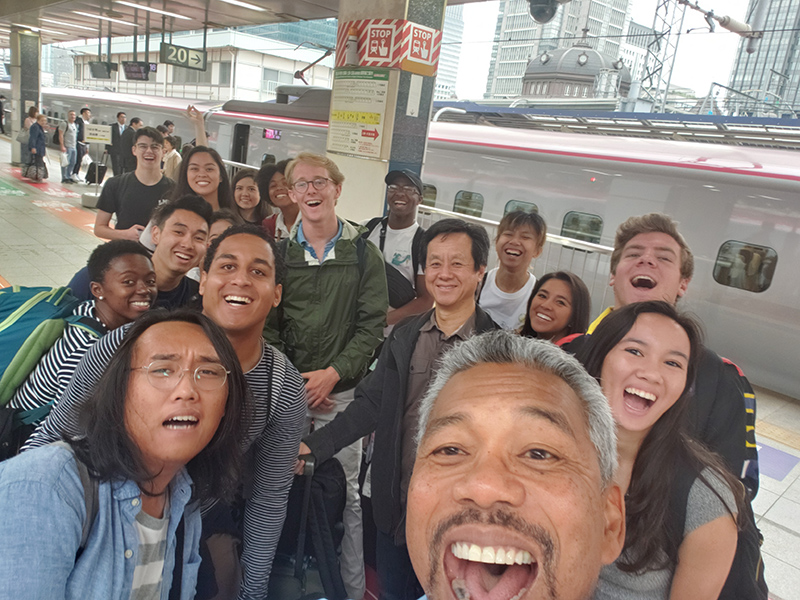
For LMU’s program, I was fortunate to receive four grants over 10 years to take different groups of students to Japan, as well as host students from Japan in Los Angeles. My program has focused on communities that have been historically underrepresented.
I wanted to give the [participating students] another identity as TOMODACHI Inouye scholars, which meant they have responsibilities to give back to the campus and their own communities. I wanted them to take [home] those experiences and the relationships they made with the students from Sophia University, which is the school that we’ve always partnered with.
The program helps bring me full circle because Sophia University is the one that took me in as a college junior. I wrote them and said, “We don’t have an exchange program. I want to come. Can we make this work?” And they said, “Yes, we will make it work.” So that’s been a really special connection for me, and we still do institutional work with Sophia.
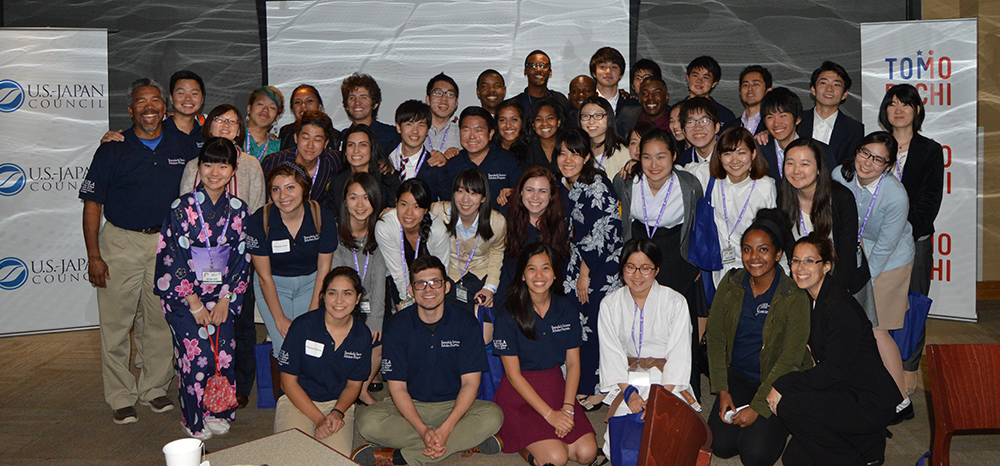
What’s been important with our approach is, our students learn a lot about Japanese culture, but that’s not the center of our teaching.
What’s at the center is: how do we fully see the other? If you’re going to be an incredible leader or the leader you want to be, you have to first learn to listen. Then you have to learn to see, and then to be vulnerable and share. When you’re talking cross-culturally, that’s where it begins. And in that process, you’ll learn so much more about yourself.
We’ve had program participants who had never been on a plane before. We had to work with several students to get their passports. Homestay was part of the program, but some students had never stayed at the house of someone who wasn’t a relative. Probably 50% were the first to go [to college].
I’ve had colleagues and relationships here with different entities in Japan so that our students can see other possibilities. We had a wonderful panel with folks of color at the U.S. embassy. They talked about how they came to work in the State Department, and just like me, it was all accident. There were only a few people who had planned to work at the State Department; the rest had found themselves there. That was really refreshing for our students. They said, “Luck is when preparation meets opportunity. So continue to prepare yourself, see what opportunities come, and don’t close the door to anything.”
Fortunately, through the generosity of a donor, I’ll be able to do this program for the next four years. We’re going to shift it a little bit. It’s now called “Tomogu.” We put the words for “friend” in Japanese and Korean together, tomodachi and [chingu]. We’ll spend six to seven days in Japan and around six to seven days in Korea, looking at where those [two countries] intersect both in terms of challenge and reward.
We’re planning to make sure we do Hiroshima. I think for our students it’s always been a very important thing to visit Hiroshima, but we’ll also go to the memorial for the Koreans who were at Hiroshima at the time. [We’ll show] that it wasn’t just Japanese people, but others, too. In that program, they will also learn about the Burakumin, Ainu people, etc. [We want them to] understand that there’s a richness [to society].
An Interesting Mendokusai
I tend to think of DI [Diversity & Inclusion]—I was working on this before they called it “DEI”—as a richness. There’s a vibrant and robust richness to the variety of ways in which people engage with the world and see themselves in relation to it. If we open ourselves up to that richness, we can grow incredibly.
I was talking to someone the other day about this. Even when it’s mendokusai, or a little bit troublesome, you can allow it to be an “interesting mendokusai,” as opposed to something to be afraid of. Usually, when we think things are different, we take it with fear. We say we don’t know or we’re not sure. From the perspective of American culture and American academics, we won’t respect things we can’t understand.
And that’s not the way life works. There are experiences that you have as a woman. I can theorize about it and read about it, but I’m never going to know or understand it fully. But that doesn’t mean I can’t respect it.
Growing up as someone who’s mixed, I think Third Culture Kids and transracial adopted kids are probably the closest [to us in experience]. We share a lot in the overlapping Venn diagram. But each has their own uniqueness. It’s important that we respect other people’s experiences, but we don’t have to understand it. I may gain knowledge and come to a better understanding, but I won’t ever [fully] understand it. And that’s okay.
Western notions of education and the rational scientific model really pushes us to understand everything, and [to think that] when we can understand it, we can respect it. I think Western education has gotten us a lot of stuff. I really believe in it. I make a living in it, and it’s taught me a lot. That doesn’t mean it can’t be critiqued. And the thing that I would critique is, you can respect without understanding. And when we’re talking about people, that’s important.
The other piece of it is, we then also have to have a little “grace.” This is a Christian term that means “a sense of forgiveness.” If we all knew how to work together, we’d be doing it. But obviously we don’t.
So if someone is working hard toward it, they’re going to say something offensive. They’re going to say something wrong. You say you worry about what term to use because you don’t want to hurt anyone. Now, if someone’s coming from pureness and goodness, and they say something that can be extremely offensive, you can either jump down their throat—you do need to on occasion—or you can understand it as: they’ve been taught very well by our society in different ways, so how do we get them to a conversation to unteach?
Other times, you have that conversation just by being who you are. One of my best friends from Manhattan, Kansas, ended up working for a Japanese company for most of his adult life. He became the president of that company in the U.S.
When he was here in Tokyo, we were running around together. And I asked him what role my mom might have played. And what he said was, it wasn’t that it was positive or instrumental in that it made him want to go out and look for something Japanese. But when the opportunity came, he wasn’t afraid of it.
When he first took the job, we were on the phone every month. He’s asking, “They’re doing this; what does this mean? What should I do?”, just trying to get cultural cues. But he wasn’t afraid [of Japan]. That’s what I mean by how we make each other not afraid of one another.
And that takes a little grace on our part. Because I believe that most people want to do good by others. I think everyone has a gift of some sort. And if we engage that gift in ourselves and we nurture that gift in others, whatever their gift is, then we have a chance. It’s never going to be perfect. It’s never going to be perfectly smooth. Life would be boring if it was! But I believe that first we have to be able to hear [each other].
That’s really sage advice. I really appreciate how you explain the difference between respect and understanding. I think you’re absolutely right. I think we try to understand each other first in a logical way, whereas respect needs to be approached from a more emotional and personal way in terms of one-on-one relations.
A Superpower and a Gift
I was wondering if you have any advice for people who are struggling with choosing—such as where to be based and what career they want to have—because they feel pulled in different directions because of their identity.
I ask especially because you mentioned how it’s really important to be seen, not only for yourself, but also to have people not be afraid of your community. A lot of people struggle with confidence when they have multiple identities because they don’t feel like they belong to the majority community or the more mainstream minority. So they feel like they need to stay small and not be seen. Whereas it’s more important [for themselves and for society] to be seen. So I was wondering where you start that positive cycle of giving yourself confidence, putting yourself out there, etc.
I’ve had the privilege of having a conversation on tape with Naomi Osaka. When the camera wasn’t rolling and we were chatting, she said, “Being multiple is my superpower.”
I think the world wants to tell us when we’re multiple that we aren’t a single thing. Particularly in this era, in which our lives are ruled by zeros and ones. Computer coding is all binary. AI is still binary [at this point]. We live in a science-based “either/or” world. But humans are more complex than that. We’re so often “both/and.”
Our societies, whether it’s Japanese society or U.S. society, wants us to be something that’s “one.” So when you are more than one, the discourse wants you to feel like you’re duplicitous.
I would say to you, that’s your superpower. That’s one of your gifts. You have the opportunity to understand. You have to hone it, you have to work at it, and you have to do some other things. You have the ability to be respectful.
And it’s okay that you aren’t a one. It took me a long time for me to even get to some of that for myself. I’m in a profession where we have people who are experts on a singular thing. They’d be one of the top five people in the world on this thing.
Personally, I just couldn’t do that. I can do a lot of things reasonably well. But what I am really good at is synthesis: to see systems, pull things together, take all these different pieces, and make them fit. I don’t think I could do that if I wasn’t a multiple.
Those of us who’ve grown up with multiple lives have had to decode systems, see where there’s synergy among the systems, where they’re completely different.
We have to ask the question, “Who am I?” And take all the different multiples and say, “Given these, who am I?” As we sort that out, we can start to recognize in some ways, “What are the larger groups that I belong to or don’t belong to, and how do I see myself, whether it’s my family [or something else]?” And I like what Stephen Murphy-Shigematsu says: the only person who gets to decide how Japanese I am is me.
And it’s okay to privilege one over the other in a given moment. I’m in Japan, so I privilege my Japaneseness right now. But sometimes, being in Japan, I’m able to explore and understand my Blackness better than I can in the States. But when I’m in the Black community in the States, I probably privilege my Blackness, because speaking Japanese isn’t going to help me.
If you think of it, using the language that’s appropriate for that setting helps me to meet other people’s needs and get my own needs met. That doesn’t mean I don’t know the other language. In this case I’m talking cultural language, but also spoken language.
Society wants us to feel bad about moving around and not being in the same place all the time. And that’s just not possible for us. I don’t think it’s possible for anyone, really. The role you play as a daughter is different than the role you play as a partner or a friend. We all move through these spaces and privilege those roles in moments that need to be privileged.
The other thing is that, wherever we find ourselves today, we don’t have to be in that same place tomorrow.
In a work that Rika Houston and an anthropologist did—I can’t remember their name—they say that being mixed is about being comfortable with and embracing fluidity. It’s about being able to move back and forth, through, across, and around the various things that make us up.
You and I can speak in Japanese, intersperse English words, code switch in the middle of the sentence, and keep moving. Purists in either language might not like it, but it sure helps us get our needs met. It allows us to meet other people’s needs.
In that sense, I like to say that nobody ever lives at the mean. It’s okay that we don’t, either. We just have multiple means that we get to run around.
And you have to come to some comfort with yourself. My mom once put it this way: “If you don’t love yourself, how can anybody else?” Mom was straightforward sometimes. When I got too stuck on something, she goes, “You know that the sun’s coming up tomorrow.”
She’s so wise!
Yeah, she got me out of my own head. I think that’s part of it. You have to get out of your own head.
Find Folks Who Ground You
What helps is: you have to identify people who want more for you than you want for myself. I’ve been blessed that way. They wanted success more for me than I sometimes wanted or even knew for myself.
There are people out there who will serve that [role], whether it’s your peers or someone who’s a little bit older or younger. It’s not always the older people. I think I get as much inspiration from folks who are younger than I am as folks who are older. Because I think [younger people] see possibilities that sometimes we’re too jaded to see.
That’s where [you need to] have folks that you can trust. That’s not easy to find. Who will be honest with you? When you’re mixed, the challenge is that you are in these liminal communities or liminal spaces. What helps me is that I have a community of people with whom I inhabit these liminal spaces. We found each other in the early to mid-80s.
Some of those folks are still an important part of my life, whether it’s Steve Murphy-Shigematsu or Teresa Williams or Velina Houston or Rika Houston or Maria Root. I can list a lot of others. Or the next generation with Maya Washington and Wendy Thompson, who do work on Black Asians, and Lily Anne Welty Tamai, who does some incredible work. Those are some poets and folks who are doing community work in that realm. There are others who aren’t necessarily in the mixed community, like Megumi Ishimoto from Women’s Eye [which supports women affected by the Great East Japan Earthquake] and Michiko Kurebayeshi.
Finding folks who are doing work that help others—I think that’s what grounds me. There are some incredible people out there who do amazing things.
And sometimes you just have to take a chance. [When I approached] my third cousin, Aoi, I went to his home, knocked on the door, and asked the person who helped me translate say, “I think I’m your cousin.” He pulled out his koseki and sure enough, we were cousins, and we began our conversation. But that was scary, I think, for both of us. I’m working on something about it that I hope will come out in Discover Nikkei this year.
As for my second cousins in Yokohama, I left a note in their mailbox. I heard back after about three or four months, and we got together. We were able to hakamairi together because we share a great-grandfather. Our grandfathers were brothers.
I just had lunch with some of them in Chinatown [in Yokohama] yesterday. And one of them said to me, “Our lives have been so busy that even though we’re cousins, we rarely get together. And now that you’ve come, we’ve seen each other more in the last two years than we have in the last ten.”
But boy was it scary for me to reach out! Not only was it like, “Who’s this guy?” for them, I’m also acutely aware that I’m also Black and not just Japanese. And that has weight sometimes in ways that I don’t want it to, or ways that are not fun. And I get remembered!
But again, I think I can only do that because I have some folks that ground me. I think there are people like that in your lives if you look. And sometimes you have to ask.
I think the beauty of it is that if we allow it, we can learn from each other and be shaped from each other, but having that happen doesn’t change the essence of who we are. Find your essence, hold on to that essence, and then be wonderfully flavored by everything around you.
Sometimes it doesn’t come together well and it’s a dumpster fire, but you keep coming back. It’s that notion of gaman, a sense of persistence, like [the Japanese proverb] “fall down seven, get up eight.” I can say it’s worth the fight. The fight can be fun, but fun is not the anthesis of hard work.
I think that’s incredibly helpful. I love how you said how identity can be fluid. Depending on the situation, you can seem like you’re part of one community exclusively, but you can also hold on to your essence, remain true to yourself, and know that you belong to different communities as well.
It’s our own different normal. Embrace it. It’s fun. Let it be fun.
Thank you very much. I just love what you said.
All right.
Thank you!
Notes:
- Koseki: Japanese family registry. ↩︎
- Gohan: Rice. ↩︎
- Hapa: The Hawaiian word for “half” or “part,” referring to people of mixed ancestry. This episode of Code Switch discusses some of the background and more recent views / controversy surrounding the use of that word. ↩︎
- Hafu: The Japanese word for “half.” ↩︎
- Senpai: An older or more experienced person in the same school, workplace, industry, etc. In this context, someone who graduated from the same school before you. ↩︎
- Ji-chan: Grandpa. ↩︎
- Ni-chan: Older brother. ↩︎
- Romaji: Japanese written using the alphabet. ↩︎
Leave a Reply